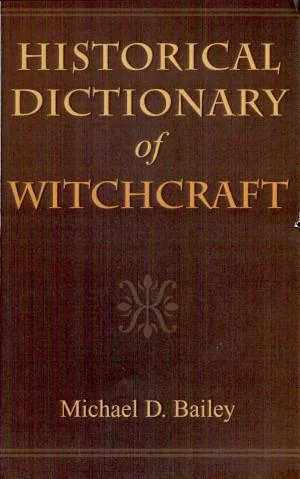
Historical Dictionary of Witchcraft
 78
78

Historical Dictionary of Witchcraft
Michael David Bailey's 'Historical Dictionary of Witchcraft' offers a commendably broad sweep, presenting scholarly definitions for an impressive range of terms, historical figures, and concepts. Its strength lies in its encyclopedic nature, providing a solid foundation for anyone needing quick, reliable reference points. The coverage of the 16th and 17th-century witch hunts in Europe is particularly detailed, offering essential context. However, the work occasionally feels more like a compilation than a narrative, sometimes lacking deeper analysis of the esoteric or philosophical implications of the terms it defines. For instance, while it defines 'Wicca,' it doesn't deeply engage with its modern initiatory structure or theological underpinnings. Bailey's dictionary is an indispensable tool for factual recall, but readers seeking nuanced interpretation will need to look elsewhere. It stands as a valuable, if somewhat dry, scholarly resource.
📝 Description
78
Michael David Bailey's Historical Dictionary of Witchcraft was first published in 2003.
This dictionary serves as an academic reference for the study of witchcraft throughout Western history. It documents beliefs, practices, and figures from ancient times to contemporary movements like Wicca. The work prioritizes factual accuracy and scholarly rigor, showing witchcraft as a diverse and changing phenomenon rather than a single entity.
The dictionary is a valuable resource for students, historians, and researchers of Western esotericism and religious studies. It offers reliable information on the historical persecution of alleged witches, the development of folklore around magic, and the academic study of pagan revivals. It provides a grounded perspective for anyone looking into occult traditions.
Bailey's work arrived when academic interest in witchcraft was solidifying, moving past sensationalism. The decades before its publication saw increased scholarly engagement with both historical witch trials and modern paganism. This dictionary consolidated existing research into a single volume, detailing the intense witch hunts in 16th and 17th century Europe.
This dictionary situates the study of witchcraft within broader Western esoteric traditions. It distinguishes between historical accusations of maleficium, folk magic, and organized diabolical cults. By clarifying these distinctions and covering topics from classical antiquity to modern Wicca, the work helps readers understand witchcraft's complex place in the history of Western belief and practice. It acknowledges the academic shift away from sensationalism towards a more rigorous examination of these phenomena.
💡 Why Read This Book?
• Understand the historical persecution of witches through detailed entries on figures and legal texts from the 16th and 17th centuries, providing specific context beyond general folklore. • Differentiate between historical witchcraft accusations and modern pagan practices by examining the evolution of terms and beliefs from antiquity to contemporary Wicca. • Gain a structured overview of Western esoteric terminology, including definitions for concepts like 'Malleus Maleficarum', essential for academic study.
⭐ Reader Reviews
Honest opinions from readers who have explored this book.
❓ Frequently Asked Questions
What historical periods does the Historical Dictionary of Witchcraft cover?
The dictionary spans the entirety of Western history, beginning with classical antiquity and extending through to modern movements like Wicca, with a significant focus on the 16th and 17th centuries in Europe.
Is this book suitable for beginners interested in witchcraft?
Yes, as a scholarly reference, it provides clear definitions and historical context, making it suitable for beginners seeking factual information on the subject.
Does the book discuss modern Wicca?
Yes, the dictionary includes entries on modern Wicca, tracing its development and placing it within the broader historical context of witchcraft.
What is the primary focus regarding the European witch hunts?
Particular attention is paid to the history of witchcraft in Europe during the 16th and 17th centuries, the era of the most intense witch trials.
Is this the only scholarly reference work on witchcraft?
The original blurb states it is the only single-volume, scholarly reference work available on this subject, aiming for reliable information across Western history.
Who is the author of the Historical Dictionary of Witchcraft?
The author is Michael David Bailey, and the work was first published in 2003.
🔮 Key Themes & Symbolism
European Witch Hunts
The dictionary offers extensive coverage of the witch trials that swept across Europe, particularly during the 16th and 17th centuries. It details historical accusations, legal proceedings, and the societal fears that fueled this era. Entries clarify the roles of figures and texts like the Malleus Maleficarum, providing a factual basis for understanding this dark chapter in Western history and its impact on perceptions of magic.
Evolution of Witchcraft Beliefs
Bailey meticulously charts the transformation of witchcraft concepts from ancient magical practices and folk traditions to the organized religious movements of modern times. The work distinguishes between historical notions of maleficium, diabolism, and the later neopagan revivals like Wicca, demonstrating how the term 'witchcraft' has been applied to vastly different phenomena across millennia.
Folk Magic and Maleficium
A significant theme is the distinction and overlap between folk magic—the everyday practices of healing, divination, and protection—and the concept of maleficium, or harmful magic, which became central to witch accusations. The dictionary explores how local customs and beliefs interacted with theological doctrines and legal frameworks to shape perceptions of witchcraft.
Scholarly Study of the Occult
This volume emphasizes a scholarly approach to the study of occult phenomena. By providing a structured, encyclopedic overview, it enables researchers and students to engage with the history of witchcraft from an academic perspective, grounding discussions in verifiable historical data and documented beliefs rather than pure speculation.
💬 Memorable Quotes
Direct passages from the work, attributed to the author.
“The work provides reliable information on magic and witchcraft for the entire span of western history.”
— This statement highlights the dictionary's core function: to be a factual and comprehensive resource covering millennia of Western esoteric and magical traditions.
“Particular attention is paid to the history of witchcraft in Europe in the 16th and 17th centuries.”
— This indicates the book's deep dive into the period of the major witch hunts, acknowledging its critical importance in shaping the historical narrative of witchcraft.
“From classical antiquity to modern Wicca.”
— This phrase captures the chronological breadth of the dictionary, illustrating its scope from ancient magical practices to contemporary neopagan religions.
“The only single-volume, scholarly reference work available on this subject.”
— This emphasizes the book's unique position as a consolidated, academic source for information on witchcraft, intended for serious study.
“Reliable information on magic and witchcraft.”
— This underscores the commitment to accuracy and trustworthiness, positioning the dictionary as a go-to source for dependable knowledge in the field.
🌙 Esoteric Significance
Tradition
While not strictly aligned with a single esoteric tradition, Bailey's work serves as a foundational text for the academic study of Western esotericism. It provides the historical and terminological scaffolding necessary for understanding various occult paths, including Hermeticism, Kabbalah, and modern paganism, by meticulously defining their historical antecedents and related practices.
Symbolism
The dictionary illuminates symbols crucial to understanding witchcraft's perception and practice. For instance, the 'Malleus Maleficarum,' often depicted as a symbol of patriarchal oppression and witch persecution, is analyzed for its historical impact. Symbols associated with folk magic, such as herbs or talismans, are also contextualized within their historical use for protection or healing, moving beyond simplistic interpretations.
Modern Relevance
Contemporary practitioners of Wicca and other neopagan paths, as well as scholars of new religious movements, draw heavily on this dictionary for accurate historical context. It informs discussions on the lineage and development of modern magical traditions, helping to distinguish between historical witchcraft and its modern reconstructions, and providing a common lexicon for academic and practitioner discourse.
👥 Who Should Read This Book
['• Academic researchers of Western religious history and folklore, seeking precise definitions and historical context for terms related to magic and witchcraft.', '• Students of comparative religion and occult studies, needing a reliable reference to work through the complexities of historical witch trials and modern pagan movements.', '• Enthusiasts of esoteric history interested in the factual underpinnings of witchcraft beliefs from classical antiquity to the 20th century.']
📜 Historical Context
Published in 2003, Michael David Bailey's 'Historical Dictionary of Witchcraft' entered a scholarly landscape increasingly dedicated to the nuanced study of magic and its historical manifestations. The late 20th century had witnessed a surge in academic interest, moving beyond sensationalism towards rigorous analysis of witch trials and the history of magic, influenced by scholars like Keith Thomas and the wider historiography of popular beliefs. Bailey's work aimed to consolidate this growing body of knowledge into a single, accessible volume. Its detailed focus on the 16th and 17th-century witch hunts provided a crucial reference point for debates concerning the social, religious, and legal factors underpinning these persecutions. The book offered a counterpoint to earlier, more mythologized accounts, grounding the study of witchcraft in historical fact and documented practices, and has since become a standard reference in religious studies and occult history.
📔 Journal Prompts
The impact of the Malleus Maleficarum on European witchcraft accusations.
Distinguishing between folk magic and maleficium in historical context.
The chronological evolution of the term 'witchcraft' from antiquity to modern Wicca.
Key figures or texts that defined the 16th and 17th-century European witch hunts.
The scholarly consensus on the nature of witchcraft during the major European persecutions.
🗂️ Glossary
Maleficium
Latin for 'wrongdoing' or 'harm'. In the context of historical witchcraft, it refers to the belief that a witch used supernatural powers to cause harm, illness, or misfortune to others or their property.
Malleus Maleficarum
Latin for 'Hammer of Witches'. A notorious treatise on witchcraft published in 1487, widely used by witch hunters in the 16th and 17th centuries. It detailed methods for identifying, prosecuting, and punishing suspected witches.
Wicca
A contemporary neopagan religion that emerged in the mid-20th century, often characterized by the worship of a Goddess and a God, nature-based rituals, and magical practices. It is distinct from historical notions of witchcraft.
Classical Antiquity
The period of history covering the ancient Greek and Roman civilizations, roughly from the 8th century BCE to the 5th century CE. The dictionary examines magical beliefs and practices from this foundational era.
Diabolism
The worship or invocation of the devil. During the European witch hunts, accusations often shifted from simple maleficium to encompass diabolical pacts and Satanic rituals.
Folk Magic
A broad category of magical beliefs and practices, often passed down through generations within communities. It typically includes charms, divination, healing rituals, and protective spells, distinct from more formalized religious or diabolical witchcraft.
Witch Hunts
Periods of intense persecution and execution of individuals accused of witchcraft. The most significant occurred in Europe between the 15th and 18th centuries, particularly peaking in the 16th and 17th centuries.
This book appears in 1 collection
🔮 Readers Also Liked
Browse all →









From the “Witchcraft” Collection
View all →



More Free Occult Philosophy Books
View all →