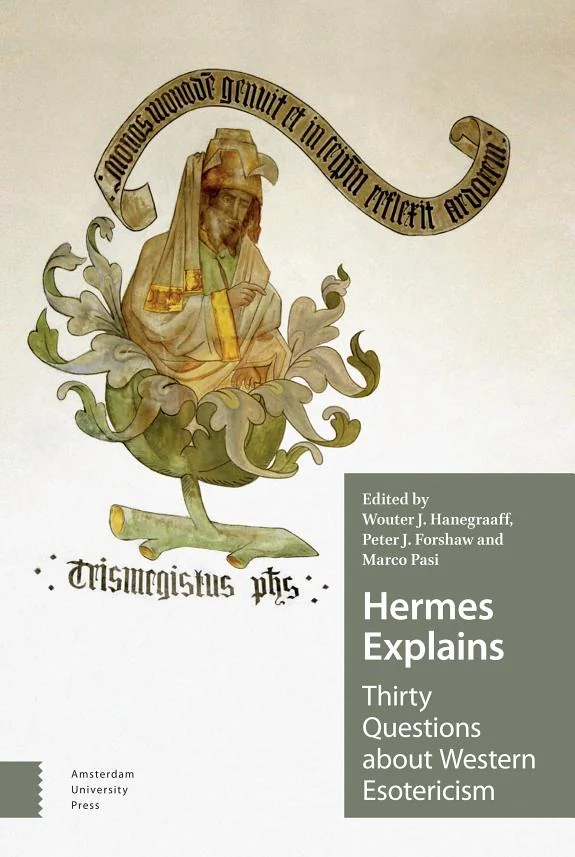
Hermes Explains
 77
77

Hermes Explains
Forshaw, Hanegraaff, and Pasi's 'Hermes Explains' attempts a vital task: demystifying the academic study of Western esotericism. The collection shines when scholars dissect specific historical episodes, such as the reception of Hermetic texts in Renaissance Europe. A particular strength lies in the detailed examination of how academic biases have shaped interpretations of figures like Giordano Bruno. However, the volume occasionally suffers from internal jargon, making some sections less accessible to the intended broader audience. The original blurb's promise to address misconceptions is largely fulfilled, though the sheer breadth of 'esotericism' means some areas receive only cursory attention. Overall, it serves as a valuable, if sometimes dense, primer for understanding the scholarly landscape of esoteric traditions.
📝 Description
77
Published in 2019, Hermes Explains addresses common misunderstandings in the academic study of Western esotericism.
This collection of essays originates from the University of Amsterdam's Centre for History of Hermetic Philosophy and Related Currents. It aims to correct persistent misconceptions within the academic study of Western esotericism. The contributors, scholars in the field, work to clarify the methodologies and historical background of these subjects. The volume seeks to connect specialized research with a wider audience interested in esoteric traditions.
Academics, students, and dedicated enthusiasts of Western esotericism, occult history, and comparative religion will find this book valuable. It is for those who want to understand a scholarly approach to these topics, moving beyond sensationalized popular accounts. Readers looking for a historical viewpoint on movements like Hermeticism, alchemy, and magic will find considerable material.
Emerging from an academic center focused on Hermetic philosophy, this volume speaks to the ongoing scholarly engagement with Western esotericism. It challenges older academic views that treated these traditions as mere fringe elements. Instead, it positions them as complex intellectual and cultural currents worthy of serious study. The book contributes to a growing body of scholarship that treats esoteric history with rigor and historical context.
💡 Why Read This Book?
• Gain clarity on academic approaches to esoteric history, understanding the methodologies employed by scholars at the University of Amsterdam's Centre for History of Hermetic Philosophy and Related Currents since its inception. • Distinguish between popular notions and scholarly analysis of Western esotericism, appreciating the critical distinctions made concerning Hermeticism and Gnosticism. • Grasp the historiographical challenges inherent in studying secretive traditions, learning how scholars navigate issues of source interpretation and transmission as discussed within the book's essays.
⭐ Reader Reviews
Honest opinions from readers who have explored this book.
❓ Frequently Asked Questions
What is the primary goal of 'Hermes Explains'?
The book's main objective is to clarify the academic study of Western esotericism, addressing common misunderstandings and showcasing the scholarly methods used by researchers, particularly those associated with the University of Amsterdam.
Who are the main authors contributing to this volume?
The volume features contributions from scholars associated with the Centre for History of Hermetic Philosophy and Related Currents. Peter Forshaw, Wouter J. Hanegraaff, and Marco Pasi are listed as editors or key figures.
What specific historical periods or movements does the book cover?
While not exhaustive, the book touches upon various periods and movements within Western esotericism, including Hermeticism, Gnosticism, and alchemy, often examining their reception and interpretation across different eras.
Is 'Hermes Explains' suitable for beginners in esoteric studies?
It is suitable for beginners who are serious about understanding the academic perspective, but some essays may contain specialized terminology requiring focused reading.
When was 'Hermes Explains' first published?
The book was first published on May 28, 2019, serving as an anniversary volume for the Centre for History of Hermetic Philosophy and Related Currents.
What kind of misconceptions about esotericism does the book address?
It tackles misconceptions regarding the legitimacy of esoteric traditions as fields of academic study, the nature of esoteric practices, and the historical interpretation of key figures and texts.
🔮 Key Themes & Symbolism
Academic Study of Esotericism
This volume champions the rigorous academic investigation of Western esoteric traditions, countering the perception of these fields as merely fringe or pseudoscientific. It highlights the importance of historical context, textual analysis, and critical methodology in understanding movements like Hermeticism. The essays demonstrate how scholarly approaches, exemplified by the work of the University of Amsterdam's Centre for History of Hermetic Philosophy and Related Currents, can illuminate complex intellectual currents often obscured by popular myth or occultist agendas.
Hermeticism and its Legacy
Central to the book is the tradition stemming from Hermes Trismegistus. The essays examine the transmission and reinterpretation of Hermetic texts, such as the Corpus Hermeticum, across centuries. It addresses how Renaissance humanists and later esotericists engaged with these ideas, often shaping their meaning in distinct ways. The work clarifies the academic study of Hermeticism's influence on alchemy, magic, and philosophical thought.
Historiography of Esoteric Currents
The book critically assesses the challenges and biases inherent in writing the history of esoteric movements. It discusses issues like the secrecy surrounding many traditions, the difficulty of verifying esoteric claims, and the tendency for earlier scholarship to dismiss or sensationalize esoteric phenomena. The authors advocate for a nuanced approach that respects the historical agency of practitioners while maintaining scholarly objectivity, particularly relevant since the Centre's founding.
Gnosticism and Esoteric Interpretation
Several essays likely explore the complex history of Gnosticism and its relationship to Western esotericism. The book probably explores how Gnostic ideas have been understood, misunderstood, and appropriated throughout history, often becoming entangled with Hermetic and alchemical traditions. It aims to provide a more accurate historical and textual basis for understanding Gnostic influences.
💬 Memorable Quotes
Direct passages from the work, attributed to the author.
“The academic study of Western esotericism has long been hampered by misconceptions.”
— This statement captures the core motivation behind the book: to correct popular and academic biases that have historically marginalized or misrepresented esoteric traditions, paving the way for more informed scholarship.
“Defining the boundaries of 'Western esotericism' remains a complex scholarly task.”
— This highlights the inherent difficulty in categorizing diverse traditions like Hermeticism, alchemy, and Kabbalah under a single academic umbrella, acknowledging the fluid and contested nature of the field.
“Misinterpretations of figures like Giordano Bruno often stem from applying modern frameworks to historical contexts.”
— This suggests a critical approach to historical figures, warning against anachronism and emphasizing the need to understand individuals within their specific intellectual and cultural milieu.
“The Centre for History of Hermetic Philosophy and Related Currents has dedicated twenty years to advancing scholarship.”
— This points to the institutional commitment and established expertise behind the volume, underscoring the depth of research and the academic rigor brought to the study of esoteric subjects.
“Scholarly engagement requires moving beyond mere cataloging of beliefs to understanding their historical function.”
— This emphasizes the analytical depth expected in the study of esotericism, prioritizing historical context and the lived reality of these traditions over simple descriptions of their doctrines.
🌙 Esoteric Significance
Tradition
The work primarily engages with the Western esoteric tradition, with a strong emphasis on Hermeticism, as indicated by its title and the focus of the contributing Centre. It situates itself within the lineage of Hermetic philosophy, alchemy, magic, and related currents that have shaped Western intellectual and cultural history since antiquity. The book departs from purely devotional or practical approaches by foregrounding historical and critical analysis, seeking to understand these traditions as complex phenomena within their specific historical contexts.
Symbolism
While the book focuses on academic discourse, it implicitly engages with key esoteric symbols. The name 'Hermes' itself evokes the syncretic deity of wisdom, magic, and communication, central to Hermetic thought. Symbols associated with alchemy, such as the Ouroboros (representing cyclicality and self-creation) or the Mercurial principle (associated with transformation and intellect), are likely discussed in terms of their historical interpretation and symbolic meaning within esoteric lineages.
Modern Relevance
Contemporary scholars and students of comparative religion, intellectual history, and occult studies draw heavily on the research methodologies and historical insights presented in works like 'Hermes Explains'. The book's focus on accurate historical context and academic rigor is crucial for current practitioners and theorists seeking to understand the roots and evolution of modern esoteric movements, from neo-Hermeticism to contemporary magical orders.
👥 Who Should Read This Book
• Academic researchers and students of religious studies, history, and philosophy seeking to understand the scholarly framework for studying Western esotericism. • Enthusiasts of Hermeticism, alchemy, and Gnosticism who wish to move beyond popular interpretations to a more historically grounded understanding. • Librarians and curators specializing in occult and metaphysical literature aiming to contextualize their collections within current scholarship.
📜 Historical Context
Published in 2019, 'Hermes Explains' emerged from the Centre for History of Hermetic Philosophy and Related Currents at the University of Amsterdam, an institution dedicated to advancing the academic study of Western esotericism for two decades. This volume reflects a broader shift in academia from the mid-20th century onwards, where fields previously dismissed as fringe or pseudoscientific began to receive serious scholarly attention. Prior to this, thinkers like Frances Yates had begun laying groundwork in areas like Renaissance Hermeticism, but a dedicated institutional focus was less common. The book implicitly engages with earlier dismissive attitudes found in some circles of historical scholarship, which often viewed esoteric traditions as mere historical curiosities or deviations. By addressing misconceptions, the volume positions itself against simplistic or biased interpretations, contributing to a more nuanced understanding of traditions like Hermeticism, Gnosticism, and Kabbalah within intellectual history.
📔 Journal Prompts
The definition and scope of 'Western esotericism' as discussed.
Hermeticism's influence across different historical periods.
The challenges of studying secretive traditions.
Misconceptions regarding figures like Giordano Bruno.
The role of the Centre for History of Hermetic Philosophy and Related Currents.
🗂️ Glossary
Western Esotericism
A broad academic term encompassing diverse spiritual, mystical, and philosophical traditions originating in Europe and the Mediterranean, including Hermeticism, Kabbalah, alchemy, and magic, often characterized by a focus on hidden knowledge and spiritual transformation.
Hermeticism
A philosophical and religious tradition based primarily upon writings attributed to Hermes Trismegistus, a syncretic figure blending Greek god Hermes and Egyptian Thoth. It emphasizes divine knowledge, cosmic unity, and the potential for human spiritual ascent.
Gnosticism
A diverse set of religious ideas and systems, prominent in the early Christian era, that emphasized spiritual knowledge (gnosis) as the path to salvation. Gnostic systems often feature a complex cosmology involving a supreme, remote God and lesser divine beings, with humanity possessing a divine spark trapped in the material world.
Alchemy
An ancient tradition combining chemical, philosophical, and mystical practices, often aimed at transmuting base metals into gold, achieving immortality, or attaining spiritual purification. It is deeply intertwined with Hermeticism and symbolism.
Historiography
The study of the writing of history. In the context of esotericism, it involves examining how these traditions have been historically documented, interpreted, and represented by scholars and chroniclers.
Corpus Hermeticum
A collection of Greek philosophical and religious texts written in the 2nd and 3rd centuries AD, attributed to the legendary figure Hermes Trismegistus. These texts are foundational to the Hermetic tradition.
Renaissance Humanism
An intellectual movement during the Renaissance that emphasized the study of classical literature, philosophy, and history, focusing on human potential and secular concerns, often leading to a renewed interest in ancient texts, including Hermetic ones.
This book appears in 1 collection
🔮 Readers Also Liked
Browse all →









From the “Western Esotericism” Collection
View all →







More Free Occult Philosophy Books
View all →