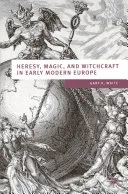
Heresy, Magic and Witchcraft in Early Modern Europe
 81
81

Heresy, Magic and Witchcraft in Early Modern Europe
Waite's "Heresy, Magic and Witchcraft in Early Modern Europe" provides a critical deconstruction of how religious conflict and evolving theological anxieties in the 16th century transformed perceptions of witchcraft. The work compellingly argues that the Reformation, rather than an inherent belief in Satanic cults, was the primary catalyst for the widespread fear of diabolical conspiracies that fueled witch trials. Waite skillfully demonstrates how figures from religious dissidents to Jewish communities and magicians were swept into these narratives of Satanic plots. While the book excels in its detailed historical analysis and its tracing of intellectual currents, the dense academic prose may present a challenge for readers less familiar with early modern historiography. The section detailing the shift from 15th-century skepticism regarding inquisitorial claims to 16th-century panic is particularly illuminating. This study offers a vital corrective to simplistic understandings of the witch craze, grounding it firmly in the socio-religious landscape of its time.
📝 Description
81
Gary K. Waite's 2007 book examines the early modern European entanglement of religious dissent and magical belief.
Gary K. Waite's 2007 study looks at how early modern Europe connected religious dissent with magical practices and the developing idea of witchcraft. The book shows how official views and public fears about devilish plots changed, especially after the Reformation began. Waite moves past simple explanations to show the complex social, political, and religious factors that led to accusations and trials.
The period from the 15th century onward saw major religious changes. The Catholic Inquisition initially had trouble accepting the idea of a large Satanic witch group. However, later religious conflicts in the 16th century, including reform movements and popular uprisings, created an environment where fears of devilish conspiracies became powerful. These fears affected not only religious dissenters and Jews but also magicians, leading to legal persecution of those accused of witchcraft.
This work is situated within scholarship on the history of Western esotericism, specifically concerning the demonization of marginalized beliefs and practices during periods of religious and social upheaval. It addresses how concepts like magic and heresy became intertwined with fears of diabolical allegiance, influencing legal and social structures. The book contributes to understanding how dominant religious frameworks defined and persecuted alternative spiritualities and folk practices, contributing to the construction of the figure of the witch.
💡 Why Read This Book?
• Gain a nuanced understanding of how the Reformation's religious conflicts, specifically in the 16th century, created the climate for widespread belief in diabolical conspiracies, moving beyond simplistic notions of inherent superstition. • Learn how figures like religious dissidents, Jews, and magicians were strategically incorporated into narratives of Satanic plots, illustrating the mechanisms of scapegoating during periods of intense social and theological upheaval. • Appreciate the historical evolution of witchcraft accusations, distinguishing between earlier inquisitorial skepticism and the later, more intense persecutions driven by the perceived threats of the Reformation era.
⭐ Reader Reviews
Honest opinions from readers who have explored this book.
❓ Frequently Asked Questions
Did authorities always believe in Satanic witch sects before the 16th century?
No, the work highlights that in the 15th century, many authorities were skeptical of inquisitors' claims about a unified Satanic witch sect. The shift in belief intensified during the 16th-century Reformation.
What role did the Reformation play in witchcraft accusations?
The Reformation created an atmosphere of intense religious conflict and popular reform movements. This environment fostered a heightened belief in diabolical conspiracies, leading to increased accusations and persecutions.
Who were often implicated in these "diabolical conspiracies"?
The book shows that fear of diabolical conspiracies ensnared various groups, including religious dissidents, Jewish communities, and magicians, who were seen as threats to the established religious and social order.
When was "Heresy, Magic and Witchcraft in Early Modern Europe" first published?
The book by Gary K. Waite was first published on October 10, 2019.
What distinguishes the 15th century's view on witchcraft from the 16th century's?
In the 15th century, authorities often doubted inquisitors' stories of widespread Satanic witch sects. The 16th century, however, saw a surge in belief, fueled by Reformation-era conflicts and fears of diabolical plots.
Does the book focus on magical practices or legal proceedings?
The book examines the intersection of both, exploring how beliefs about magic and heresy, particularly the concept of diabolical conspiracies, influenced legal proceedings and judicial outcomes during early modern Europe.
🔮 Key Themes & Symbolism
The Reformation's Impact
This theme examines how the religious and political upheavals of the 16th-century Reformation fundamentally altered perceptions of heresy and magic. Waite illustrates how popular movements of reform and revolt, coupled with intense theological conflict, fostered an atmosphere where diabolical conspiracies were seen as a tangible threat, moving beyond earlier skepticism. The work details how this created fertile ground for increased accusations and persecutions, re-casting religious dissidents and practitioners of magic as agents of Satan.
Diabolical Conspiracy Narratives
The book dissects the concept of the 'diabolical conspiracy' as a central element in early modern witchcraft accusations. It details how this narrative evolved, particularly in the 16th century, to encompass a wide array of individuals, including religious non-conformists, Jews, and magicians. Waite explores how the belief in an organized, Satanic plot provided a framework for understanding and persecuting perceived threats to Christian society, linking heresy, magic, and imagined demonic alliances.
Inquisition vs. Reformation Fears
A key theme is the contrast between the approach of the 15th-century Inquisition and the anxieties prevalent during the 16th-century Reformation. Waite highlights the earlier skepticism towards claims of a unified Satanic witch sect by some authorities, contrasting it with the fervent belief in diabolical threats that emerged later. This shift underscores how changing religious landscapes and social conflicts directly influenced the intensity and nature of witchcraft accusations and subsequent judicial actions.
Social and Religious Dissent
This theme addresses how social and religious dissenters became targets within the context of witchcraft accusations. The work demonstrates how figures associated with religious reform movements, those outside orthodox religious practice, and individuals perceived as wielding forbidden knowledge (magicians) were often caught in the net of suspected diabolical pacts. It illuminates how anxieties about social order and religious purity became intertwined with accusations of witchcraft during this era.
💬 Memorable Quotes
Direct passages from the work, attributed to the author.
“In the fifteenth century many authorities did not believe Inquisitors' stories of a supposed Satanic witch sect.”
— This highlights the initial skepticism towards widespread, organized witchcraft in the 15th century, setting the stage for the dramatic shift in perception that occurred later.
“the religious conflict of the sixteenth-century Reformation... helped to create an atmosphere in which diabolical conspiracies... were believed to pose a very real threat.”
— This emphasizes the Reformation's important role in fostering the widespread fear of Satanic plots, transforming abstract theological concerns into perceived immediate dangers.
“diabolical conspiracies (which swept up religious dissidents, Jews and magicians into their nets) were believed to pose a very real threat.”
— This points to the broad scope of accusations, showing how various marginalized or dissenting groups were incorporated into the narrative of a Satanic threat during the Reformation era.
“Fear of the Devil and his followers inspired horrific incidents of judicially-approv”
— This illustrates the direct link between the perceived threat of the Devil and the violent, state-sanctioned persecutions that characterized witchcraft accusations in early modern Europe.
“many authorities did not believe Inquisitors' stories of a supposed Satanic witch sect.”
— This suggests a more complex history of witchcraft beliefs, indicating that the intense persecutions were not a constant or universally accepted phenomenon throughout the early modern period.
🌙 Esoteric Significance
Tradition
While not strictly within a single esoteric lineage like Hermeticism or Kabbalah, Waite's work engages with the historical roots of beliefs that later informed occult traditions. It explores the historical construction of "magic" and its perception alongside "heresy" and "witchcraft" within a predominantly Christian theological framework. The study is crucial for understanding the historical context from which modern esoteric practices emerged, particularly those that grappled with notions of forbidden knowledge, pacts with supernatural entities, and the categorization of certain practices as dangerous or heretical by dominant religious powers.
Symbolism
The central symbolic motif is the "diabolical conspiracy," which functions as a symbolic representation of ultimate evil and social disintegration. Within the Christian framework of the era, this symbolized a rejection of God's order and an embrace of Satanic chaos. The figure of the "witch" herself became a potent symbol, often associated with the inversion of Christian sacraments, the corruption of the natural world through forbidden arts, and the perceived threat to patriarchal and religious authority. The association of magic with these figures further imbues it with symbolic weight as a transgressive force.
Modern Relevance
Contemporary practitioners of Western esotericism, particularly those interested in the historical development of magic, ceremonial magic, and folk magic traditions, draw on this work. It provides essential context for understanding how practices now considered esoteric were historically demonized and persecuted. Thinkers and groups exploring the history of demonology, grimoires, and the societal construction of "occultism" find Waite's analysis of the Reformation's impact on fears of magic invaluable. It informs modern discussions about the relationship between power structures, religious belief, and the marginalization of alternative spiritual or magical practices.
👥 Who Should Read This Book
• Students of Early Modern European History: Gain a deeper understanding of the social, religious, and political forces that shaped the era, particularly the impact of the Reformation on popular beliefs and legal systems. • Scholars of Witchcraft and Magic: Access a detailed analysis of how concepts of heresy, magic, and diabolical conspiracies were intertwined, influencing accusations and persecutions during a critical historical period. • Readers Interested in Religious Studies: Explore the complex interplay between theological doctrine, religious conflict, and the demonization of dissenters and perceived practitioners of forbidden arts.
📜 Historical Context
Gary K. Waite's work is situated within the turbulent field of early modern Europe, a period defined by the seismic shifts of the Protestant Reformation and the Counter-Reformation. The era saw intense religious conflict, with movements like Lutheranism and Calvinism challenging the established Catholic order. Intellectual currents were marked by a heightened engagement with theological debates, demonology, and the perceived threats to Christian society. While the 15th century saw inquisitorial efforts against perceived heresies, Waite highlights a distinct lack of widespread belief in a unified Satanic witch sect among many authorities at that time. This contrasts sharply with the 16th century, where religious wars and popular reformist zeal created an atmosphere ripe for believing in diabolical conspiracies. Scholars like Jean Bodin, writing in the late 16th century, were influential in articulating the dangers of witchcraft and heresy, contributing to the intellectual climate that Waite examines. The reception of such ideas was often fraught, with ongoing debates about the nature of evidence and the legitimacy of accusations, though censorship was a constant factor for dissenting views.
📔 Journal Prompts
The shift from 15th-century skepticism to 16th-century fear of diabolical conspiracies.
The role of religious dissidents, Jews, and magicians within the "diabolical conspiracy" narratives.
How did the Reformation's conflicts specifically foster an atmosphere of perceived threat from the Devil?
The distinction between inquisitorial beliefs and Reformation-era anxieties regarding witchcraft.
The judicial consequences of believing in Satanic plots during the early modern period.
🗂️ Glossary
Diabolical Conspiracy
A belief system prevalent in early modern Europe positing a coordinated effort by Satan and his followers (including witches, heretics, and magicians) to undermine Christian society and God's divine order.
Reformation
The 16th-century religious movement that led to the establishment of Protestant churches, marking a significant schism within Western Christianity and causing widespread religious and political conflict across Europe.
Inquisition
Historically, institutions established by the Catholic Church to combat heresy. In the context of the book, it refers to the inquisitorial bodies active in the 15th century whose claims about witchcraft were met with skepticism by some authorities.
Heresy
A belief or opinion contrary to orthodox religious doctrine. In early modern Europe, heresy was often conflated with witchcraft and perceived as a direct challenge to religious and social stability.
Magic
Practices believed to involve the manipulation of supernatural forces or entities to achieve certain outcomes. In early modern Europe, magic was often viewed with suspicion and frequently linked to diabolical pacts and witchcraft.
Witchcraft
The practice of magic, typically associated with evil intentions or a pact with the Devil. Accusations of witchcraft led to widespread persecution throughout early modern Europe.
Religious Dissidents
Individuals or groups who held beliefs or advocated practices that differed from the established state church, particularly during the Reformation and Counter-Reformation periods.