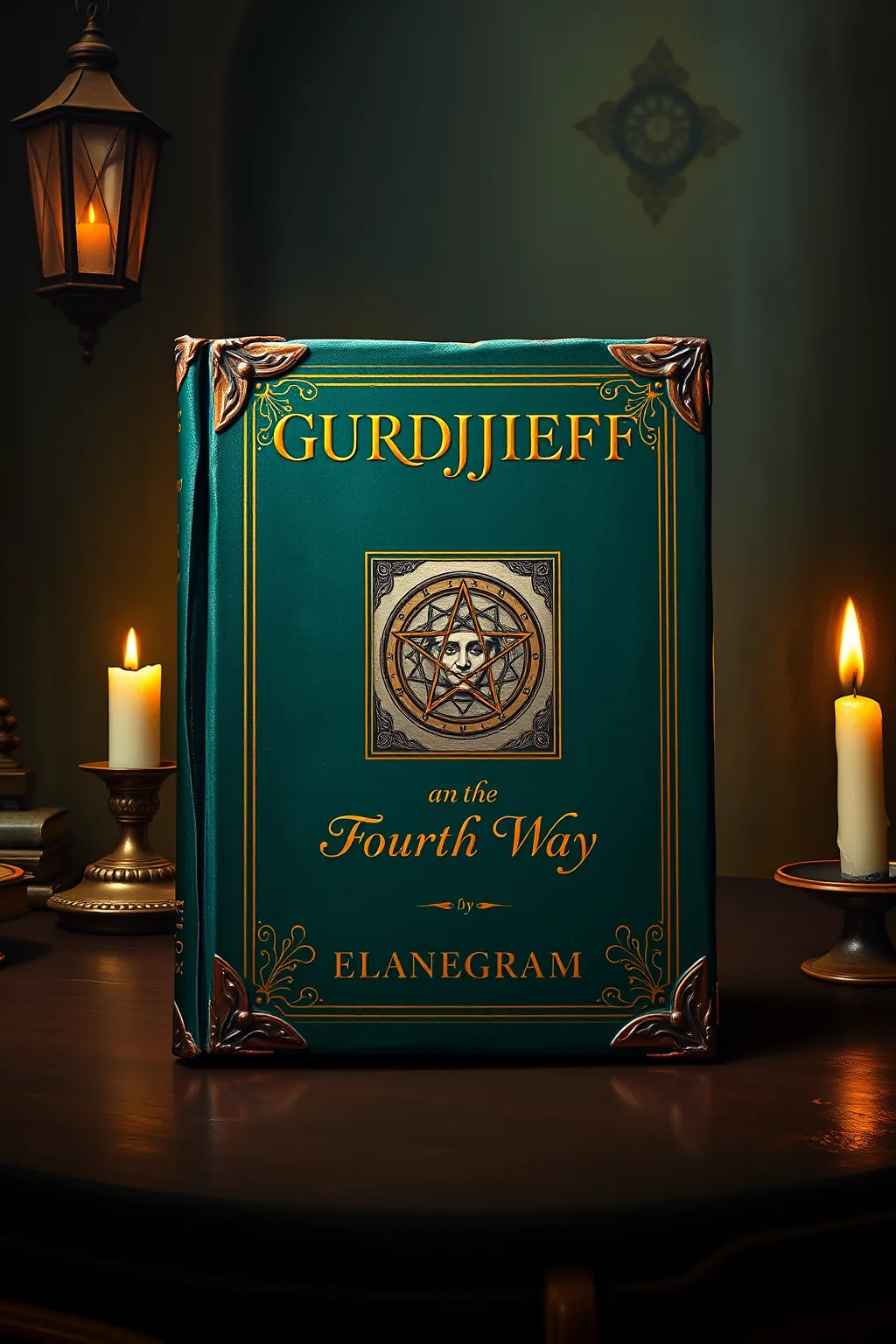
Gurdjieff, Enneagram and the Fourth Way
 82
82

Gurdjieff, Enneagram and the Fourth Way



This concise yet potent essay offers a masterful distillation of Gurdjieff's complex system. The author expertly navigates the labyrinthine concepts of the Enneagram and the Fourth Way, providing clarity without sacrificing the inherent mystery. It succeeds in illuminating Gurdjieff's intellectual lineage and the practical application of his 'Work.' A valuable resource for seasoned practitioners and curious newcomers alike, this piece serves as an indispensable primer for anyone drawn to the profound challenges and transformative possibilities of Gurdjieff's teachings.
📝 Description
82
This book examines George Gurdjieff's 'Work,' focusing on the Enneagram and the Fourth Way.
This volume addresses the philosophical system developed by George Gurdjieff. Gurdjieff's 'Work' aimed at raising human consciousness. The text examines the Enneagram symbol and the principles of the Fourth Way, which Gurdjieff presented as a distinct path for spiritual development.
It traces the influences on Gurdjieff's thought, looking at connections to older esoteric traditions and spiritual currents active during his lifetime. The book also details the practical methods Gurdjieff proposed for developing self-awareness and realizing human potential. It aims to clarify Gurdjieff's contribution to spiritual thought and its possible applications today.
Gurdjieff's teachings emerged in the early 20th century, a period marked by interest in Eastern religions and Western esotericism. His 'Fourth Way' differed from monastic or common worldly paths by suggesting spiritual development was possible through ordinary life, aided by specific psychological and physical exercises. The Enneagram, a nine-pointed geometric figure, served as a central symbol in his system, representing cosmic laws and human psychology. This book situates Gurdjieff's unique synthesis within this broader milieu of esoteric revival and philosophical inquiry.
💡 Why Read This Book?
Unravel the profound mysteries of Gurdjieff's 'Work,' the Enneagram, and the Fourth Way. This book offers a rare glimpse into esoteric wisdom, making complex ideas accessible. Ideal for spiritual seekers, philosophy enthusiasts, and those yearning for deeper self-understanding and practical methods for transformation. Discover a path to awakened consciousness.
⭐ Reader Reviews
Honest opinions from readers who have explored this book.
❓ Frequently Asked Questions
What is the Enneagram?
The Enneagram, in Gurdjieff's context, is a complex symbolic diagram representing universal laws and processes. It's a dynamic tool for understanding cosmic principles and their manifestation within human psychology and the universe.
What is the Fourth Way?
The Fourth Way, or the 'Way of the Sly Man,' is a spiritual path that integrates the physical, emotional, and intellectual aspects of being, allowing for transformation without total renunciation of worldly life. It emphasizes conscious work on oneself.
Who was George Gurdjieff?
George Gurdjieff was an Armenian mystic and spiritual teacher who developed a unique system of self-development and esoteric philosophy known as the Fourth Way, deeply influencing 20th-century spiritual thought.
What were Gurdjieff's 'sources'?
Gurdjieff claimed to have drawn inspiration from ancient esoteric traditions, Sufi orders, and hidden spiritual schools encountered during his extensive travels in Central Asia and the Middle East.
Is this book suitable for beginners?
Yes, while Gurdjieff's teachings are profound, this essay provides a clear and accessible introduction, making it an excellent starting point for those new to his work.
🔮 Key Themes & Symbolism
The Enneagram as a Cosmic Map
This section studies the Enneagram not merely as a personality typology, but as a profound geometric symbol encapsulating universal laws of motion, causality, and transformation. It explores how Gurdjieff utilized this ancient diagram to illustrate the interconnectedness of all phenomena and the intricate dance of energies within the cosmos and the individual psyche. Understanding the Enneagram as a dynamic blueprint reveals the underlying structure of existence and provides a key to unlocking deeper levels of awareness and conscious participation in life's processes.
The Fourth Way: A Path of Conscious Evolution
Here, the focus shifts to the practical application of Gurdjieff's 'Work' – the Fourth Way. This path distinguishes itself by demanding a holistic integration of the physical, emotional, and intellectual faculties, without requiring ascetic withdrawal from the world. The text elucidates the core principles of self-observation, conscious labor, and intentional suffering as tools for shattering the illusion of ordinary consciousness and awakening dormant potentials. It presents a challenging yet attainable route towards genuine spiritual development and self-realization in the midst of everyday life.
Gurdjieff's Esoteric Lineage and Legacy
This theme investigates the historical and spiritual antecedents of Gurdjieff's teachings. It traces the threads of influence from ancient wisdom traditions, Sufism, and possibly forgotten schools of inner development. The essay examines how Gurdjieff synthesized these disparate elements into a coherent and potent system, addressing the perceived spiritual stagnation of the modern era. Furthermore, it evaluates his enduring impact on subsequent esoteric movements and his continued relevance for those seeking authentic spiritual transformation and a deeper understanding of the human predicament.
💬 Memorable Quotes
Direct passages from the work, attributed to the author.
“The Enneagram is the law of three and the law of seven.”
— This highlights the symbolic nature of the Enneagram, representing the interplay of fundamental cosmic forces (the law of three) and the processes of development and change (the law of seven).
“Work on oneself is the only real work.”
— This emphasizes the paramount importance of inner development and conscious effort in Gurdjieff's system, suggesting that true progress lies in transforming one's own being.
“The Fourth Way requires a waking sleep.”
— This paradoxical statement points to the necessity of being present and aware even while engaged in ordinary activities, integrating conscious attention into the fabric of daily life.
“Knowledge without practice is like a bird without wings.”
— This underscores the experiential nature of Gurdjieff's teachings, stressing that theoretical understanding must be coupled with dedicated practice to yield genuine transformation.
💡 Key Ideas
Editorial paraphrase of the work's core concepts — not direct quotes.
To awaken is to begin to see.
This quote expresses the core aim of Gurdjieff's 'Work': to move beyond the automatism of everyday life and attain a state of conscious perception, recognizing reality as it truly is.
🌙 Esoteric Significance
Tradition
Gurdjieff's teachings are deeply rooted in the esoteric traditions of Central Asia and the Middle East, particularly Sufism, while also incorporating elements from ancient Egyptian mysticism and possibly Zoroastrianism. His 'Work' represents a unique synthesis, aiming to reintroduce lost knowledge and practical methods for spiritual awakening that were believed to have been preserved in hidden schools and oral transmissions.
Symbolism
The Enneagram stands as the most prominent symbol, a sophisticated diagram illustrating universal laws and processes. Beyond this, Gurdjieff employed a rich vocabulary of symbolic language, including archetypal figures, cosmic principles, and allegorical narratives, to convey complex metaphysical concepts. These symbols are not mere decorations but integral tools for understanding the structure of reality and the mechanics of consciousness.
Modern Relevance
In an age characterized by information overload, distraction, and a pervasive sense of alienation, Gurdjieff's emphasis on self-awareness, conscious attention, and the cultivation of inner will is more relevant than ever. His methods offer a potent antidote to the passive consumption of external stimuli, providing practical tools for individuals seeking to reclaim agency over their lives and achieve genuine personal transformation in a rapidly changing world.
👥 Who Should Read This Book
This work is essential for sincere seekers of truth who are dissatisfied with superficial answers and are ready for profound self-inquiry. Scholars of comparative religion, philosophy, and psychology will find invaluable insights into the development of esoteric thought in the 20th century. Practitioners of spiritual disciplines, particularly those interested in consciousness studies and transformative practices, will discover a rigorous and effective methodology for inner work. Beginners curious about Gurdjieff's unique system will find this an accessible yet comprehensive introduction, while advanced students will appreciate the nuanced exploration of his core ideas.
📜 Historical Context
Emerging in the early 20th century, a period marked by profound societal upheaval, scientific advancement, and a burgeoning interest in the esoteric, George Gurdjieff's teachings arrived as a radical challenge to conventional thought. The era witnessed the decline of traditional religious authority and the rise of new philosophical and psychological paradigms, creating fertile ground for alternative spiritual systems. Gurdjieff's 'Work,' often presented in conjunction with movements like Theosophy and Anthroposophy, offered a compelling, albeit demanding, path to self-discovery and spiritual liberation. His synthesis of Eastern mysticism with Western psychological insights resonated with many seeking meaning beyond the materialist worldview, positioning him as a central, though often controversial, figure in the history of modern spirituality and esoteric thought.
📔 Journal Prompts
Reflect on a moment when you felt truly awake. What were the conditions that facilitated this state?
How does the concept of 'waking sleep' manifest in your daily life? Identify specific instances.
Consider the Enneagram as a map of universal laws. How might this perspective change your understanding of a recent event?
In what ways can you integrate 'conscious labor' into your current responsibilities or activities?
What does 'self-observation' mean to you, and what are the challenges you face in practicing it consistently?
🗂️ Glossary
The Work
The term Gurdjieff used to describe his system of spiritual and psychological self-development, aimed at awakening consciousness and transforming the individual.
Enneagram
A nine-pointed geometric figure used by Gurdjieff as a symbol of universal laws and processes, particularly the laws of three and seven.
Fourth Way
The name Gurdjieff gave to his specific path of spiritual development, distinguished by its integration of inner and outer life, and its focus on conscious effort.
Conscious Attention
A state of focused awareness and intentional presence, cultivated through practice, which allows for a deeper perception of reality and oneself.
Self-Observation
The practice of observing one's own thoughts, feelings, and actions without judgment, as a means of understanding one's habitual patterns and mechanical reactions.
This book appears in 2 collections
🔮 Readers Also Liked
Browse all →




From the “Theosophy” Collection
View all →




More Free Theosophy & Anthroposophy Books
View all →