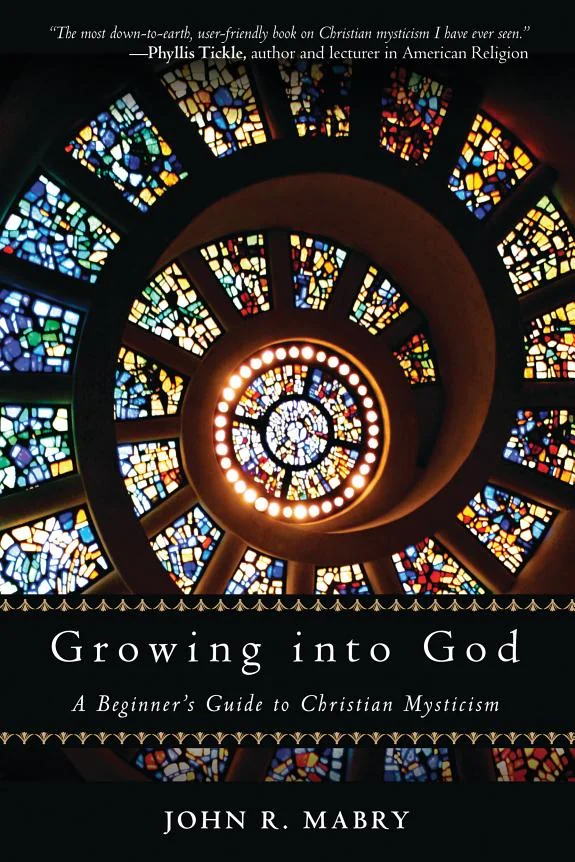
Growing into God
 71
71

Growing into God
John R. Mabry's *Growing into God* confronts the popular, often sensationalized, image of mysticism head-on. By defining it simply as "the pursuit-and enjoyment-of union with God," Mabry immediately demystifies the practice, grounding it within orthodox Christian aims. This is a significant strength, making contemplative spirituality accessible rather than alienating. The work is particularly effective when it moves beyond definition to practical application, suggesting how ordinary Christian life can be a vehicle for this union. However, while Mabry seeks to integrate mysticism into mainstream Christianity, the book sometimes feels a bit too didactic, occasionally lacking the lived, experiential texture one might expect from a guide to spiritual union. The emphasis on "discipline" is clear, but the "enjoyment" aspect could be more vividly illustrated through concrete, relatable examples of this union in practice, perhaps by elaborating on the specific spiritual disciplines that foster such growth. Ultimately, Mabry offers a valuable corrective to common misunderstandings, advocating for a Christian life lived more fully in divine presence.
📝 Description
71
John R. Mabry's 2012 book argues Christian mysticism is the core of spiritual life.
John R. Mabry's *Growing into God*, published in 2012, re-examines Christian mysticism. Mabry contends that the pursuit of union with the Divine is not a niche interest but the central aim of authentic Christian spirituality. He works to remove the association of mysticism with secrecy or occultism, instead presenting it as an accessible and inherent part of Christian practice. The book focuses on the soul's development toward God.
This book is for readers who want a deeper, more integrated connection to their Christian faith. It speaks to those who find traditional spiritual expressions lacking or who have been confused by common misunderstandings of mysticism. Students of theology and clergy interested in Christianity's contemplative side will find it useful. The work offers valuable perspective for anyone questioning the divide between ordinary faith and mystical experience.
Mabry's work appeared during a period of renewed interest in contemplative Christianity. Unlike some contemporary discussions that draw from Eastern traditions, Mabry grounds his exploration squarely within the Christian lineage. He references figures such as Meister Eckhart and Teresa of Ávila, placing his ideas within a long-standing Christian contemplative tradition. The book was published in 2012 to fill a need for accessible writing that clearly articulated Christian mysticism as a main spiritual discipline, not a peripheral one.
💡 Why Read This Book?
• Understand Christian mysticism as an inherent pursuit of divine union, not secret rites, as explored in the book's initial definition. • Discover how everyday Christian life can be a path to spiritual growth, a concept central to Mabry's argument for "soul growth" towards God. • Gain a clear framework for deepening your faith, moving beyond superficial observance to embrace the contemplative dimension, a key takeaway from the 2012 publication's focus.
⭐ Reader Reviews
Honest opinions from readers who have explored this book.
❓ Frequently Asked Questions
What is the core definition of mysticism presented in John R. Mabry's *Growing into God*?
John R. Mabry defines Christian mysticism as the pursuit and enjoyment of union with God, positioning it as the central goal of all Christian spirituality, rather than a secretive or occult practice.
When was *Growing into God* first published and by whom?
*Growing into God* was first published on December 13, 2012, authored by John R. Mabry, an Anglican-rite Congregational minister.
Does the book suggest mysticism is separate from mainstream Christianity?
No, Mabry explicitly argues that mysticism is not separate but is "at the heart of an authentic Christian life," aiming to integrate contemplative practice into everyday faith.
What common misconception about mysticism does the book address?
The book directly counters the misconception that mysticism involves sinister or secretive rituals, emphasizing its nature as a direct, personal experience of God's presence.
Who is the author, John R. Mabry?
John R. Mabry is an Anglican-rite Congregational minister who writes on Christian spirituality and mysticism, advocating for its central role in authentic faith.
What is the primary goal of the spiritual discipline discussed in the book?
The primary goal is the "soul growth" into God, facilitating an authentic and enjoyable union with the Divine, as detailed in the book's exploration of Christian spirituality.
🔮 Key Themes & Symbolism
Authentic Christian Union
The book posits that the ultimate aim of Christianity is not merely adherence to doctrine but the direct, experiential union with God. This union is framed not as an extraordinary achievement for a select few, but as the natural culmination of a life lived in authentic spiritual pursuit. Mabry distinguishes this from popular, often sensationalized, notions of mysticism, clarifying that it is about the soul's development towards the Divine, a process inherent in genuine Christian life since its inception.
Soul Growth as Discipline
Mabry emphasizes that growing into God is an active process of "soul growth," requiring intentional discipline rather than passive reception. This discipline is not about austere self-denial but about cultivating an awareness and receptivity to the Divine presence within the ordinary fabric of life. The book explores how consistent spiritual practices, even seemingly simple ones, contribute to this organic transformation, fostering a deeper, more integrated relationship with the Creator.
Explaining Contemplation
A significant theme is the demystification of Christian mysticism. By stripping away the association with occultism and secrecy, Mabry makes contemplative spirituality accessible to the average believer. The work clarifies that experiencing God's presence is not reserved for historical figures or cloistered monks but is a potential reality for anyone committed to the spiritual journey. This approach encourages readers to see their own faith path as inherently mystical.
The Enjoyment of God's Presence
Beyond the pursuit, the book highlights the "enjoyment" of union with God. This suggests that the spiritual journey culminates not in struggle, but in a profound sense of peace, fulfillment, and divine communion. This aspect counters the idea that spiritual disciplines are burdensome, reframing them as pathways to a deeply satisfying and joyful relationship with the Divine. It speaks to the inherent bliss found in true spiritual connection.
💬 Memorable Quotes
Direct passages from the work, attributed to the author.
“True mysticism isn’t at all sinister or secretive.”
— This statement serves as the book's foundational thesis, directly challenging common, often fear-based, perceptions of mystical practices and re-centering them within an accessible spiritual framework.
“Mysticism is at the heart of an authentic Christian life.”
— This assertion reframes mysticism not as an optional add-on or fringe practice, but as an essential component of genuine Christian experience and discipleship.
“It is nothing more and nothing less than the pursuit-and enjoyment-of union with God.”
— This concise definition distills the essence of Christian mysticism to its core purpose: a direct, relational connection with the Divine, emphasizing both the active seeking and the resulting fulfillment.
“Christian mysticism is the discipline of growing the soul into God”
— This phrase captures the book's central metaphor and concept, portraying spiritual development as an organic, intentional process of transformation towards divine integration.
“The goal of all Christian spirituality is union with God.”
— This is a powerful statement of purpose, aligning the entire spectrum of Christian practice under the singular, unifying objective of achieving direct communion with the Divine.
🌙 Esoteric Significance
Tradition
Mabry's work engages with the Christian contemplative tradition, a lineage stretching from the Desert Fathers and Mothers through figures like Meister Eckhart and Teresa of Ávila. While not strictly 'esoteric' in the sense of secret knowledge, it draws from the mystical stream within Christianity, which emphasizes direct, experiential knowledge of God over purely intellectual understanding. It departs from Gnostic or Hermetic traditions by maintaining a Christocentric focus and orthodox Trinitarian theology.
Symbolism
The primary 'symbol' Mabry explores is the soul itself, viewed as a growing entity moving towards divine union. The concept of 'growth' is central, implying a developmental process akin to a seed developing into a plant, guided by divine influence. The 'discipline' itself functions as a motif, representing the intentional actions and attitudes that facilitate this spiritual maturation, rather than reliance on external magical symbols or rituals.
Modern Relevance
Mabry’s emphasis on the accessibility of Christian mysticism appeals to contemporary spiritual seekers who feel disconnected from institutional religion but seek meaning within a Christian framework. His work informs modern contemplative practices and discussions within churches exploring deepening spiritual life, influencing clergy and laypeople alike who seek to integrate the "prayer of the heart" into their daily lives, aligning with movements focused on embodied spirituality.
👥 Who Should Read This Book
• Christians seeking to understand and practice the contemplative dimensions of their faith, moving beyond surface-level observance. • Students of theology or comparative religion interested in the historical and practical aspects of Christian mysticism as distinct from other traditions. • Individuals disillusioned by popular, often sensationalized, portrayals of mysticism who desire a grounded, orthodox Christian perspective on spiritual union.
📜 Historical Context
Published in 2012, John R. Mabry's *Growing into God* arrived during a resurgence of interest in contemplative spirituality within Christian circles. Figures like Richard Rohr and Cynthia Bourgeault were actively reintroducing ancient monastic practices to a contemporary audience, often through accessible books and retreats. Mabry’s work distinguished itself by firmly rooting its exploration of mysticism within the Anglican-rite Congregational tradition, directly countering the trend of drawing heavily from Eastern or New Age sources. While not directly engaging in a public debate with a specific contemporary author, his work implicitly responded to a broader theological conversation about the nature of spiritual experience. The book’s clear articulation of mysticism as central to, rather than peripheral to, Christian life aimed to correct perceived imbalances in theological education and popular understanding of the faith.
📔 Journal Prompts
The pursuit and enjoyment of union with God: What does this balance mean in your daily life?
Reflect on the concept of 'soul growth' as presented by Mabry. How is your soul currently growing?
Identify one area where you perceive mysticism as 'sinister or secretive' and reframe it through the book's lens.
Consider the 'discipline' of growing into God. What practices could you intentionally cultivate?
How can the 'enjoyment' of God's presence be more fully realized in your current spiritual practice?
🗂️ Glossary
Mysticism (Christian)
In the context of this book, Christian mysticism refers to the direct, experiential pursuit and experience of union with God, considered the core of authentic Christian spirituality.
Union with God
The ultimate goal of Christian spirituality as defined by Mabry; a deep, personal, and often ineffable communion and oneness with the Divine.
Soul Growth
The process by which the individual's spiritual nature (soul) develops and matures towards God, facilitated by intentional spiritual discipline and divine grace.
Discipline
The active, intentional practices and attitudes undertaken to foster spiritual development and facilitate the soul's growth towards God.
Authentic Christian Life
A life lived in genuine accordance with Christian principles, characterized by a deep, experiential relationship with God, including the pursuit of mystical union.
Anglican-rite Congregational minister
The author's specific ministerial background, indicating a tradition that blends elements of Anglican liturgy and governance with Congregationalist principles of church autonomy.
Occult
Referred to as a common misconception associated with mysticism; typically denotes hidden, secret, or supernatural practices, which Mabry argues are not characteristic of true Christian mysticism.
This book appears in 1 collection
🔮 Readers Also Liked
Browse all →








From the “Christian Mysticism” Collection
View all →








More Free Mysticism & Contemplation Books
View all →