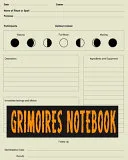
Grimoires Notebook: A Blank Journal of Spell Paper
 79
79

Grimoires Notebook: A Blank Journal of Spell Paper
The Grimoires Notebook presents itself as a tool, and in that capacity, it largely succeeds. Its 8" x 10" dimensions offer ample space for detailed entries without feeling cumbersome, a welcome consideration for spell components and lengthy ritual descriptions. The paper quality, while standard, holds ink adequately, preventing significant bleed-through for most common writing instruments. Its lack of perforation or spiral binding lends it a sturdier feel, akin to a traditional grimoire, which may appeal to those seeking a more formal repository for their craft. However, its purely functional nature means it offers no inherent guidance; it is a blank canvas, demanding the user's existing knowledge and discipline. A notable absence is any introductory material or suggestion on how to best utilize such a journal for magical development. The strength lies in its simplicity and durability, but its limitation is a complete lack of pedagogical support. This notebook is a reliable vessel for existing practices, not a guide for new ones.
📝 Description
79
Published in 2018, the Grimoires Notebook is a blank journal for recording magical workings.
This 8" x 10" journal contains 110 pages of white, unlined paper, bound without a spiral. Its design is straightforward, intended as a practical tool for those engaged in esoteric practices. The notebook's purpose is to provide a dedicated space for logging rituals, spellcasting, and personal observations related to magical work. It is suitable for individuals who keep a personal Book of Shadows or grimoire and seek a durable, simple format for documenting their craft.
The journal aims to support practical documentation of magical activity. Users can record details of spell construction, ritual execution, and any observed phenomena or insights. This structured approach is meant to aid practitioners in cultivating personal gnosis. By diligently keeping records, users can track their progress, identify recurring patterns, and refine their magical techniques over time.
The Grimoires Notebook follows a long tradition of personal magical journals. Historically, figures like Aleister Crowley and Eliphas Lévi kept extensive records of their research and experiences. These private documents were crucial for developing and refining their magical systems, influencing later occult thought. While this notebook is a contemporary volume, it serves a similar function by facilitating the systematic recording of magical practice, allowing users to build their own corpus of knowledge and experience.
💡 Why Read This Book?
• Gain a dedicated, durable physical space (8" x 10") to meticulously record your spellcasting sessions and ritual outcomes, fostering a structured approach to your magical practice. • Utilize a non-perforated, non-spiral bound format that mimics traditional grimoires, enhancing the sense of gravitas and permanence for your documented esoteric knowledge. • Select from a series with varied cover designs, allowing for personal expression and a journal that visually complements your individual magical aesthetic.
⭐ Reader Reviews
Honest opinions from readers who have explored this book.
❓ Frequently Asked Questions
What is the primary purpose of the Grimoires Notebook?
The primary purpose is to serve as a blank journal for witches, Wiccans, mages, and other practitioners to record spells, rituals, and magical observations, acting as a personal Book of Shadows.
What are the physical dimensions and page count of this notebook?
The notebook has a trim size of 8" x 10" and contains 110 pages of white paper.
Is the paper perforated or spiral-bound?
No, the paper is non-perforated and non-spiral bound, offering a more traditional and durable feel for a magical journal.
Who is the intended audience for this Grimoires Notebook?
It is intended for individuals engaged in new age magickal practices, including witches, Wiccans, mages, and druids who wish to document their craft.
Are there different versions of this notebook available?
Yes, this notebook is part of a series available in four separate volumes, each featuring a different cover design to suit user preferences.
When was Grimoires Notebook first published?
Grimoires Notebook was first published on September 17, 2018.
🔮 Key Themes & Symbolism
Practical Spellcraft Documentation
This journal emphasizes the utilitarian aspect of magical practice by providing a dedicated space for recording spells and rituals. It encourages users to meticulously document every detail, from ingredients and incantations to the observed outcomes. This systematic approach aligns with the historical practice of grimoire creation, where practitioners like those in the 17th century would compile their own working texts based on experience and tradition. The notebook facilitates this by offering blank pages for unfiltered transcription and personal annotation.
Personal Book of Shadows
The Grimoires Notebook functions as a modern iteration of the 'Book of Shadows,' a personal magical record traditionally kept by witches and covens. It allows practitioners to consolidate their unique magical knowledge, rituals, and insights into a single, organized volume. This aligns with the concept of personal gnosis, where individual experience and understanding are paramount in esoteric development, moving beyond generic templates to create a truly bespoke magical system.
Esoteric Practice Aesthetics
While primarily functional, the series' offering of multiple cover designs acknowledges the aesthetic component often associated with esoteric tools. The physical appearance of a grimoire can influence the practitioner's mindset and connection to their work. By providing choices in cover art, the notebook caters to the individual's relationship with their magical practice, allowing the external form to complement the internal spiritual and practical work undertaken within its pages.
Structured Magical Learning
The act of writing and organizing magical information within this journal promotes a structured approach to learning and development. It encourages practitioners to reflect on their practices, analyze results, and refine their methods, mirroring the empirical approach seen in early scientific experimentation. This structured recording process is crucial for tracking progress and building a coherent magical repertoire over time.
💬 Memorable Quotes
Direct passages from the work, attributed to the author.
“110 pages designed for use by witches, wiccans, mages, druids and other new age magick practitioners.”
— This directly states the intended user base and purpose, highlighting its practical application for a broad spectrum of contemporary magical practitioners.
“Use it to log rituals or spellcasting sessions.”
— This instruction emphasizes the journal's core function: a practical tool for documenting the execution and results of magical workings.
“Part of a series that are available in four separate volumes with different cover designs.”
— This points to the availability of choice and personalization within the product line, catering to individual aesthetic preferences.
“8" x 10" TRIM SIZE | 110 PAGES”
— This provides essential physical specifications, indicating a substantial size suitable for detailed entries and a significant number of pages for extensive record-keeping.
“Non-Perforated Non-spiral bound”
— These details underscore the journal's durable, traditional format, distinguishing it from more ephemeral notebooks and suggesting a more permanent repository for magical knowledge.
🌙 Esoteric Significance
Tradition
This notebook aligns with the Western Esoteric Tradition, particularly the modern Wiccan and Neopagan movements that emphasize personal practice and documentation. It serves as a practical tool for individual magical development, akin to a personal grimoire or Book of Shadows. While not tied to a specific historical lineage like Hermeticism or Kabbalah, it provides a framework for practitioners within these broader traditions to record their unique interpretations and applications of magical principles.
Symbolism
The notebook itself, as a blank volume, symbolizes potential and the unmanifested. Its pages represent the void awaiting inscription, mirroring the magician's will shaping reality. The act of filling its pages with spells and rituals is a symbolic act of creation, bringing inner knowledge and intention into tangible form. The physical act of writing imbues the words and symbols with personal energy, transforming the blank pages into a sacred space of power.
Modern Relevance
Contemporary practitioners of witchcraft, modern ceremonial magic, and eclectic paganism utilize such journals extensively. Thinkers and authors like Jason Miller, who advocates for practical, results-oriented magic, emphasize diligent record-keeping. This notebook directly supports the modern emphasis on personalized spiritual paths and the empirical observation of magical effects, making it relevant for anyone seeking to structure and deepen their ongoing esoteric studies and practices.
👥 Who Should Read This Book
• Beginning students of Witchcraft or Wicca who are starting to develop their personal practice and wish to keep a record of spells, rituals, and insights. • Experienced practitioners of various esoteric paths (mages, druids) seeking a durable, no-frills journal for documenting complex magical workings and observations. • Comparative religion scholars or occult historians interested in the practical tools used by modern esoteric practitioners for personal grimoire construction.
📜 Historical Context
Published in 2018, Grimoires Notebook emerges during a period characterized by a significant increase in public engagement with witchcraft and esoteric practices, a trend building momentum since the late 20th century. This resurgence is partly fueled by increased access to information via the internet and a growing dissatisfaction with mainstream spiritual offerings. While this notebook is a modern tool, it carries the long tradition of personal magical journals dating back centuries. Figures like Agrippa, in his *Three Books of Occult Philosophy* (first published 1531), discussed the importance of accurately recording observations and experiments, a principle essential for any serious magical practitioner. Contemporary occultists, influenced by authors such as Israel Regardie and Doreen Valiente, continue to maintain personal records as integral to their magical development. This notebook serves as a contemporary vessel for that enduring practice, distinct from academic or historical texts, focusing solely on the practitioner's immediate engagement with their craft.
📔 Journal Prompts
Record the full details of your most recent spellcasting session, including intent, materials, and observed effects.
Document a significant ritual you performed, noting any personal insights or feelings that arose during the process.
Outline a new spell you wish to create, listing potential components and the desired outcome.
Reflect on the patterns observed in your previous magical workings logged in this grimoire.
Describe any synchronicities or meaningful coincidences that occurred during your magical practice this week.
🗂️ Glossary
Grimoire
A textbook of magic, typically containing instructions on how to create magical tools, cast spells, and perform rituals. Historically, grimoires were often attributed to famous magicians or ancient figures.
Book of Shadows
A personal journal kept by individuals practicing witchcraft or Wicca, containing spells, rituals, correspondences, and personal magical notes. It serves as a record of their magical knowledge and practice.
Spellcasting
The practice of performing magical actions or rituals intended to bring about a specific outcome or effect, often involving the use of intent, energy, and specific tools or words.
Ritual
A set of actions performed in a prescribed order, often for religious or magical purposes. Rituals can be used for various intentions, such as consecration, invocation, or manifestation.
Wiccan
A follower of Wicca, a modern Pagan religion based on reverence for nature and the practice of magic, often involving covens and specific ethical guidelines.
Druid
A member of the ancient Celtic religious hierarchy, or a modern adherent of Neo-Druidism, a spiritual path focused on nature, reverence for the earth, and often ancient Celtic traditions.
New Age
A broad range of spiritual or metaphysical beliefs and practices that emerged in the Western world during the late 1970s, often incorporating elements from various traditions and philosophies.