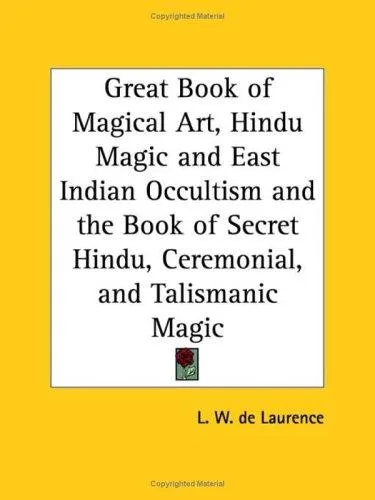
Great Book of Magical Art, Hindu Magic and East Indian Occultism and the Book of Secret Hindu, Ceremonial, and Talismanic Magic
 62
62

Great Book of Magical Art, Hindu Magic and East Indian Occultism and the Book of Secret Hindu, Ceremonial, and Talismanic Magic


Evander Ashcroft (Alchemy & Hermeticism Editor) — A cornerstone for serious occultists, de Laurence's 'Great Book of Magical Art' masterfully dissects the intricate tapestry of Hindu magic. Its strength lies in its comprehensive approach, bridging ceremonial rites with the deep philosophical underpinnings of Eastern occultism. The author's dedication to presenting authentic practices, from talismanic workings to yogic secrets, is evident. While dense, it rewards diligent study, offering profound insights into energetic manipulation and spiritual ascension. This volume is essential for practitioners seeking to integrate potent Eastern methodologies into their magical repertoire, transcending mere ritual to grasp true spiritual mastery.
📝 Description
62
L. W. de Laurence published the 'Great Book of Magical Art' in 1915, compiling Hindu occult traditions.
This 1915 compilation by L. W. de Laurence presents a broad survey of Hindu magical practices. It covers ceremonial magic, talismanic arts, and various occult philosophies derived from Indian traditions. The text aims to instruct readers in channeling cosmic energies and invoking divine forces, detailing complex rituals and the symbolism found in yogic disciplines and tantric lore. It serves as a reference for those interested in the practical applications of spiritual power and sacred rites within an occult framework. The book draws upon a range of esoteric concepts to illuminate what it describes as the subtle architecture of reality and the forces that shape existence.
Published in the early 20th century, de Laurence's work is situated within the Western esoteric interest in Eastern religions and occultism. It reflects a period where figures like Helena Blavatsky and others popularized concepts from Hindu and Buddhist traditions, adapting them for Western audiences. This book specifically focuses on magical applications, blending ceremonial techniques with interpretations of Hindu spiritual and philosophical systems. It represents an effort to codify and disseminate esoteric knowledge from India within a Western occult framework, often emphasizing practical results and arcane power.
💡 Why Read This Book?
Uncover the potent, ancient secrets of Hindu magic and East Indian occultism. This book offers a comprehensive guide to ceremonial rites, talismans, and yogic philosophies, revealing hidden pathways to spiritual power. Ideal for serious practitioners, scholars of esotericism, and seekers of profound metaphysical knowledge, it bridges Eastern and Western magical traditions.
⭐ Reader Reviews
Honest opinions from readers who have explored this book.
❓ Frequently Asked Questions
What are the primary focuses of this book?
The book primarily focuses on Hindu magic, East Indian occultism, ceremonial magic, and the creation and use of talismans, offering insights into ancient spiritual and magical practices.
Is this book suitable for beginners in magic?
While comprehensive, the depth of the material may be best suited for those with some prior exposure to occult or philosophical studies. Beginners may find it a challenging but rewarding deep dive.
What kind of rituals are described?
The text details various ceremonial and talismanic rituals, often drawing from Hindu traditions, aimed at invoking specific energies, achieving spiritual goals, or manifesting desired outcomes.
Does the book explain the symbolism behind the practices?
Yes, a significant aspect of the book involves explaining the rich symbolism inherent in Hindu mythology, yogic practices, and magical rites, providing context and deeper understanding.
Is L. W. de Laurence a recognized authority in occultism?
L. W. de Laurence was a prolific publisher and author in the early 20th century, known for disseminating occult and magical texts, making him a significant figure in the history of Western esotericism.
🔮 Key Themes & Symbolism
The Power of Hindu Sacred Arts
This theme looks at the profound spiritual and magical efficacy attributed to the ancient practices of India. It explores how rituals, mantras, and yogic disciplines are not merely symbolic but are potent tools for influencing the subtle realms and manifesting tangible results. The text illuminates the intricate connection between the practitioner's consciousness, the divine energies invoked, and the ultimate realization of their intent, presenting a holistic view of magic as an integrated spiritual path.
Ceremonial and Talismanic Magic
Here, the focus shifts to the structured application of magical forces through carefully orchestrated ceremonies and potent talismans. The book dissects the principles behind creating sacred space, invoking deities or elemental forces, and imbuing objects with specific magical properties. It highlights the importance of precise timing, symbolic gestures, and the concentrated will of the magician in achieving transformative effects, offering practical guidance for those seeking to harness these ancient techniques for personal growth and spiritual advancement.
Esoteric Philosophy of the East
This theme explores the philosophical underpinnings of East Indian occultism, revealing a worldview where the material and spiritual are intimately connected. It elucidates concepts such as karma, reincarnation, the chakras, and the nature of consciousness, demonstrating how these principles inform magical practices. The text emphasizes the pursuit of liberation (moksha) and self-realization as the ultimate goals, positioning magic as a means to accelerate spiritual evolution and achieve a deeper understanding of the universe and one's place within it.
💬 Memorable Quotes
Direct passages from the work, attributed to the author.
“Magic is the science of hidden forces.”
— This defines magic as a systematic study and application of unseen energies, emphasizing that it is not mere superstition but a profound, albeit esoteric, field of knowledge.
“The true temple is within the heart.”
— This highlights the internal nature of spiritual and magical work, suggesting that genuine power and connection are cultivated through introspection and inner development, not solely external rituals.
“Ignorance is the greatest obstacle to power.”
— This emphasizes the crucial role of knowledge and understanding in the magical arts, implying that dispelling illusion and gaining insight is fundamental to unlocking one's latent abilities.
“The talisman is a key to unlock the celestial.”
— This succinctly explains the function of a talisman within the context of the book, portraying it as a sacred object designed to facilitate connection with higher or spiritual realms.
💡 Key Ideas
Editorial paraphrase of the work's core concepts — not direct quotes.
The Adept knows that the universe is the theatre of his will.
This quote underscores the core tenet of magical practice: the power of focused intention and the belief that the practitioner can actively shape their reality through conscious will and mastery.
🌙 Esoteric Significance
Tradition
This work is deeply rooted in the esoteric traditions of Hinduism, specifically drawing from yogic philosophy, Tantra, and ancient Indian magical practices. It bridges these Eastern concepts with Western ceremonial magic, presenting a comprehensive system for spiritual and magical development. The text views magic not as mere trickery, but as a profound science and art form integral to spiritual evolution and the attainment of higher consciousness within the Hindu framework.
Symbolism
The book is replete with detailed symbolism drawn from Hindu cosmology, deities, and sacred texts. Key symbols include the chakras, mandalas, mantras, and the iconography of various gods and goddesses, each representing specific energies, states of consciousness, or cosmic principles. Talismans are presented as powerful symbolic representations imbued with divine or elemental forces, acting as focal points for magical intent and spiritual connection.
Modern Relevance
In contemporary times, this book offers a vital bridge to understanding the enduring power and philosophical depth of Eastern occultism. It provides practitioners with authentic techniques for spiritual growth, energy work, and manifestation, relevant to modern seekers exploring holistic approaches to well-being and consciousness. The emphasis on inner development and the interconnectedness of all things resonates strongly with current interest in mindfulness, personal transformation, and the exploration of subtle energies.
👥 Who Should Read This Book
This book is a treasure for the dedicated seeker of esoteric knowledge, particularly those drawn to the mystical traditions of the East. Scholars of comparative religion and occult history will find it an invaluable primary source. Experienced practitioners of Western magic may discover new dimensions and potent techniques by exploring its Hindu and East Indian methodologies. Beginners interested in a profound, albeit challenging, introduction to the depths of Eastern occultism and ceremonial arts will also find much to contemplate and study.
📜 Historical Context
Published in the early 20th century, L. W. de Laurence's work emerged during a period of intense Western fascination with Eastern philosophies and occult traditions. Theosophy, Spiritualism, and various Hermetic orders were popularizing ideas from India, Egypt, and other ancient cultures. De Laurence himself was a prolific publisher and author, known for his accessibility and his role in disseminating esoteric knowledge to a broader audience. His books often served as practical guides, translating complex spiritual and magical concepts into a format digestible for the burgeoning occult community. This particular volume reflects the era's desire to explore and integrate the rich mystical heritage of India, presenting it as a source of potent magical and philosophical wisdom.
📔 Journal Prompts
Reflect on a specific deity or symbol mentioned and its potential correspondence with your own inner landscape. What energies does it represent for you?
Consider the concept of 'will' as described in the book. How can you cultivate more focused intention in your daily life and magical practice?
Explore the idea of talismans as conduits of power. What personal 'talisman' or object could you create to symbolize a specific aspiration or protection?
How does the book's perspective on the interconnectedness of the material and spiritual realms challenge or affirm your current worldview?
Meditate on the idea of magic as a path to spiritual liberation. What does 'liberation' mean to you, and how might magical practices facilitate it?
🗂️ Glossary
Talisman
A magical object inscribed with symbols or characters, believed to possess protective or empowering qualities, often consecrated for a specific purpose or to attract certain energies or influences.
Ceremonial Magic
A structured form of magic involving elaborate rituals, incantations, and the use of symbolic tools and objects to invoke specific spiritual or elemental forces for magical purposes.
Occultism
The study and practice of hidden or secret knowledge, often concerning supernatural, mystical, or magical powers and phenomena, aiming to understand the underlying principles of the universe.
Chakra
In yogic and Hindu traditions, these are energy centers within the subtle body, often depicted as spinning wheels of light, each associated with specific physical, emotional, and spiritual functions.
Mantra
A sacred utterance, sound, syllable, word, or group of words that is repeated, chanted, or sung, believed to have spiritual or psychological power, often used in meditation and ritual.
This book appears in 3 collections
🔮 Readers Also Liked
Browse all →




More by L. W. de Laurence
All books →




From the “Ritual Magic” Collection
View all →







More Free Magic & Ritual Books
View all →