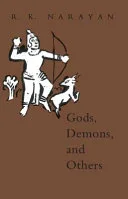
Gods, Demons, and Others
 81
81

Gods, Demons, and Others
R. K. Narayan’s reinterpretation of Indian epic fragments in "Gods, Demons, and Others" succeeds through its author’s inimitable voice, though it occasionally feels too streamlined. Narayan’s strength lies in his ability to distill complex mythic events into lucid, character-driven narratives. His urbane humor, evident in passages describing the foibles of gods and mortals alike, injects a unique vitality into tales that could otherwise feel distant. For instance, his rendering of the demoness Surpanakha’s interactions offers a touch of wry observation. However, the deliberate omission of deeper theological or social commentary, while sharpening the focus, sometimes leaves the reader wanting more context for the characters' motivations. The work offers a graceful, accessible entry into these profound stories, but its brevity means some of the original myths' resonant power is inevitably softened. It is a collection best appreciated for its elegant prose and character sketches rather than its theological depth.
📝 Description
81
R. K. Narayan's 1993 collection retells stories from India's epics, focusing on characters.
R. K. Narayan's "Gods, Demons, and Others" gathers tales from the Ramayana and Mahabharata. Published in 1993, the book bypasses lengthy theological or social analysis. Narayan instead emphasizes the characters and dramatic events within these ancient narratives, employing his characteristic clarity and subtle humor. The selection highlights significant moments and memorable figures, making India's vast mythology more accessible.
This volume is suited for those drawn to mythology, Indian literature, and strong storytelling. Readers wishing to grasp the central stories of the Ramayana and Mahabharata without getting lost in academic discussion will find it especially valuable. Fans of Narayan's unique writing style, known for its gentle wit and smooth prose, will also enjoy it. Students of comparative mythology or world religions may find its focus on character and plot beneficial.
This collection situates itself within the broader tradition of disseminating foundational religious and mythological texts for a wider audience. By extracting key narratives from the Ramayana and Mahabharata, Narayan offers access to concepts like dharma and karma, which are central to Indic spiritual thought. His approach, which prioritizes character and dramatic action over theological exegesis, mirrors historical efforts to make complex spiritual ideas relatable. The book serves as a modern conduit for ancient Indic cosmology, presenting deities and demons not merely as figures of myth but as embodiments of fundamental human experiences and cosmic principles.
💡 Why Read This Book?
• Gain an accessible introduction to core figures and events from the Ramayana and Mahabharata, focusing on character and plot as Narayan distills them in the 1993 publication. • Experience R. K. Narayan's distinctive narrative style, characterized by urbane humor and graceful prose, which breathes new life into ancient Indian myths. • Understand archetypal conflicts like dharma versus adharma through Narayan’s simplified, character-focused retellings, making ancient ethical dilemmas more comprehensible.
⭐ Reader Reviews
Honest opinions from readers who have explored this book.
❓ Frequently Asked Questions
What are the primary sources for R. K. Narayan's "Gods, Demons, and Others"?
The primary sources for R. K. Narayan's collection are the ancient Indian epics, the Ramayana and the Mahabharata. Narayan draws specific tales from these vast narratives, first published in their collected form in 1993.
Does "Gods, Demons, and Others" include theological interpretations?
No, R. K. Narayan deliberately omits extensive theological or social commentary. His focus is on the narrative and characters, presenting the myths with his characteristic wit and clarity, rather than deep scholarly analysis.
What distinguishes Narayan's retelling from the original epics?
Narayan's retelling is distinguished by his urbane humor, graceful style, and selective focus on character and plot. He streamlines the narratives, making them more accessible to a modern, international audience than the original, often lengthy, Sanskrit epics.
Who are some key characters featured in the stories?
While the collection draws from broader epics, individual stories within "Gods, Demons, and Others" feature characters like the monkey god Hanuman, the demoness Surpanakha, and various Pandava brothers from the Mahabharata, presented through Narayan's unique lens.
Is this book suitable for beginners interested in Indian mythology?
Yes, it is highly suitable for beginners. Narayan’s accessible prose and focus on narrative clarity make "Gods, Demons, and Others" an excellent starting point for those unfamiliar with the complexities of the Ramayana and Mahabharata.
When was "Gods, Demons, and Others" originally published?
R. K. Narayan's "Gods, Demons, and Others" was first published on May 15, 1993, making it a relatively modern collection of ancient tales.
🔮 Key Themes & Symbolism
Archetypal Characters
The collection foregrounds figures that embody enduring human qualities and cosmic forces. From the steadfast devotion of Hanuman to the cunning machinations of demons, Narayan presents characters as vibrant embodiments of specific traits. These figures, drawn from the Ramayana and Mahabharata, serve as vehicles for exploring fundamental aspects of existence, such as loyalty, ambition, and the nature of power. Narayan’s focus remains on their actions and interactions, offering a clear lens through which to view these mythic personalities.
Dharma and Adharma
Underpinning many of the narratives is the concept of dharma, or righteous duty and cosmic order, contrasted with adharma, its opposite. Narayan simplifies the intricate philosophical discussions often found in the source epics, instead illustrating dharma through the choices and consequences faced by his characters. The stories explore how adherence to or deviation from one's dharma impacts individuals and the wider world, providing a moral framework for understanding the characters' struggles and triumphs.
Mythic Narrative Structure
Narayan adapts the grand narratives of the Ramayana and Mahabharata into more concise, digestible stories. He selects episodes that possess strong dramatic arcs and memorable characters, omitting the extensive genealogies or philosophical digressions that can make the original epics challenging. This structural adaptation emphasizes storytelling momentum and character development, making the ancient tales feel immediate and engaging for readers unfamiliar with the source material.
The Nature of Divinity and Demonic
The collection explores the interplay between divine beings and demonic forces, not always presented as purely good versus evil. Narayan’s interpretations often reveal the complexities and even the occasional banality of these powerful entities. Gods may exhibit human-like caprice, while demons can possess motivations that, while destructive, are understandable within the narrative logic. This nuanced portrayal challenges simplistic interpretations and highlights the spectrum of forces at play in the mythological universe.
💬 Memorable Quotes
Direct passages from the work, attributed to the author.
“The author's versions of tales taken from the Ramayana and the Mahabarata.”
— This phrase from the original blurb accurately frames the book's core purpose: Narayan is not simply retelling but actively interpreting and adapting these foundational Indian epics for a new audience, emphasizing his distinctive narrative voice.
“Carefully selecting those stories which include the strongest characters, and omitting the theological or social commentary.”
— This highlights Narayan's editorial strategy. By prioritizing character-driven narratives and excising complex philosophical or societal layers, he aims for a more direct, engaging, and accessible storytelling experience, focusing on the human (and superhuman) drama.
“Narayan informs these fascinating myths with his urbane humor and graceful style.”
— This points to the unique flavor Narayan brings. His characteristic wit and elegant prose transform potentially dense mythological material into something light, engaging, and charming, making the ancient tales feel fresh and contemporary.
“The book focuses on important moments and compelling figures from Indian epics.”
— This interpretation underscores Narayan's selectivity. He isolates key dramatic junctures and memorable characters from the vast scope of the Ramayana and Mahabharata, presenting them in a concentrated and impactful manner.
💡 Key Ideas
Editorial paraphrase of the work's core concepts — not direct quotes.
Mr. Narayan gives vitality and an original viewpoint to the most ancient of legends.
This interpretation, paraphrased from the original review snippet, emphasizes Narayan's success in revitalizing familiar stories. His fresh perspective prevents the myths from feeling stale, injecting them with a new energy and relevance.
🌙 Esoteric Significance
Tradition
While not strictly aligned with a singular Western esoteric lineage like Hermeticism or Theosophy, Narayan's work engages with the profound symbolic language inherent in Indic traditions. These epics function as a form of 'living scripture' within Hinduism, conveying complex philosophical and ethical principles through narrative. Narayan's retellings, by focusing on character and plot, can be seen as secularizing or humanizing these divine narratives, making their underlying archetypes accessible without requiring deep adherence to specific yogic or devotional practices.
Symbolism
Key symbols often appear implicitly. The Rakshasa (demon) represents primal chaos or unchecked desire, a force often contrasted with the divine order embodied by gods like Vishnu or Rama. The concept of the avatar, a divine incarnation, is central, representing divine intervention in earthly affairs. Furthermore, the monkey god Hanuman symbolizes devoted service and immense power, embodying the potential for transformation through unwavering loyalty and spiritual strength, a potent symbol within both the Ramayana and broader Indic spiritual thought.
Modern Relevance
Contemporary thinkers and practitioners interested in comparative mythology, archetypal psychology (drawing parallels with Jungian concepts), and narrative theory find value in Narayan's distilled versions. His work serves as a gateway for those exploring Eastern spiritual traditions without immediate immersion in complex philosophical texts. Furthermore, authors and storytellers seeking to adapt mythic material for modern audiences can study Narayan's techniques for simplifying complex narratives while retaining their core emotional and moral resonance.
👥 Who Should Read This Book
• Readers new to Indian mythology: Those unfamiliar with the Ramayana or Mahabharata will appreciate Narayan's clear, character-focused retellings, which provide an accessible entry point. • Admirers of R. K. Narayan's prose: Fans of his gentle humor, graceful style, and unique narrative voice will find these stories a delightful extension of his literary output. • Students of comparative literature and religion: Individuals interested in how ancient myths are adapted and presented for contemporary audiences will find Narayan's approach a valuable case study.
📜 Historical Context
R. K. Narayan's "Gods, Demons, and Others," published in 1993, arrived at a time when Indian authors writing in English had achieved significant global literary stature. While figures like Salman Rushdie were exploring post-colonial identity and complex historical narratives, Narayan maintained a distinct focus on traditional Indian storytelling, particularly drawing from the Ramayana and Mahabharata. His approach offered a counterpoint to more experimental or politically charged literature, grounding his work in the enduring myths and folk traditions of India. The reception of his work generally praised its accessibility and charm, though some critics noted the deliberate simplification of the source material. Compared to the elaborate philosophical and historical explorations by contemporaries, Narayan’s concise, character-focused retellings provided a unique entry point into the subcontinent's vast mythological landscape, demonstrating the continued relevance of these ancient narratives.
📔 Journal Prompts
The demoness Surpanakha's interactions and Narayan's wry observation.
How the concept of dharma is illustrated through character actions.
The contrast between divine beings and demonic forces as presented by Narayan.
Narayan's deliberate omission of theological commentary and its effect.
The archetypal qualities embodied by characters like Hanuman.
🗂️ Glossary
Ramayana
One of the two major Sanskrit epics of ancient India, narrating the quest of Prince Rama to rescue his wife Sita from the demon king Ravana.
Mahabharata
The other major Sanskrit epic of ancient India, which narrates the struggle for the throne of Hastinapura between the Kaurava and the Pandava princes in their කුරුක්ෂේත්ර War.
Dharma
In Hinduism, dharma signifies the inherent nature of reality, one's duty, righteousness, or the cosmic law that upholds the universe. Its observance is crucial for spiritual progress.
Adharma
The opposite of dharma, representing unrighteousness, injustice, or actions that disrupt cosmic order. It leads to negative consequences and spiritual decline.
Rakshasa
A type of demon or supernatural being in Hindu mythology, often depicted as powerful, malevolent, and capable of shapeshifting. They represent forces of chaos.
Avatar
A deliberate descent or incarnation of a deity, typically Vishnu, to Earth in a spiritually awesome form (e.g., Rama, Krishna) to maintain cosmic order.
Urbane Humor
Sophisticated, smooth, and often subtly witty humor characteristic of refined or city dwellers, as exemplified in Narayan's narrative style.

















![BHAGAVAD GITA WIE SIE IST [GERMAN LANGUAGE].](/img/thumb/bhagavad-gita-wie-sie-ist-german-language-ac-bhaktivedanta-swami-prabhupada-691655.webp)