Giza
 82
82

Giza
Lawton and Ogilvie-Herald's "Giza" approaches its subject with a commendable breadth of research, assembling a wide array of theories surrounding the Great Pyramid. The work’s strength lies in its compilation of diverse perspectives, from the "Pyramid inch" theories of the 19th century to more contemporary speculations on its cosmic alignments. The authors effectively present these ideas, allowing the reader to grapple with the sheer volume of esoteric interpretation that has accrued around this ancient monument. However, the book sometimes struggles with critical differentiation; while it presents numerous theories, the analytical framework for evaluating their relative merit or historical basis could be more robust. A particular passage that stands out is the detailed exploration of the so-called "Grand Gallery" and its proposed functions, which encapsulates the book's tendency to explore speculative possibilities with significant detail. Ultimately, "Giza" serves as an extensive compendium for those already invested in the mystery, offering a wide lens on a monument that continues to inspire unconventional thought.
📝 Description
82
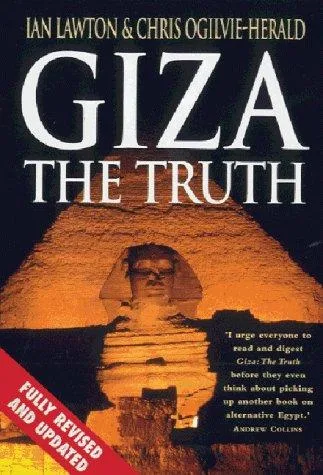
Lawton and Ogilvie-Herald's Giza examines the Great Pyramid beyond conventional history in 2005.
Published in 2005, Giza by Ian Lawton and Chris Ogilvie-Herald moves past standard historical views of the Great Pyramid of Giza. The authors investigate the monument not just as an ancient Egyptian structure, but as a site holding deep esoteric significance. They look into theories about how it was built, its intended use, and the advanced knowledge attributed to its creators. The book also covers its astronomical alignments and possible functions within ancient spiritual or cosmological frameworks.
The authors bring together a range of fringe theories and historical interpretations, presenting a broad look at the pyramid's lasting mystique. This volume is for serious researchers and enthusiasts of esoteric history, ancient puzzles, and alternative archaeology. Those interested in the Giza plateau and the Great Pyramid, especially those seeking viewpoints that question mainstream Egyptology, will find considerable information within its pages. The book will appeal to readers who value careful analysis of historical accounts, symbolic meanings, and the connection between ancient buildings and metaphysical ideas.
The Great Pyramid has long attracted esoteric interest, with figures like John Taylor in the 19th century proposing unique measurements. This tradition continued with interpretations of data from Egyptologists like Flinders Petrie. Lawton and Ogilvie-Herald engage with this lineage of inquiry, synthesizing various non-mainstream theories and historical readings that explore the monument's potential hidden meanings and advanced knowledge, placing it within a broader occult philosophical discourse.
💡 Why Read This Book?
• Understand the esoteric significance of the Great Pyramid's dimensions and alignments, such as its precise cardinal orientation, which goes beyond conventional historical explanations. • Explore theories of Giza as a repository of lost ancient knowledge, including its potential encoding of mathematical constants and astronomical data, as detailed in the book's sections on sacred geometry. • Gain insight into the historical development of Giza's esoteric interpretations, tracing ideas from 19th-century researchers like John Taylor to more modern speculative frameworks.
⭐ Reader Reviews
Honest opinions from readers who have explored this book.
❓ Frequently Asked Questions
What is the primary focus of the book "Giza" by Ian Lawton and Chris Ogilvie-Herald?
The book "Giza" focuses on the Great Pyramid of Giza, exploring its esoteric significance, potential for encoded knowledge, and its place within ancient mystery traditions, rather than solely adhering to mainstream Egyptological views.
Does "Giza" discuss theories about the construction of the Great Pyramid?
Yes, the work examines various theories regarding the construction of the Great Pyramid, including speculative ideas about advanced ancient technologies and knowledge attributed to its builders.
What historical periods or figures are relevant to the esoteric interpretations presented in "Giza"?
The book references figures like 19th-century researcher John Taylor and Egyptologist Flinders Petrie, whose work, though scientific, has been interpreted esoterically, providing historical context for Giza's mystical allure.
Are there discussions about the Great Pyramid's astronomical alignments in the book?
Certainly. "Giza" extensively discusses the pyramid's precise alignment with cardinal points and its potential astronomical significance, exploring how these features might have been intentional and meaningful.
What kind of knowledge is theorized to be encoded within the Great Pyramid according to this book?
The book explores theories suggesting the pyramid encodes mathematical constants, sacred proportions, and possibly spiritual or cosmological information, reflecting a sophisticated understanding by its creators.
Is "Giza" a purely historical account of the pyramid?
No, "Giza" is not a purely historical account. It delves into esoteric interpretations, alternative theories, and metaphysical significance attributed to the Great Pyramid, extending beyond conventional archaeological findings.
🔮 Key Themes & Symbolism
Lost Ancient Knowledge
The central thesis posits the Great Pyramid as a repository for advanced wisdom lost to subsequent ages. This includes sophisticated mathematical, geometrical, and astronomical data supposedly encoded within its structure. The authors explore theories suggesting its dimensions reflect universal constants or sacred proportions, implying a profound understanding of cosmic order by its builders. This theme challenges conventional views of ancient Egyptian capabilities, suggesting a level of knowledge that could have originated from a precursor civilization or a highly developed spiritual science.
Sacred Geometry and Cosmology
This theme examines the Great Pyramid through the lens of sacred geometry, focusing on its precise measurements, alignments, and proportions. The work investigates theories that its dimensions relate to Earth's circumference, the speed of light, or other fundamental constants, suggesting a deliberate cosmological blueprint. The alignment to cardinal points and celestial bodies is analyzed for its spiritual or energetic implications, positing Giza as an instrument for understanding or interacting with universal forces. This perspective views the pyramid as a microcosm reflecting the macrocosm.
Giza as a Global Nexus
The book explores the idea of Giza not as an isolated monument, but as a key node in a worldwide network of ancient sacred sites. This concept suggests a global system designed for energy transmission, spiritual communication, or the dissemination of knowledge across continents. The authors examine the geographical placement of Giza in relation to other significant ancient locations, proposing a harmonized planetary grid. This perspective elevates the Great Pyramid's role from a regional marvel to a linchpin in a forgotten global civilization's infrastructure.
Esoteric Function and Purpose
Beyond the tomb theory, the work investigates alternative functions for the Great Pyramid, such as a temple, an initiation center, or a spiritual device. The unique architecture, particularly the Grand Gallery and King's Chamber, is analyzed for its potential role in ritual or transformative processes. This theme explores interpretations that the pyramid was designed to facilitate spiritual awakening, attunement with cosmic energies, or as a physical representation of spiritual ascent. The focus is on its active rather than passive role in ancient life.
💬 Memorable Quotes
Direct passages from the work, attributed to the author.
“The pyramid's dimensions are not arbitrary; they are a language speaking of cosmic truths.”
— This interpretation highlights the core belief that the Great Pyramid's physical form contains a coded message. It suggests that its size, proportions, and placement are deliberate expressions of universal laws and spiritual principles, intended to be deciphered by those with the right knowledge.
“Giza stands as a marker, a point of convergence for ancient energies and knowledge systems.”
— This statement frames the Great Pyramid as more than just a structure; it's presented as a functional element within a larger, potentially global, esoteric framework. It implies Giza served as a hub for the transmission or activation of spiritual or energetic forces.
“Conventional Egyptology explains the 'how' but misses the profound 'why' of the Great Pyramid.”
— This sentiment underscores the book's departure from mainstream archaeology. It argues that while scientific explanations for construction might exist, they fail to address the deeper, perhaps spiritual or cosmic, purpose attributed to the monument by esoteric traditions.
“The builders possessed knowledge that transcended their time, perhaps even ours.”
— This statement emphasizes the perceived advanced nature of the pyramid's creators. It implies a level of scientific, spiritual, or technological understanding so sophisticated that it seems almost alien or lost, suggesting a forgotten golden age of human capability.
💡 Key Ideas
Editorial paraphrase of the work's core concepts — not direct quotes.
The geometry of the pyramid reflects the geometry of the heavens and the human spirit.
This quote connects the physical structure of the pyramid to both celestial order and inner human experience. It suggests a fundamental correspondence between the microcosm (humanity/pyramid) and the macrocosm (universe), a key tenet in many esoteric philosophies.
🌙 Esoteric Significance
Tradition
The work engages primarily with the Western esoteric tradition, particularly its modern manifestations influenced by Theosophy, Hermeticism, and alternative archaeology. It draws from a long line of interpretation that views ancient monumental structures as more than mere historical artifacts, but as embodiments of spiritual science and cosmic principles. This perspective often aligns with the search for a 'perennial wisdom' or a lost Atlantean civilization, viewing Giza as a key physical manifestation of such ancient knowledge.
Symbolism
Central symbols include the pyramid itself, representing stability, ascension, and the union of earthly and divine principles. The number Pi and the Golden Ratio (Phi) are discussed as crucial geometrical constants encoded within its dimensions, symbolizing universal order. Celestial alignments, particularly with cardinal directions and specific stars, represent cosmic harmony and the ancient understanding of astronomical cycles as divine patterns.
Modern Relevance
Contemporary thinkers and practitioners in fields like sacred geometry, consciousness studies, and fringe archaeology continue to reference and build upon the ideas explored in "Giza." Its synthesis of various theories makes it a valuable resource for those exploring the energetic properties of ancient sites, the potential for lost advanced civilizations, and the intersection of mathematics, astronomy, and spirituality in ancient cultures.
👥 Who Should Read This Book
• Researchers of ancient mysteries and alternative archaeology seeking a comprehensive overview of Giza's esoteric interpretations. • Students of sacred geometry and cosmology interested in the mathematical and astronomical theories surrounding the Great Pyramid. • Enthusiasts of esoteric history looking to understand how the Giza plateau has been viewed through a metaphysical lens across different eras.
📜 Historical Context
Published in 2000, "Giza" emerged during a period of renewed popular interest in ancient mysteries and alternative history, fueled by the rise of the internet and accessible publishing. This era saw continued engagement with the legacy of 19th-century figures like John Taylor and the mathematical interpretations of figures like William Flinders Petrie, whose meticulous surveys of the Giza plateau in the 1880s provided foundational data. Esoteric interpretations of the pyramid had long been debated, with key works by authors such as Ignatius Donnelly (1883) and later volumes by authors like Graham Hancock (1995) challenging conventional timelines and narratives. Lawton and Ogilvie-Herald's work fits within this lineage, synthesizing various speculative theories and presenting them within a framework that emphasizes the pyramid's esoteric and cosmological significance, often in contrast to the more conservative views of mainstream Egyptology.
📔 Journal Prompts
The pyramid's encoded mathematical language: What specific constants or ratios are discussed, and how do they suggest a universal design?
Analyze the concept of Giza as a global nexus. How might this monumental structure have served as a point of connection in an ancient world system?
Consider the esoteric purpose of the Great Pyramid. If not a tomb, what spiritual or initiatory functions might its architecture have served?
Reflect on the historical shift in interpreting Giza, moving from archaeological fact to esoteric speculation, as detailed in the book.
Examine the symbolism of the pyramid's cardinal alignment. What does this precision imply about the builders' worldview and their relationship with the cosmos?
🗂️ Glossary
Pyramid inch
A unit of measurement, theorized by 19th-century researchers like John Taylor, purportedly used in the construction of the Great Pyramid and believed to relate to divine or cosmic proportions.
Sacred Geometry
The study of geometrical forms and proportions believed to have divine or symbolic significance, often applied to ancient architecture and natural phenomena.
Cardinal Alignment
The precise orientation of the Great Pyramid's sides to the four cardinal directions (North, South, East, West), considered by many researchers to be intentional and significant.
Grand Gallery
A large, ascending passage within the Great Pyramid, whose unique structure and dimensions have led to various esoteric theories about its function, such as an initiation chamber.
Cosmic Constants
Fundamental mathematical or physical values believed to be inherent in the universe, which some theories suggest are encoded within the dimensions of the Great Pyramid.
Esoteric Interpretation
An understanding of a subject that goes beyond its literal or exoteric meaning, focusing on hidden, spiritual, or symbolic significance, often within mystical or occult traditions.
Perennial Wisdom
A philosophical concept suggesting that all major religions and spiritual traditions share a common source or underlying truth, often associated with ancient, lost civilizations.
🔮 Readers Also Liked
Browse all →









More by Ian Lawton, Chris Ogilvie-Herald
All books →
More Free Occult Philosophy Books
View all →