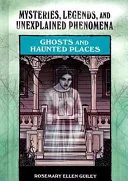
Ghosts and Haunted Places
 78
78

Ghosts and Haunted Places
Rosemary Ellen Guiley's "Ghosts and Haunted Places" stands as a thorough compendium, though its ambition sometimes outstrips its execution. Guiley’s strength lies in her broad synthesis of historical accounts, folklore, and contemporary investigation methods. She commendably avoids sensationalism, presenting a measured approach to a subject often mired in it. A particularly effective section details the evolution of ghost-hunting technology from early EMF meters to more complex recording devices, illustrating the scientific bent she applies. However, the sheer breadth of topics covered means that some areas, such as the scientific explanations for perceived hauntings, feel somewhat underdeveloped. Guiley’s insistence on the reality of ghosts, while central to her thesis, occasionally leads to interpretations that favor the paranormal over more conventional psychological or environmental explanations without fully engaging with counterarguments. Ultimately, it's a valuable resource for those seeking a detailed overview of ghostlore, albeit one that could benefit from deeper critical engagement with alternative viewpoints.
📝 Description
78
Rosemary Ellen Guiley's 2008 book examines spectral phenomena beyond simple ghost stories.
Published in 2008, Rosemary Ellen Guiley's "Ghosts and Haunted Places" moves beyond sensationalism to investigate spectral phenomena. The work considers historical accounts, folklore, and modern technology, alongside personal testimonies. Guiley questions the nature of lingering presences, considering if they are echoes of consciousness, temporal distortions, or psychological effects.
This book is for serious paranormal investigators, folklorists, and anyone interested in the enduring human fascination with ghosts. It appeals to those who prefer detailed analysis to sensationalism and who are open to academic, historical, and experiential viewpoints. Readers interested in the connections between consciousness, location, and unexplained events will find significant content.
Guiley's work emerges from a long tradition of ghostlore, tracing back to ancient beliefs in spirits and the 19th-century Spiritualist movement. While acknowledging scientific skepticism, the book integrates contemporary scientific inquiry and technology, distinguishing it from earlier, purely anecdotal or religiously focused accounts. It addresses the widespread experiential data surrounding apparitions, seeking to understand their origins within a framework that includes both historical belief and modern investigation.
💡 Why Read This Book?
• Gain an understanding of the distinction between residual hauntings and intelligent hauntings, a core concept Guiley explores to categorize spectral phenomena. • Learn about the historical evolution of ghost investigation techniques, tracing advancements from early folklore to the technological tools discussed in the book. • Explore the concept of "thin places," a specific term Guiley uses to describe locations where paranormal activity is more likely to occur, offering a unique perspective on haunted geography.
⭐ Reader Reviews
Honest opinions from readers who have explored this book.
❓ Frequently Asked Questions
What is Rosemary Ellen Guiley's primary thesis regarding ghosts?
Guiley posits that ghosts are real phenomena, often linked to strong emotional imprints or residual energies in specific locations, and she examines this from historical, scientific, and experiential viewpoints.
Does "Ghosts and Haunted Places" offer scientific explanations for hauntings?
Yes, the book explores scientific theories and technologies related to paranormal investigation, including environmental factors and psychological influences, though it also considers non-material explanations.
What types of haunted places are discussed in the book?
The book covers a wide range of haunted locations, from historical buildings and public spaces to personal residences, often detailing specific case studies and the lore associated with them.
When was "Ghosts and Haunted Places" first published?
The book was first published in 2008, reflecting contemporary approaches to paranormal research and understanding.
How does Guiley differentiate between different types of ghosts?
Guiley distinguishes between residual hauntings (imprinted energies) and intelligent hauntings (conscious spirits), a key analytical framework within the book.
Is this book suitable for beginners in paranormal studies?
Yes, it serves as a comprehensive introduction, offering a balanced view of folklore, personal experience, and investigative techniques for those new to the subject.
🔮 Key Themes & Symbolism
The Nature of Apparitions
The book systematically dissects the various forms apparitions can take, from fleeting apparitions to full-bodied spectral figures. Guiley examines the concept of "residual hauntings," where environments retain energetic imprints of past events or emotions, akin to a recording playing back. This contrasts with "intelligent hauntings," which suggest conscious entities interacting with the living. The work scrutinizes how folklore and personal experience shape our understanding of these phenomena, questioning whether what we perceive is a direct manifestation or an interpretation filtered through cultural narratives.
Haunted Locations and "Thin Places"
Central to Guiley's exploration is the idea that certain places possess a unique energetic quality conducive to hauntings. The concept of "thin places"—locations where the veil between the physical and spiritual realms is perceived to be weaker—is a recurring motif. The book details numerous case studies of historically significant or emotionally charged locations, analyzing environmental factors, historical events, and collective belief systems that contribute to their spectral reputation. It moves beyond mere anecdote to investigate potential underlying principles governing why some places become loci of paranormal activity.
Science and Technology in Investigation
Guiley addresses the role of modern science and technology in ghost hunting, a significant development since earlier eras of paranormal inquiry. The work reviews various tools, from electromagnetic field (EMF) meters and audio recorders to thermal imaging cameras, examining their utility and limitations. It discusses how scientific methodology, even when applied to the seemingly unscientific, attempts to bring empirical data to bear on ghostly phenomena. This section reflects the 2008 publication date, incorporating the technological field of the time.
Psychological and Experiential Dimensions
Beyond external phenomena, "Ghosts and Haunted Places" examines the psychological field of those who experience hauntings. Guiley considers factors like suggestion, expectation, and the human brain's predisposition to find patterns. However, she balances this by validating the lived experiences of individuals, arguing that subjective accounts, while potentially influenced by psychology, represent a significant body of evidence for the reality of hauntings. The book explores how personal beliefs and emotional states can interact with perceived spectral activity.
💬 Memorable Quotes
Direct passages from the work, attributed to the author.
“Ghosts are the single most common paranormal experience.”
— This statement, appearing early in the book, establishes the prevalence of ghost sightings and hauntings, framing them as a widespread human phenomenon worthy of serious investigation.
“Are ghosts real, are they imagined, or are they some weird aberration of time and space?”
— This rhetorical question captures the book's central inquiry, highlighting the different theoretical frameworks Guiley intends to explore, from material to metaphysical explanations for spectral encounters.
“Featuring accounts of true cases and scenarios.”
— This indicates that the book grounds its theoretical discussions in real-world examples, providing readers with concrete instances of hauntings to analyze and consider.
“The major themes in ghostlore will be explored.”
— This suggests a thematic analysis, moving beyond individual stories to identify recurring patterns and core ideas that define the study and experience of ghosts across cultures and time.
💡 Key Ideas
Editorial paraphrase of the work's core concepts — not direct quotes.
The work will examine the history, folklore, science, technology, and personal experience of ghosts and hauntings.
This paraphrased statement outlines the multi-disciplinary approach Guiley takes, promising a comprehensive overview that integrates academic research with anecdotal evidence and technological advancements.
🌙 Esoteric Significance
Tradition
While not strictly adhering to a single esoteric lineage, Guiley's work draws heavily from the broader tradition of psychical research and spiritism, which gained momentum in the late 19th and early 20th centuries. This tradition often overlaps with Theosophy and other New Age philosophies in its exploration of non-physical consciousness and subtle energies. Her focus on residual energy and environmental imprints aligns with concepts found in some occult theories regarding psychic residue and the energetic imprint of events on locations.
Symbolism
A key symbolic concept explored is the "thin place," representing a threshold or veil between ordinary reality and other dimensions or states of consciousness. Ghosts themselves function as potent symbols of unresolved pasts, lingering consciousness, and the liminal spaces between life and death. The idea of "residual energy" can be seen as a symbol of memory imprinted on the fabric of reality, suggesting that significant emotional or energetic events leave an indelible mark.
Modern Relevance
Guiley's work continues to be relevant for contemporary paranormal investigators, ghost tour operators, and researchers exploring anomalous phenomena. Her systematic approach to categorizing hauntings and her integration of technology find echoes in modern ghost-hunting teams and their evolving methodologies. Thinkers interested in consciousness studies, environmental psychology, and the intersection of belief and perception also find value in her comprehensive overview of a persistent human fascination.
👥 Who Should Read This Book
• Amateur paranormal investigators seeking a structured framework for understanding different types of hauntings and investigative techniques. • Folklore students and cultural historians interested in the evolution of ghost stories and their societal impact across different eras. • Skeptics and believers alike who wish to engage with a comprehensive overview that balances anecdotal evidence with scientific and technological considerations.
📜 Historical Context
Published in 2008, Rosemary Ellen Guiley's "Ghosts and Haunted Places" arrived during a resurgence of interest in paranormal investigation, fueled by television programs and online communities. The book positioned itself within a lineage of ghostlore that spans centuries, from ancient beliefs in spirits to the 19th-century Spiritualist movement, which saw figures like Allan Kardec systematically documenting phenomena. Guiley's approach distinguished itself by integrating contemporary scientific inquiry and technology, a departure from earlier, more purely anecdotal or religiously framed accounts. While the Enlightenment had fostered skepticism, and contemporary scientific discourse often prioritized empirical evidence, Guiley's work engaged with the widespread experiential data of hauntings. It acknowledged the scientific challenges but sought to provide a comprehensive framework that included both materialist and metaphysical perspectives, reflecting a growing willingness in some academic circles to examine anomalous experiences.
📔 Journal Prompts
The concept of "thin places" and their potential for spectral manifestation.
Residual hauntings versus intelligent hauntings: personal observations and theories.
The historical evolution of ghost-hunting technology as described in the book.
Personal experiences or folklore related to specific haunted locations mentioned.
The intersection of psychological expectation and perceived paranormal activity.
🗂️ Glossary
Residual Haunting
A type of haunting where an environment appears to replay past events or exhibit imprinted energies, often without conscious interaction from a spirit.
Intelligent Haunting
A haunting attributed to conscious spirits or entities that interact with the living, responding to questions or demonstrating awareness.
Thin Place
A location believed to have a permeable boundary between the physical world and other realms, making paranormal activity more likely.
EMF Meter
An electronic measuring instrument that detects and measures electromagnetic fields, often used by paranormal investigators.
Psychical Research
The study of paranormal and psychic phenomena, including telepathy, clairvoyance, and hauntings, often employing scientific methods.
Ghostlore
The body of folklore, myths, legends, and beliefs surrounding ghosts and spectral apparitions.
Temporal Aberration
A deviation or anomaly in the normal flow or perception of time, sometimes theorized as a cause or component of hauntings.