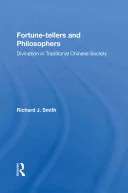
Fortune-tellers and Philosophers
 75
75

Fortune-tellers and Philosophers
Richard J. Smith’s "Fortune-tellers and Philosophers" offers a rare, scholarly look at Chinese divination, treating it with the intellectual seriousness it warrants. Smith’s strength lies in his exhaustive cataloging of mantic arts, moving beyond the familiar I Ching to encompass geomancy and physiognomy with equal rigor. He effectively dismantles the Western tendency to dismiss divination as primitive, instead positioning it as a complex epistemological tool integral to Chinese intellectual history. A slight limitation is the sheer density of information, which occasionally makes the narrative feel more like an encyclopedic reference than a flowing argument, particularly in the detailed explanations of various astrological charts. However, the section examining meteorological divination as a means of political commentary is particularly illuminating, showcasing how celestial events were interpreted to reflect earthly power dynamics. This work is a vital resource for understanding Chinese cosmology.
📝 Description
75
Richard J. Smith's 2008 book examines Chinese divination not as superstition but as a framework for understanding reality.
Richard J. Smith's "Fortune-tellers and Philosophers" examines Chinese divination practices, arguing they form a sophisticated system for comprehending reality. The book details a wide array of methods, from the I Ching and geomancy to astrology, numerology, and physiognomy. It also covers less familiar forms, such as meteorological omens, spirit-writing, and dream interpretation, demonstrating the vast scope of these arts in China.
Smith places these practices within the long history of Chinese thought, showing their integration into both philosophical discussions and popular religion over centuries. He traces how divination evolved and adapted, remaining a persistent and useful tool across dynasties and social classes. The book highlights divination's role in organizing the world, aiding decisions, and facilitating communication with the unseen.
The work explains the underlying concepts that support Chinese divination, including *qi*, *yin* and *yang*, and the Five Phases (*wuxing*). These are shown to be crucial for interpreting omens and astrological charts. Smith also discusses philosophical arguments concerning divination, its relation to fate and free will, and its connection to ethical behavior, revealing its deep entanglement with Chinese intellectual life.
This book situates Chinese divination within a tradition that seeks to understand cosmic order and human destiny through symbolic systems. For millennia, practitioners in China have used methods like the I Ching, astrology, and geomancy to interpret signs and guide decisions. These practices are deeply interwoven with Chinese cosmology, often drawing on concepts like *qi* and *yin/yang* to explain the interconnectedness of all things. "Fortune-tellers and Philosophers" shows how these divinatory arts were not fringe activities but integral to philosophical discourse and social life, demonstrating a continuous engagement with the hidden forces that shape existence.
💡 Why Read This Book?
• Gain a nuanced understanding of Chinese divination as a philosophical and social system, moving beyond superficial interpretations, as detailed in Smith's analysis of the I Ching's role in organizing reality. • Discover the interconnectedness of various mantic arts—from astrology to dream interpretation—and their historical application in Chinese society, exemplified by the practices described in chapters on geomancy and physiognomy. • Appreciate divination not as superstition, but as a method for understanding cosmology and human agency, particularly through Smith's exploration of meteorological divination's function in political discourse.
⭐ Reader Reviews
Honest opinions from readers who have explored this book.
❓ Frequently Asked Questions
What is the primary focus of Richard J. Smith's "Fortune-tellers and Philosophers"?
The book primarily analyzes Chinese divination as a sophisticated method for organizing and interpreting reality, examining a wide array of mantic techniques used throughout Chinese history.
Which specific divination methods are discussed in the book?
It covers prominent methods like the I Ching and geomancy, alongside astrology, numerology, physiognomy, analysis of written characters, meteorological divination, spirit-writing, and dream interpretation.
How does Smith approach the topic of Chinese divination?
Smith approaches divination academically, presenting it as an integral part of Chinese intellectual and social history, rather than mere superstition, exploring its philosophical underpinnings.
What historical period does "Fortune-tellers and Philosophers" cover?
While not limited to a specific period, the book draws on millennia of Chinese history to demonstrate the pervasiveness and evolution of divinatory practices across different dynasties.
Who is the author, Richard J. Smith?
Richard J. Smith is a noted scholar of Chinese history and culture, specializing in Chinese popular religion, philosophy, and cosmology.
Is "Fortune-tellers and Philosophers" suitable for beginners in esoteric studies?
Yes, while scholarly, the book provides foundational explanations of concepts like the I Ching and yin/yang, making it accessible to those new to Chinese esoteric traditions.
🔮 Key Themes & Symbolism
Divination as Epistemology
Smith argues that Chinese divination systems functioned as sophisticated epistemological frameworks, providing methods for acquiring knowledge and understanding the world. This perspective elevates practices like interpreting the I Ching or celestial omens from mere superstition to structured approaches for ordering experience and making sense of complex realities. The book details how these systems offered a means to discern patterns, predict outcomes, and navigate uncertainty, deeply embedding themselves within Chinese philosophy and daily life.
Integration of Mantic Arts
A core theme is the pervasive and often intertwined nature of various divinatory techniques in China. Smith illustrates how practices such as geomancy (siting), astrology, numerology, and physiognomy were not isolated disciplines but frequently operated in concert. This interconnectedness allowed for a multi-layered interpretation of events and individuals, demonstrating a holistic worldview where the terrestrial, celestial, and human realms were seen as deeply related through symbolic correspondences.
Social and Philosophical Function
Beyond mere prediction, the book explores the crucial social and philosophical roles divination played. It served as a mechanism for legitimizing political power, guiding personal decisions, and reinforcing cultural values. Smith examines how these practices engaged with enduring philosophical questions about fate, free will, and the human relationship to the cosmos, showing their significance in both elite intellectual circles and popular religious expression across centuries of Chinese history.
The I Ching's Centrality
While covering a broad spectrum of mantic arts, the I Ching (Book of Changes) occupies a central position in Smith's analysis. He presents it as a foundational text and symbolic system that profoundly influenced other divinatory methods. The book elucidates how the I Ching's hexagrams and associated commentaries provided a conceptual language and interpretive methodology that permeated Chinese thought and practice for over two millennia.
💬 Memorable Quotes
Direct passages from the work, attributed to the author.
“Divination served as a means of organizing and interpreting reality.”
— This concise statement captures the book's central thesis: that Chinese divination was not random but a structured intellectual system for understanding the world and one's place within it.
“The pervasiveness and tenacity of divination in China.”
— This phrase highlights the enduring and widespread nature of divinatory practices across all levels of Chinese society and throughout its long history, emphasizing their deep cultural roots.
“Analysis of meteorological divination and its political implications.”
— This points to a specific, less common form of divination explored in the book, suggesting its use not just for personal fortune but also for interpreting and commenting on statecraft and political events.
“Integration of the I Ching with geomancy and astrology.”
— This highlights the interconnectedness of different divinatory systems discussed, showing how core concepts from the I Ching were applied or synthesized with other practices like siting and celestial observation.
“Divination as a tool for decision-making and ordering experience.”
— This interpretation emphasizes the practical application of divination, positioning it as a vital resource for individuals and rulers seeking guidance and clarity in ambiguous situations.
🌙 Esoteric Significance
Tradition
This work fits within the broader context of comparative esoteric studies, analyzing practices that, while originating in Chinese culture, share common ground with Western Hermeticism and Neoplatonism in their search for cosmic correspondences and hidden orders. It examines how these systems attempt to map the macrocosm onto the microcosm, a fundamental Hermetic principle, though rooted in distinctly Chinese philosophical frameworks like *qi* and *yin/yang*.
Symbolism
Key symbols include the hexagrams of the I Ching, representing dynamic states of change and the interplay of forces, and the concept of *feng shui* (geomancy), which involves the symbolic arrangement of the environment to harmonize with natural energies. These symbols are not merely decorative but are integral to the interpretive logic of the divinatory systems, acting as conduits for understanding cosmic patterns.
Modern Relevance
Contemporary practitioners of traditional Chinese medicine, Feng Shui consultants, and students of I Ching divination draw directly from the methodologies and historical understanding presented in Smith's work. His detailed analysis provides a scholarly foundation for modern practitioners seeking to deepen their understanding of these ancient arts and their philosophical underpinnings.
👥 Who Should Read This Book
• Scholars of East Asian religions and philosophies seeking a comprehensive overview of Chinese divinatory practices and their intellectual history. • Students of comparative divination and occult traditions interested in understanding non-Western mantic systems and their frameworks for interpreting reality. • General readers curious about the historical role of astrology, geomancy, and other fortune-telling methods in shaping culture and decision-making within Chinese society.
📜 Historical Context
Published in 2021, Richard J. Smith’s "Fortune-tellers and Philosophers" emerged in an academic landscape increasingly interested in the history of science, magic, and religion. Smith’s work engages with a long tradition of scholarship on Chinese thought, building upon foundational studies of Confucianism, Daoism, and Chinese cosmology. His meticulous examination of divination contrasts with earlier, often dismissive, Western interpretations that relegated these practices to mere superstition. The book implicitly addresses the intellectual currents of Sinology, offering a nuanced view that integrates popular beliefs with elite philosophical discourse. While not directly engaging with a specific contemporary antagonist, Smith’s detailed analysis implicitly counters simplistic understandings prevalent in both academic and popular spheres, demonstrating the intellectual rigor inherent in Chinese mantic traditions.
📔 Journal Prompts
The concept of divination as a means of organizing reality.
The integration of the I Ching with other mantic arts.
The pervasiveness and tenacity of divination across Chinese history.
Interpreting meteorological divination for political commentary.
The philosophical underpinnings of physiognomy.
🗂️ Glossary
I Ching (Book of Changes)
An ancient Chinese divination text and foundational work of Chinese philosophy, used to understand cosmic patterns and make decisions through the interpretation of 64 hexagrams.
Geomancy (Siting)
A method of divination based on interpreting landforms and the flow of *qi* (vital energy) in the environment, often associated with Feng Shui principles.
Astrology (Chinese)
Systems of divination that interpret celestial bodies and phenomena, including planetary positions, constellations, and comets, to understand earthly events and human destiny.
Numerology
The study of the mystical or divine relationship between numbers and events, used in Chinese contexts to interpret auspiciousness and meaning.
Physiognomy
The practice of assessing character or personality from outward appearance, particularly the features of the face.
Qi (Chi)
A fundamental concept in Chinese philosophy representing vital life force or energy that flows through all things.
Yin and Yang
The Taoist concept of complementary, interconnected, and interdependent forces that describe the nature of reality and influence all phenomena.
This book appears in 1 collection
🔮 Readers Also Liked
Browse all →








From the “Divination” Collection
View all →








More Free Divination & Tarot Books
View all →