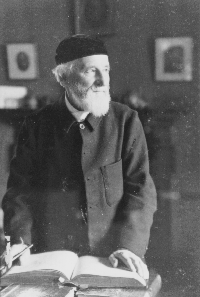
Edwin Abbott Abbott
Edwin Abbott Abbott was an English educator and theologian, celebrated for his novella 'Flatland' exploring dimensions.
Edwin Abbott Abbott was an English educator, theologian, and priest, born in London in 1838 and passing in 1926. He received a distinguished education at the City of London School and St John's College, Cambridge, excelling in classics, mathematics, and theology, and becoming a fellow of his college. Abbott dedicated much of his life to education, serving as headmaster of the City of London School from a young age and overseeing the education of notable figures. His career also included theological pursuits, marked by an open-minded approach evident in his writings. He retired from teaching to focus on literary and theological work.
Abbott is most widely recognized for his 1884 novella, 'Flatland: A Romance of Many Dimensions.' This work, often categorized as "mathematical fiction" or science fiction, presents a world with two dimensions and delves into the concept of dimensions. 'Flatland' has experienced a resurgence in popularity since the mid-20th century, influencing subsequent works in science fiction and inspiring sequels and films. Beyond 'Flatland,' Abbott authored a range of scholarly works, including 'Shakespearian Grammar,' theological writings, and educational texts, demonstrating a broad intellectual range.
Literary and Theological Contributions
Following his retirement from headmastership in 1889, Edwin Abbott Abbott dedicated himself to literary and theological endeavors. His theological views were characterized by an open-mindedness that influenced both his educational philosophy and his written works. Abbott made significant contributions to English philology with his "Shakespearian Grammar" (1870). He also published a biography of Francis Bacon in 1885. His theological writings include anonymously published religious romances such as "Philochristus" (1878), "Onesimus" (1882), and "Silanus the Christian" (1908), which aimed to encourage engagement with the Gospels. More substantial theological works include the anonymous "The Kernel and the Husk" (1886), "Philomythus" (1891), and "The Anglican Career of Cardinal Newman" (1892). His critical examination of "The Gospels" in the Encyclopædia Britannica also generated considerable discussion within theological circles. Abbott's scholarly output extended to studies on St. Thomas of Canterbury and linguistic analyses like "Johannine Vocabulary" (1905) and "Johannine Grammar" (1906).
Flatland: A Dimensional Exploration
Edwin Abbott Abbott's most enduring legacy is the novella "Flatland: A Romance of Many Dimensions," published in 1884. This imaginative work describes a world existing in two dimensions and serves as a vehicle for exploring the nature of dimensions and perception. While frequently classified as science fiction, "Flatland" is perhaps more accurately described as "mathematical fiction" due to its rigorous exploration of geometric and dimensional concepts. The novella gained renewed prominence from the 1950s onward, resonating particularly with science fiction enthusiasts and cyberpunk subcultures. Its influence has been far-reaching, inspiring numerous literary sequels, short films, and other creative works that build upon its foundational ideas about higher dimensions and spatial understanding.
Books by Edwin Abbott Abbott
2 free public domain books · Read online or download