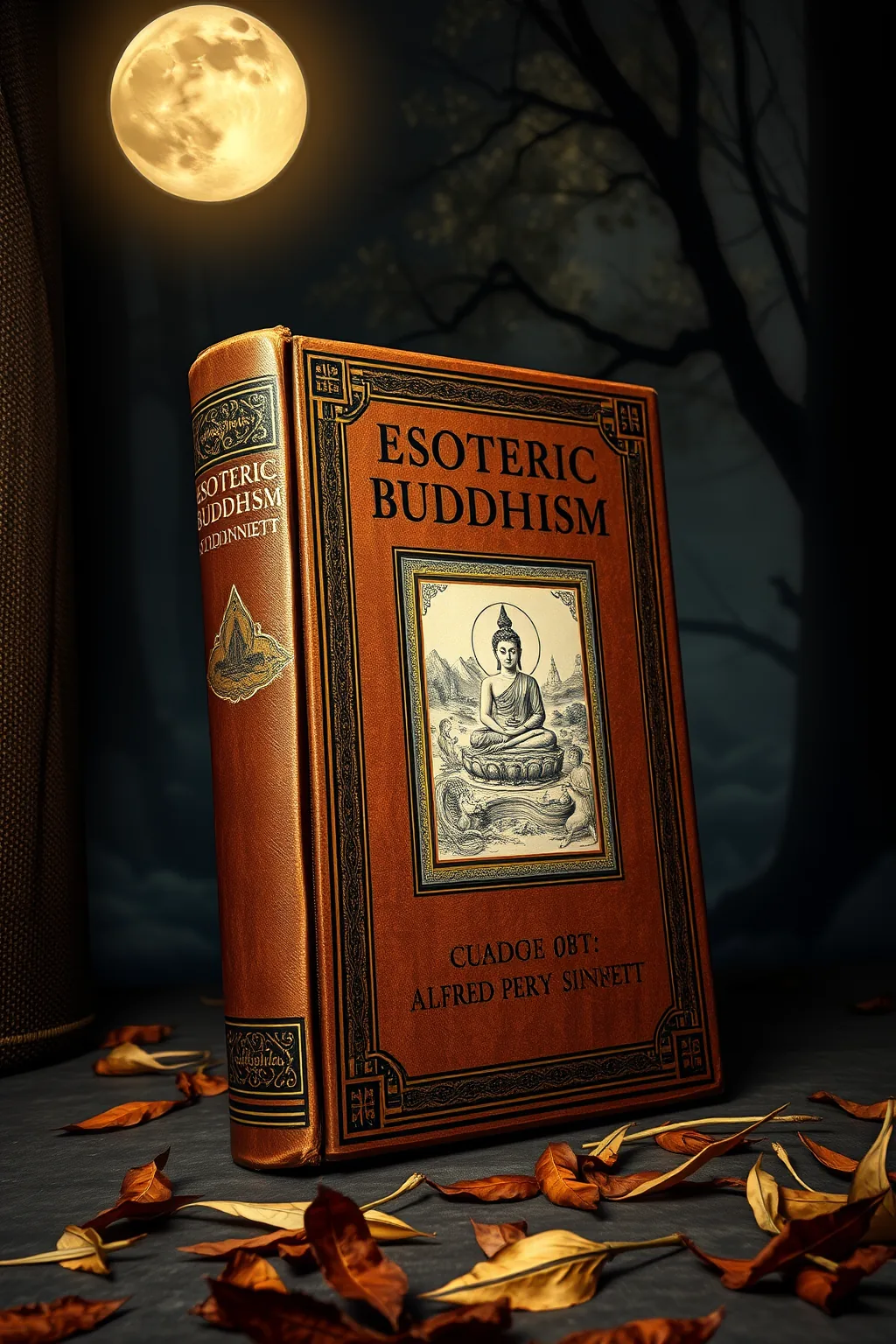
Esoteric Buddhism
 80
80

Esoteric Buddhism
Sinnett's 'Esoteric Buddhism' is less a scholarly examination and more a direct transcript of what he understood to be profound teachings from Masters. Its strength lies in its raw presentation of Theosophical bedrock concepts – the sevenfold human constitution and the elaborate cosmology of planetary chains and manvantaras are laid out with an earnestness that defined the movement's early appeal. The directness of the Mahatmas' purported guidance, filtered through Sinnett's journalistic clarity, makes complex ideas accessible, albeit in a system-building rather than experiential manner. However, the book's primary limitation is its historical specificity; it is intrinsically tied to the Theosophical Society's nascent phase. A passage detailing the 'progress of humanity' through various stages, while informative, can feel dated without contemporary comparative context. The work offers a foundational glimpse into a specific esoteric system, valuable for historical tracing but requiring critical engagement with later developments. It serves as a vital primary document for understanding the genesis of modern Western esoteric thought.
📝 Description
80
Published in the early 1880s, Esoteric Buddhism details teachings from the Mahatmas Koot Hoomi and Morya.
Alfred Percy Sinnett's Esoteric Buddhism communicates core tenets of Theosophy as received from the Mahatmas Koot Hoomi and Morya. The book addresses the structure of human beings, describing seven principles that constitute the individual from the physical to the spiritual. It also outlines stages of existence after death, specifically the states of Kâma-loka, the desire world, and Devachan, a state of spiritual repose. The ultimate aim discussed is Nirvana, the state of liberation.
This work is aimed at those seriously studying esoteric philosophy, particularly the origins of Theosophical thought. Readers interested in the mechanics of reincarnation, karma, and the subtle bodies will find detailed explanations. It is also relevant for those examining the late 19th century's engagement with Eastern spiritual traditions and Western occultism, as Sinnett's correspondence forms the basis of the book. The author, a British journalist, was a significant figure in disseminating these ideas.
Esoteric Buddhism emerged from the letters exchanged between Alfred Percy Sinnett and the Mahatmas Koot Hoomi and Morya, figures central to the early Theosophical Society. This period in the early 1880s saw a growing interest in Eastern religions within Western occult circles, partly influenced by Helena Blavatsky. Sinnett's book became a primary source for Theosophical doctrines concerning human constitution and cosmic evolution, bridging Eastern metaphysical concepts with a Western audience. It presented a structured interpretation of reincarnation and karma, distinct from purely religious dogma.
💡 Why Read This Book?
• Gain insight into the early Theosophical framework for the human constitution, detailing the distinct planes of consciousness like Kâma-loka and Devachan as explained in Sinnett's correspondence with the Mahatmas. • Understand the cyclical view of cosmic and human evolution presented in the early 1880s, focusing on concepts like planetary chains and world periods that Sinnett received directly. • Explore the foundational ideas of esoteric Buddhism as interpreted by Alfred Percy Sinnett, including the nature of Nirvana and the evolutionary path toward spiritual attainment.
⭐ Reader Reviews
Honest opinions from readers who have explored this book.
❓ Frequently Asked Questions
When was Alfred Percy Sinnett's 'Esoteric Buddhism' first published?
Alfred Percy Sinnett's 'Esoteric Buddhism' was first published on November 16, 2013, though its genesis lies in correspondences from the early 1880s.
Who were the Mahatmas Koot Hoomi and Morya?
Koot Hoomi and Morya were purported spiritual Masters who corresponded with Alfred Percy Sinnett in the early 1880s, sharing esoteric teachings that formed the basis of Theosophy.
What is Kâma-loka according to 'Esoteric Buddhism'?
Kâma-loka is described as a post-mortem plane of existence, often translated as the 'desire world,' where the lower principles of a deceased individual linger before dissolution or transition.
What does 'Esoteric Buddhism' say about the human constitution?
The book details a sevenfold human constitution, outlining physical, astral, and various mental/spiritual principles that evolve and function across different planes of existence.
Is 'Esoteric Buddhism' a primary text for Theosophy?
Yes, 'Esoteric Buddhism' is considered a foundational text, presenting core Theosophical doctrines derived from direct correspondence with the Mahatmas in the early 1880s.
What is Devachan as presented in this book?
Devachan is presented as a post-mortem state of spiritual rest and happiness, a 'heaven-world' where the higher principles of a person experience the results of their earthly good deeds before rebirth.
🔮 Key Themes & Symbolism
The Seven Principles of Man
This work systematically outlines the complex structure of the human being as understood within esoteric traditions. It posits seven distinct principles, or sheaths, ranging from the physical body (Sthula Sharira) to the higher spiritual aspects (Atma, Buddhi, Manas). Understanding these principles is crucial for comprehending individual spiritual evolution and the process of death and rebirth, as detailed through the Mahatmas' teachings to Sinnett in the early 1880s.
Cosmic Evolution and Cycles
Esoteric Buddhism provides a sweeping view of universal cycles, introducing concepts like 'Manvantaras' (periods of manifestation) and 'Pralayas' (periods of dissolution), and the 'Planetary Chain' of worlds. Humanity's progress is charted through successive Root Races and Rounds, illustrating a grand, cyclical unfolding of consciousness across vast epochs, as communicated by Koot Hoomi and Morya.
Post-Mortem Existence
The book offers detailed explanations of the states of existence following physical death. It delineates the nature of Kâma-loka, the area of desire where residual energies persist, and Devachan, a state of spiritual beatitude and rest. This framework addresses the nature of consciousness and personal identity after the dissolution of the physical form.
The Path to Nirvana
Central to the work is the concept of Nirvana, presented not as annihilation but as the ultimate state of spiritual liberation and peace attainable through evolutionary progression. The example of the Buddha serves as a paradigm for this journey, illustrating the potential for humanity to transcend the cycles of suffering and rebirth.
💬 Memorable Quotes
Direct passages from the work, attributed to the author.
“The Masters gave Sinnett the basic ideas of Theosophy on the constitution of man, the planetary chain, the world periods, life after death in Devachan and Kâma-loka, the progress of humanity, Buddha and Nirvana.”
— This summary highlights the core teachings Sinnett received, emphasizing the foundational nature of these concepts for the burgeoning Theosophical movement and its unique cosmological and anthropological views.
“The early 1880s saw A.P. Sinnett correspond with the Mahatmas Koot Hoomi and Morya.”
— This factual anchor pinpoints the historical period and key figures involved, establishing the direct channel through which these esoteric doctrines were purportedly transmitted to the West.
“Sinnett was a British journalist and occultist involved in the Theosophical Society's first generation.”
— This statement contextualizes Sinnett's role and background, identifying him as a key intermediary figure in disseminating Theosophical ideas during its formative years.
“The work explores the progress of humanity through vast cosmic cycles and evolutionary stages.”
— This interpretation focuses on the grand scale of the teachings, emphasizing the evolutionary perspective that views human development as part of a much larger, cyclical universal process.
💡 Key Ideas
Editorial paraphrase of the work's core concepts — not direct quotes.
The book details the structure of the human constitution, the stages of post-mortem existence in Devachan and Kâma-loka, and the ultimate goal of Nirvana.
This paraphrase expresses the thematic scope of the work, focusing on its exploration of human anatomy beyond the physical and the journey of the soul through different states of consciousness.
🌙 Esoteric Significance
Tradition
This work is a core part of the Theosophical tradition, a Western esoteric lineage heavily influenced by Hinduism and Buddhism but reinterpreted through a specific cosmological and evolutionary lens. It departs from traditional Buddhism by emphasizing a detailed, sevenfold human constitution and a complex system of planetary and human evolution governed by laws of karma and reincarnation, as communicated by the Mahatmas.
Symbolism
The concept of the 'Planetary Chain' functions as a primary symbol, representing the cyclical journey of globes and humanity through vast cosmic periods. The seven 'Principles of Man' serve as another symbolic map, detailing the different levels of consciousness and being, from the dense physical to the subtle spiritual, guiding understanding of life, death, and rebirth.
Modern Relevance
Contemporary esoteric schools and individual practitioners of Western esotericism, particularly those within or influenced by Theosophy, continue to draw upon Sinnett's foundational concepts. Thinkers exploring consciousness studies, comparative religion, and the evolution of spirituality often reference the frameworks presented here for understanding reincarnation, karma, and subtle body anatomy.
👥 Who Should Read This Book
• Students of Theosophy's origins: Those seeking to understand the direct teachings received by early Theosophists like A.P. Sinnett, including the core doctrines of reincarnation and cosmic evolution. • Comparative religion scholars: Researchers interested in the late 19th-century synthesis of Western occultism with Eastern philosophies, particularly Buddhist concepts as adapted into a Western esoteric framework. • Seekers of esoteric cosmology: Individuals drawn to detailed explanations of spiritual evolution, the structure of consciousness (Devachan, Kâma-loka), and humanity's place within vast cosmic cycles.
📜 Historical Context
Published in the wake of Helena Blavatsky's 'Isis Unveiled' (1877), Alfred Percy Sinnett's 'Esoteric Buddhism' appeared in 1883, a key year for the Theosophical Society. Sinnett, a journalist and editor, became a key figure through his correspondence with the Mahatmas Koot Hoomi and Morya. This era was marked by intense Western interest in Eastern philosophies, often filtered through the lens of mediums and spiritualism, but Theosophy aimed for a more systematic and philosophical presentation. Sinnett's work synthesized the Masters' teachings on reincarnation, karma, and cosmic evolution, providing a coherent framework that differentiated Theosophy from contemporary movements like the Spiritualists. While influential, these doctrines also faced skepticism, particularly from traditional religious institutions and later from scientific circles questioning their empirical basis.
📔 Journal Prompts
The seven principles of man as outlined by the Mahatmas: Reflect on how these distinct aspects might interact in daily life.
The concept of Kâma-loka and Devachan: Consider the potential energetic residues or imprints left after intense emotional experiences.
Humanity's progress through Root Races and Rounds: Ponder the evolutionary trajectory of consciousness described in the book.
The nature of Nirvana as presented: Explore what spiritual liberation means beyond mere cessation.
Sinnett's role as a conduit for Theosophical ideas: Analyze the impact of receiving esoteric teachings through a journalistic lens.
🗂️ Glossary
Mahatmas
Highly evolved spiritual beings, referred to as Masters, who purportedly communicated esoteric teachings to individuals like A.P. Sinnett in the late 19th century, forming the basis of Theosophy.
Kâma-loka
A post-mortem plane of existence, often described as the 'desire world,' where the lower, more personal aspects of a deceased individual may temporarily persist before dissolution.
Devachan
A post-mortem state of spiritual rest and happiness, a 'heaven-world' where the higher principles experience the fruition of good deeds before reincarnation.
Planetary Chain
A Theosophical concept describing a series of seven globes or worlds, through which a particular humanity evolves in successive stages across vast cosmic periods.
Manvantara
A Sanskrit term signifying a 'period of Manu,' representing a 'day of Brahma' or a vast cycle of cosmic manifestation and activity.
Nirvana
The ultimate goal in many Eastern traditions, interpreted here as a state of profound spiritual peace, liberation, and rest attainable through evolutionary progress.
Root Race
A major stage in the evolution of humanity on Earth, with each Root Race characterized by distinct physical and mental development, occurring sequentially across vast periods.