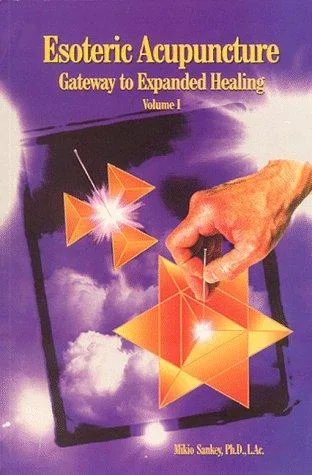
Esoteric Acupuncture
 75
75

Esoteric Acupuncture
Mikio Sankey’s Esoteric Acupuncture offers a fascinating, albeit demanding, expansion of traditional acupuncture theory. Its strength lies in its ambitious attempt to bridge the empirical world of meridians with the abstract realms of Hermeticism and astrology, presenting the body as a sacred energetic map. The concept of Acupuncture 365, linking points to the annual celestial cycle, is particularly intriguing, suggesting a profound cosmic resonance within the human form. However, the book's density can be a significant hurdle. Sankey assumes a considerable prior knowledge of both esoteric traditions and acupuncture, sometimes leaving the reader to connect very disparate dots. For instance, the chapter discussing the Kabbalistic Tree of Life's relationship to acupuncture points, while conceptually rich, requires substantial background study to fully grasp. The limitation is its accessibility; it’s a specialized text for the already initiated. Sankey’s work is a unique contribution for those willing to undertake the intellectual journey.
📝 Description
75
Mikio Sankey's Esoteric Acupuncture, first published in 2002, reinterprets acupuncture points through spiritual and psychological archetypes.
Esoteric Acupuncture moves beyond standard anatomical and energetic mapping. Sankey proposes a system where acupuncture points connect with spiritual and psychological archetypes. The book views the body as a microcosm reflecting larger patterns. It suggests energetic imbalances can be understood and treated by looking at consciousness and esoteric cosmology.
This is not simply a technical manual. It functions as a philosophical text. It examines the body's energetic pathways as channels for spiritual development. The work connects the practice of acupuncture to deeper metaphysical concepts. It aims to provide a more integrated understanding of the body's energetic system.
Published in 2002, Esoteric Acupuncture emerged as Western interest in integrative medicine and Eastern thought grew. While acupuncture discussions often focused on physiology, Sankey aligned the practice with spiritual disciplines. His work connects acupuncture to systems like Hermeticism and Gnosticism, traditions experiencing renewed attention in esoteric circles. This approach offers a counterpoint to more scientifically or TCM-focused interpretations.
💡 Why Read This Book?
• Gain a unique perspective on the body's energetic system by learning about Spiritual Anatomy, a concept that reframes acupuncture points as interfaces for consciousness beyond mere physical healing. • Understand the cosmic influence on energetic states through the Acupuncture 365 system, which maps specific points to astrological and calendrical cycles, offering a method not found in standard texts. • Explore the integration of Eastern energetic medicine with Western esoteric philosophy, specifically how principles from Hermeticism and Kabbalah are applied to acupuncture, a novel approach first explored in detail by Sankey.
⭐ Reader Reviews
Honest opinions from readers who have explored this book.
❓ Frequently Asked Questions
What is the primary difference between Esoteric Acupuncture and traditional acupuncture?
Esoteric Acupuncture, as presented by Mikio Sankey, moves beyond the purely physiological and Qi-based explanations of traditional acupuncture. It integrates Western esoteric philosophies, such as Hermeticism and Kabbalah, and astrological principles to view the body's energetic points as conduits for spiritual growth and consciousness.
When was Esoteric Acupuncture first published?
The foundational work 'Esoteric Acupuncture' by Mikio Sankey was first published in 2002, marking a significant moment for esoteric interpretations of acupuncture.
What is the 'Acupuncture 365' system?
Acupuncture 365 is a concept introduced in Esoteric Acupuncture that links specific acupuncture points to the days of the year and corresponding astrological influences, suggesting a celestial rhythm to bodily energy.
Who is Mikio Sankey?
Mikio Sankey is the author of 'Esoteric Acupuncture' and a practitioner who developed a unique system integrating acupuncture with Western esoteric traditions and consciousness studies.
Does Esoteric Acupuncture require prior knowledge of Kabbalah or Hermeticism?
While prior knowledge of Kabbalah or Hermeticism can deepen understanding, Sankey's work aims to introduce these connections. However, a foundational understanding of acupuncture principles is generally assumed for effective comprehension of the material.
What is 'Spiritual Anatomy' in the context of Esoteric Acupuncture?
Spiritual Anatomy, as explored in Sankey's book, refers to the understanding of the body's acupuncture points and meridians not just for physical health but as energetic gateways for spiritual development and consciousness exploration.
🔮 Key Themes & Symbolism
Spiritual Anatomy
This theme redefines the human body not merely as a biological organism but as a sacred energetic vessel. Sankey proposes that acupuncture points and meridians serve as interfaces for consciousness and spiritual evolution. This perspective shifts the focus from purely physical ailment management to the body's role in facilitating higher states of awareness and addressing deeper existential patterns, viewing energetic blockages as reflections of spiritual stagnation.
Acupuncture 365
This innovative system connects the cyclical nature of time and celestial movements to the energetic range of the body. By mapping specific acupuncture points to days of the year and astrological conjunctions, Sankey suggests a profound cosmic influence on our energetic states. It provides a framework for understanding how external cycles can manifest internally and how treatments can be synchronized with these universal rhythms.
Esoteric Cosmology
The book integrates principles from Western esoteric traditions, such as Hermeticism and Kabbalah, into the practice of acupuncture. It posits that the body's energetic system mirrors the macrocosm, aligning acupuncture points with archetypal forces and divine emanations. This allows for a more profound understanding of dis-ease as disharmony with universal laws and spiritual purpose.
The Body as a Microcosm
A central tenet is the ancient Hermetic principle 'As Above, So Below.' Esoteric Acupuncture views the human body as a microcosm reflecting the larger universe. Energetic imbalances or specific points on the body are seen as corresponding to cosmic structures, archetypes, or spiritual principles, offering a holistic lens for diagnosis and treatment that includes existential and spiritual dimensions.
💬 Memorable Quotes
Direct passages from the work, attributed to the author.
“The body is a map of the universe.”
— This concise statement captures the core philosophy of Esoteric Acupuncture, suggesting that the physical form and its energetic pathways are not isolated entities but reflections of the greater cosmic order.
“Acupuncture points can address karmic patterns.”
— This concept challenges conventional views by proposing that specific energetic manipulations can influence not just present physical conditions but also deep-seated karmic imprints or patterns carried through lifetimes.
“The calendar and stars inform energetic flow.”
— This refers to the Acupuncture 365 system, highlighting the belief that temporal and celestial cycles are intrinsically linked to the body's Qi and can be utilized therapeutically.
“Healing is a spiritual journey.”
— This interpretation emphasizes that for Sankey, the process of acupuncture extends beyond physical restoration; it is viewed as a pathway to spiritual growth, self-awareness, and alignment with one's higher purpose.
“Consciousness shapes energetic reality.”
— This highlights the idea that our mental and spiritual states are not separate from but actively influence our energetic constitution and physical well-being, a key aspect of Spiritual Anatomy.
🌙 Esoteric Significance
Tradition
Esoteric Acupuncture firmly situates itself within the Western Esoteric Tradition, drawing heavily from Hermeticism, Kabbalah, and Gnosticism. It synthesizes these philosophical lineages with the energetic principles of acupuncture, viewing the body's meridians and points not just as physiological pathways but as energetic gateways aligned with cosmic and spiritual archetypes. This work departs from purely TCM frameworks by imbuing each point with symbolic meaning derived from Western mystical systems, framing healing as a process of spiritual alignment.
Symbolism
Central to the book's symbolism is the concept of the Tree of Life from Kabbalah, which Sankey relates to the energetic pathways within the body, suggesting that each Sephiroth or path can be accessed or influenced through specific acupuncture points. Another key symbol is the celestial map, where acupuncture points are correlated with astrological signs and cycles, representing the 'As Above, So Below' principle and the body's resonance with universal rhythms. These symbols transform the body into a sacred diagram connecting the mundane to the divine.
Modern Relevance
Today, Esoteric Acupuncture informs contemporary practices in integrative healing, somatic psychology, and consciousness studies. Thinkers and practitioners exploring the intersection of bodywork, spirituality, and subtle energies find Sankey's framework invaluable. It influences modalities that seek to address the whole person—physical, emotional, and spiritual—by viewing the body as a locus for profound personal transformation and connection to universal consciousness.
👥 Who Should Read This Book
• Licensed acupuncturists and students seeking to deepen their practice beyond purely physical applications, by exploring the spiritual and energetic dimensions of the body. • Practitioners of Western esoteric traditions (Hermeticism, Kabbalah, Astrology) interested in applying their philosophical understanding to a tangible energetic system like acupuncture. • Comparative religion scholars and depth psychologists investigating the cross-cultural and archetypal connections between ancient healing arts and spiritual development.
📜 Historical Context
Mikio Sankey's *Esoteric Acupuncture*, published in 2002, arrived at a time when Western interest in complementary and alternative medicine was burgeoning, yet often focused on physiological explanations. While acupuncture had been integrated into Western medical discourse for decades, Sankey’s work distinguished itself by consciously aligning it with Western esoteric traditions, particularly Hermeticism and Kabbalah. This approach contrasted with the more prevalent interpretations rooted solely in Traditional Chinese Medicine (TCM) or Western scientific paradigms. The early 2000s saw a renewed exploration of consciousness studies and spiritual development, and Sankey’s book tapped into this current, offering a framework that resonated with those seeking deeper meaning in energetic practices. Unlike contemporaries who might have focused on Qi cultivation or anatomical precision, Sankey explicitly posited the body as a microcosm of cosmic order, a concept deeply embedded in Hermetic philosophy. This integration provided a novel pathway for practitioners and thinkers already engaged with esoteric studies, offering a tangible application for abstract spiritual principles.
📔 Journal Prompts
Reflect on the concept of Spiritual Anatomy and how it redefines your understanding of the body's energetic pathways.
Consider the Acupuncture 365 system: how might celestial cycles influence your personal energetic state throughout the year?
Explore the connection between a specific Kabbalistic Sephiroth and a corresponding acupuncture point discussed in the text.
How does viewing the body as a microcosm of the universe alter your perception of personal health and well-being?
Meditate on the idea that acupuncture points can address karmic patterns; what ancestral or past-life energies might be influencing you?
🗂️ Glossary
Spiritual Anatomy
The esoteric understanding of the body's energetic channels and points as interfaces for consciousness and spiritual development, extending beyond purely physical functions.
Acupuncture 365
A system developed by Mikio Sankey that maps acupuncture points to specific days of the year and astrological influences, suggesting a cosmic rhythm to bodily energy.
Microcosm/Macrocosm
The principle, central to Hermeticism, that the human being (microcosm) reflects the structure and workings of the universe (macrocosm).
Qi
The vital life force or energy that flows through the body according to traditional Chinese medicine, also central to the energetic framework of Esoteric Acupuncture.
Sephiroth
The ten emanations or attributes of God in Kabbalistic cosmology, often represented as a Tree of Life, which Sankey relates to acupuncture points.
Hermeticism
A philosophical and religious tradition based on writings attributed to Hermes Trismegistus, emphasizing esoteric knowledge, the unity of all things, and the principle of 'As Above, So Below'.
Karmic Patterns
In an esoteric context, these are imprints or tendencies carried over from past actions or experiences, which Sankey suggests can be addressed through specific acupuncture protocols.
🔮 Readers Also Liked
Browse all →








More by Mikio Sankey
All books →
More Free Occult Philosophy Books
View all →