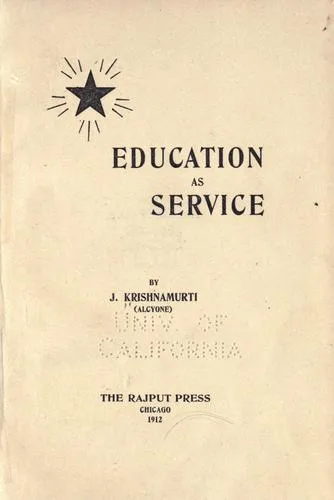
Education as service
 82
82

Education as service
Education as Service captures Jiddu Krishnamurti's persistent inquiry into the educational process, a subject he returned to throughout his life. This compilation, published in 2016, offers less a pedagogical framework and more a radical challenge to the very foundations of how we conceive of learning. Krishnamurti’s strength lies in his unwavering focus on the psychological liberation of the student, positing that true education is inseparable from self-knowledge and freedom from conditioning. A notable strength is his consistent questioning of authority and the accumulation of facts as the sole aim of schooling. However, the book’s limitation is its abstract nature; the lack of concrete examples or actionable steps for educators accustomed to practical guidance can be frustrating. One particularly arresting passage challenges the notion that 'learning to learn' is sufficient if the learner remains bound by societal conditioning. The work demands deep introspection from the reader, offering little in the way of prescriptive solutions but abundant material for contemplation.
Krishnamurti's critique of conventional education is a vital, if demanding, contribution.
📝 Description
82
Education as Service compiles Jiddu Krishnamurti's dialogues on learning, first published in 2016.
This collection presents Jiddu Krishnamurti's extended conversations and talks concerning the nature and aim of education. It addresses core questions about learning, teaching methods, and the formation of a complete human being. The book does not function as a guide for curriculum development or classroom tactics. Instead, it offers a deep look at the psychological and spiritual foundations of education. Krishnamurti questions the common focus in schooling on simply acquiring knowledge and preparing for work. He promotes an approach that encourages awareness, selfknowledge, and freedom from ingrained patterns.
His ideas challenge the typical educational structure that prioritizes exam results and rote memorization. Krishnamurti suggests that true education should lead to a transformation of consciousness, not just the transfer of information. The book contrasts this with the competitive and standardized systems prevalent today. It speaks to those who feel modern education falls short in fostering genuine human development and inner liberation.
Jiddu Krishnamurti's work on education is situated within a spiritual tradition that emphasizes direct experience and self-inquiry over dogma or external authority. His teachings, while often secular in presentation, resonate with traditions that seek inner transformation and freedom from psychological conditioning. Like certain strands of Advaita Vedanta or Zen Buddhism, Krishnamurti points to the observer and the observed, suggesting that understanding the mind's workings is central to liberation. His approach to education is less about imparting a specific doctrine and more about awakening the individual's capacity for insight and self-awareness, thereby fostering a different kind of human being.
💡 Why Read This Book?
• Learn to distinguish between the accumulation of knowledge and true psychological liberation, a core tenet of Krishnamurti's philosophy explored throughout the text. • Understand the detrimental impact of 'conditioning' on learning, a concept Krishnamurti dissects extensively, showing how societal and familial imprints hinder genuine inquiry. • Discover how 'awareness' as a practice, central to his teachings, can be the foundation of an education that fosters self-understanding rather than mere information transfer.
⭐ Reader Reviews
Honest opinions from readers who have explored this book.
❓ Frequently Asked Questions
When was Education as Service first published?
Education as Service was first published in 2016, though it compiles lectures and dialogues given by Jiddu Krishnamurti over many years.
What is Krishnamurti's main critique of traditional education?
Krishnamurti critiques traditional education for focusing on accumulating knowledge and preparing students for careers, rather than fostering psychological freedom, self-awareness, and an understanding of life's totality.
Does this book offer practical teaching methods?
No, Education as Service is not a pedagogical manual. It focuses on the underlying psychological and philosophical principles of education, prompting deep reflection rather than offering specific classroom techniques.
What does Krishnamurti mean by 'conditioning' in education?
Krishnamurti uses 'conditioning' to describe the psychological imprints from society, culture, family, and religion that shape our thoughts and perceptions, arguing that true education involves understanding and freeing oneself from this conditioning.
Who are the intended readers for Education as Service?
The book is intended for educators, parents, students of philosophy and psychology, and anyone interested in the transformative potential of learning beyond mere academic achievement.
Is this book suitable for beginners to Krishnamurti's philosophy?
While challenging, the book offers a clear entry point into Krishnamurti's core ideas on education and the mind, making it accessible to those new to his extensive body of work.
🔮 Key Themes & Symbolism
Self-Awareness and Freedom
The core of Krishnamurti's educational philosophy lies in fostering self-awareness, which he posits as the prerequisite for all genuine learning. This involves observing one's own thoughts, emotions, and reactions without judgment or the imposition of external authority. True education, in this view, is not about acquiring skills or knowledge to fit into society, but about understanding the self in its entirety – its fears, desires, and the conditioning that shapes it. This understanding leads to a state of psychological freedom, which Krishnamurti believed was the ultimate aim of education and the foundation of a harmonious individual and society.
Critique of Conditioning
Krishnamurti extensively analyzes how societal, cultural, religious, and familial conditioning limits the mind's capacity for original thought and direct perception. He argues that conventional education systems often reinforce this conditioning by emphasizing conformity, rote memorization, and the acceptance of established authorities and beliefs. The book challenges readers to recognize how deeply ingrained patterns of thought and behavior prevent true learning and hinder the development of an independent, questioning mind. Escaping this conditioning is presented not as an intellectual exercise, but as a profound psychological transformation.
Education Beyond Instruction
This work redefines 'education' as a holistic process that transcends mere instruction or the imparting of information. Krishnamurti suggests that true education is about the cultivation of the whole person – the intellect, emotions, and spirit – and the development of a mind that is alert, sensitive, and free from fear. It is an ongoing exploration of life, rather than a preparation for a future career or societal role. The emphasis is on the quality of attention and the state of consciousness of the learner, rather than the content being learned. This perspective challenges the very structure and goals of most modern educational institutions.
The Role of Authority
Krishnamurti consistently questions the role of external authority in the learning process. He argues that reliance on teachers, gurus, scriptures, or established doctrines stifles independent thought and direct experience. True understanding, he contends, comes from direct perception and self-inquiry, not from accepting pronouncements from others. The book explores how the mind, conditioned to seek guidance and validation from external sources, becomes incapable of true insight. Therefore, a fundamental aspect of education, as Krishnamurti sees it, is to understand and dissolve the need for psychological dependence on authority.
💬 Memorable Quotes
Direct passages from the work, attributed to the author.
“Education is not the accumulation of knowledge.”
— This statement captures Krishnamurti's core critique of conventional schooling, which he felt prioritized data acquisition over the cultivation of a free, aware mind.
“The aim of education is to understand the totality of life.”
— This highlights Krishnamurti's expansive view of education, extending beyond academics to encompass self-knowledge, psychological freedom, and a deep understanding of existence.
“Freedom and learning are not separate.”
— Krishnamurti posits that genuine learning can only occur in a state of psychological freedom, unburdened by fear, dogma, or the pressure to conform.
“What you are is what you have been educated with.”
— This interpretation emphasizes the lasting impact of one's education, including societal and psychological conditioning, on the formation of one's identity and being.
“To be aware is to see the whole.”
— This suggests that the practice of awareness, central to Krishnamurti's teachings, allows one to perceive the interconnectedness of all things and the totality of one's own psychological landscape.
🌙 Esoteric Significance
Tradition
While not strictly adhering to a single esoteric lineage, Krishnamurti's work draws implicitly from Eastern contemplative traditions and Western philosophical inquiry into consciousness. His emphasis on direct perception, self-awareness, and the dissolution of the ego echoes Gnostic and Vedantic ideals of liberation through gnosis and self-realization. He departs from dogmatic traditions by insisting on individual investigation and the abandonment of all authority, including his own. His approach can be seen as a form of psychological asceticism, aiming for inner transformation independent of ritual or creed.
Symbolism
The primary 'symbol' or concept Krishnamurti works with is 'awareness' itself – not as a passive state, but an active, discerning observation of one's inner and outer world. 'Conditioning' functions as a symbolic representation of the self-imposed limitations and societal imprints that obscure true perception. The 'whole' or 'totality of life' serves as the symbolic goal of education, representing an integrated understanding that transcends fragmentation and duality, a concept resonant with holistic philosophies.
Modern Relevance
Krishnamurti's ideas on education continue to influence contemporary educators, psychologists, and mindfulness practitioners. His critique of standardized testing and the pressure for academic achievement speaks to current discussions about mental well-being in schools. Thinkers and organizations focused on holistic education, contemplative pedagogy, and consciousness studies often reference his work. His emphasis on self-inquiry and freedom from psychological conditioning finds echoes in modern therapeutic approaches and personal development movements seeking deeper self-understanding.
👥 Who Should Read This Book
• Educators and parents seeking to move beyond conventional teaching methods and foster genuine psychological growth in students. • Students of philosophy and comparative religion interested in thinkers who challenge societal norms and explore the nature of consciousness and freedom. • Individuals disillusioned with the competitive and information-driven aspects of modern education, looking for a more holistic and self-exploratory approach to learning.
📜 Historical Context
Jiddu Krishnamurti's reflections on education, compiled in Education as Service and published in 2016, emerged from decades of public discourse spanning the mid-20th century and beyond. His critiques arose during a period of significant educational reform and philosophical debate. While figures like Jean Piaget were exploring cognitive development and Paulo Freire was advocating for critical pedagogy, Krishnamurti offered a distinctly psychological and spiritual perspective. He often addressed educators and parents at his foundations, such as the Brockwood Park School (established 1969) and the Rishi Valley School (established 1982). His emphasis on self-inquiry and freedom from conditioning stood apart from the more sociopolitically focused educational critiques prevalent at the time, such as those by Ivan Illich in his 1971 work 'Deschooling Society'. Krishnamurti's work, though sometimes seen as esoteric, found an audience among those seeking a radical re-evaluation of learning's purpose.
📔 Journal Prompts
Reflect on the concept of 'conditioning' as it applies to your own educational background.
How does the pursuit of 'knowledge' in your life compare to Krishnamurti's idea of 'understanding the totality of life'?
What does 'awareness' mean to you, and how might it be cultivated as a tool for learning?
Consider the role of 'authority' in your learning experiences. Where did it help, and where did it hinder?
Explore the distinction between mere instruction and a truly transformative educational process.
🗂️ Glossary
Awareness
A state of alert, non-judgmental observation of one's own thoughts, emotions, sensations, and the external environment, seen by Krishnamurti as the foundation of all true learning and self-understanding.
Conditioning
The psychological and social imprinting from family, culture, religion, and education that shapes an individual's thoughts, beliefs, and behaviors, often limiting freedom and original perception.
Self-knowledge
The process of deeply understanding the entirety of one's own psychological makeup – one's fears, desires, motivations, and the structure of thought – as distinct from accumulating external information.
Authority
External or internal structures, doctrines, or individuals that dictate belief or behavior, which Krishnamurti argues must be understood and transcended for genuine psychological freedom and learning.
Totality of Life
The holistic understanding of existence, encompassing psychological, social, and spiritual dimensions, which Krishnamurti posits as the ultimate aim of true education.
Psychological Freedom
A state of being free from fear, dogma, conditioning, and the limitations imposed by the self and society, enabling clarity, insight, and genuine perception.
Direct Perception
Seeing or understanding something directly, without the mediation of thought, memory, or the influence of past conditioning; immediate insight.
🔮 Readers Also Liked
Browse all →





More by Jiddu Krishnamurti
All books →





More Free Theosophy & Anthroposophy Books
View all →