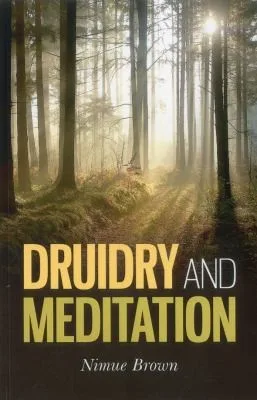
Druidry And Meditation
 83
83

Druidry And Meditation
Nimue Brown’s Druidry And Meditation presents a compelling argument for the inherent contemplative nature of Druidic practice. The work avoids the pitfalls of many modern spiritual guides by grounding its teachings in accessible, actionable steps. Brown's strength lies in her clear prose and her ability to demystify complex concepts, particularly the integration of breathwork with natural observation. One particularly resonant passage discusses the meditative quality of observing a single tree through the seasons, a simple yet profound exercise. A limitation, however, is that the book could benefit from a more detailed exploration of the specific historical Druidic texts or archaeological evidence that underpins some of its meditative interpretations, rather than relying solely on inferential reasoning. Nonetheless, for those seeking a practical bridge between earth-based spirituality and inner stillness, this book offers a grounded and valuable perspective.
📝 Description
83
Nimue Brown's 2012 book connects Druidic practice with meditative stillness.
Druidry And Meditation, published in 2012, details methods for integrating mindfulness and contemplative techniques into a modern Druidic path. Nimue Brown examines how the philosophical underpinnings of Druidry can inform and be enhanced by focused mental discipline. This work is a practical guide for individuals interested in establishing or deepening a personal spiritual practice rooted in nature. It appeals to existing Druids seeking to enrich their ritual and personal development, as well as those curious about pagan traditions.
The book argues that meditation is not a foreign import but a natural extension of Druidic principles. Brown discusses 'active meditation' in nature, the use of sacred groves as contemplative spaces, and the connection between breathwork and natural cycles. It also touches upon reinterpreting ancient myths and symbols through a meditative lens, fostering a deeper connection to the land and its energies. Beginners to both Druidry and meditation will find accessible guidance within its pages.
Emerging from the late 20th and early 21st century Neopagan revival, this book speaks to a renewed interest in Druidry. Within a milieu that saw movements like OBOD gain prominence, there was a demand for texts connecting historical reconstruction with contemporary spiritual needs. Brown's work fits within this broader context of Celtic spirituality and earth-based religions, aiming to make ancient practices relevant for modern practitioners seeking a contemplative, nature-based spirituality.
💡 Why Read This Book?
• Learn practical techniques for nature-based meditation, drawing from the specific concept of 'sacred groves' as contemplative sites to deepen your connection to the environment. • Discover how to integrate breathwork, as detailed in Chapter 3, with the observation of natural cycles, offering a unique method for grounding and presence not found in secular mindfulness. • Gain an understanding of how to reinterpret ancient Druidic symbols through a meditative practice, as explored with the Ogham in Chapter 5, providing a distinct approach to spiritual symbolism.
⭐ Reader Reviews
Honest opinions from readers who have explored this book.
❓ Frequently Asked Questions
What is the core philosophy behind Druidry And Meditation?
The core philosophy is that meditation is a natural and integral part of the Druidic path, emphasizing connection with nature and inner stillness. It posits that contemplative practices can enrich one's understanding and experience of Druidic principles and nature.
Is this book suitable for absolute beginners to meditation?
Yes, the book is designed to be accessible to beginners. It explains foundational meditative techniques and breathwork exercises in a clear manner, making it suitable for those new to the practice.
Does the book require prior knowledge of Druidry?
While prior knowledge of Druidry can be helpful, it's not strictly necessary. The author introduces key Druidic concepts alongside meditative practices, allowing newcomers to learn both simultaneously.
What kind of meditative practices are discussed?
The book covers various practices including mindfulness of breath, nature observation, active meditation in natural settings, and the use of sacred symbols and sounds.
When was Druidry And Meditation first published?
Druidry And Meditation was first published in 2012, reflecting a period of renewed interest in both Druidic revivalism and contemplative spiritual practices.
Does the book offer practical exercises?
Absolutely. The text is rich with practical exercises, including guided meditations, journaling prompts, and suggestions for creating personal sacred spaces in nature.
🔮 Key Themes & Symbolism
Nature as Sacred Space
The book posits that natural environments, from forests to single trees, serve as potent spaces for meditation and spiritual connection. It guides readers to perceive the sacred in the mundane aspects of nature, encouraging practices like mindful walking and observing natural phenomena. This theme emphasizes a direct, experiential relationship with the earth, moving beyond abstract theology to embodied spirituality grounded in the physical world.
Breath and Being
Central to Brown's approach is the transformative power of breath. The work explores breathwork not merely as a physiological function but as a spiritual anchor, connecting the individual to the rhythm of life and the cosmos. It details techniques for using the breath to achieve altered states of consciousness, enhance focus during meditation, and foster a deeper sense of presence and vitality.
Druidic Meditative Integration
This theme addresses how traditional Druidic concepts, such as reverence for ancestors, the Ogham, and the cycles of the year, can be explored and deepened through meditative practice. It suggests that meditation is not an addition but a method for internalizing and living Druidic wisdom. The book offers ways to bring meditative awareness to rituals and daily life, fostering a holistic spiritual path.
The Inner Grove
Brown introduces the concept of the 'inner grove'—a personal sanctuary cultivated through meditation and visualization. This metaphorical space mirrors the sacred groves of ancient Druids but exists within the practitioner's own consciousness. It serves as a refuge for contemplation, healing, and connecting with one's inner wisdom and the spirit of nature.
💬 Memorable Quotes
Direct passages from the work, attributed to the author.
“The breath is the link between our inner and outer worlds.”
— This statement highlights the fundamental role of breath as a bridge. It suggests that by consciously working with our breath, we can harmonize our internal state with our external environment and spiritual aspirations.
“Finding stillness is not about escaping the world, but about finding your place within it.”
— This interpretation emphasizes that true meditation, particularly within a nature-based tradition like Druidry, is about deepening engagement with reality rather than withdrawal. It's about cultivating inner peace that informs one's presence in the world.
“Every tree can be a teacher if we learn to listen.”
— This idea frames the natural world as a source of profound wisdom. It encourages a receptive, observant attitude towards trees, suggesting that through mindful attention, we can gain insights into life, resilience, and cyclical processes.
“The Ogham offers a meditative path through the seasons of the year.”
— This suggests that the ancient Celtic Ogham alphabet is more than just a symbolic system; it can be actively used as a tool for contemplative practice, linking its letters and associated trees to the flow of time and natural change.
“Our inner landscape mirrors the outer.”
— This concept draws a parallel between the practitioner's internal state and the natural world. It implies that cultivating a peaceful and vibrant inner life can lead to a greater appreciation and connection with the corresponding qualities in nature.
🌙 Esoteric Significance
Tradition
This work fits within the broader stream of Western Esotericism, specifically aligning with modern Druidic revivalism and earth-based spiritual traditions. It draws upon a lineage that seeks to reconstruct and reinterpret ancient Celtic practices through a spiritual lens. While not strictly Hermetic or Kabbalistic, it shares with these traditions an emphasis on inner transformation and the use of symbolic systems for spiritual development. It departs by prioritizing direct experience of nature and immanent divinity over more abstract philosophical systems.
Symbolism
Key symbols explored include the Ogham, the ancient Celtic tree alphabet, which is presented as a meditative tool for understanding natural cycles and personal growth. The sacred grove, a recurring motif, represents a consecrated space for communion with nature and the divine. Trees themselves are treated as potent symbols of wisdom, resilience, and connection to the earth and the spirit world, embodying principles of life and regeneration.
Modern Relevance
Contemporary practitioners of eco-spirituality, nature-based witchcraft, and modern Druidry find significant value in Brown's approach. Thinkers and groups focused on rewilding the spirit and fostering a deeper ecological consciousness often draw upon the principles outlined in this book. Its emphasis on accessible, nature-integrated meditation speaks to current trends in mindfulness and personal well-being that seek alternatives to purely urban or technologically-mediated experiences.
👥 Who Should Read This Book
• Individuals interested in Neopaganism and earth-based spiritual paths seeking to integrate contemplative practices into their worldview. • Practicing Druids looking to deepen their connection to nature and enhance their personal spiritual development through meditation. • Beginners to meditation who are drawn to a nature-centric approach and wish to explore a spiritual path rooted in the natural world.
📜 Historical Context
Nimue Brown's Druidry And Meditation, published in 2012, emerged during a period of significant growth and diversification within the modern Druid movement. Following the foundational work of figures like Robert MacGregor and later Gerald Gardner and Philip Carr-Gomm, the early 21st century saw a proliferation of authors seeking to articulate and expand upon Druidic principles for contemporary practitioners. Brown's work contributes to this scholarly and practical exploration, offering a specific focus on contemplative practices. This period also witnessed a broader interest in earth-based spiritualities and a re-evaluation of ancient Celtic cultures, often through the lens of Neopaganism. While not directly engaging in academic debates with historians of Celtic religion, Brown's book participated in the cultural milieu shaped by figures like Miranda Aldhouse-Green, who were publishing accessible scholarship on Celtic symbolism and beliefs, providing a context for the spiritual interpretations found in Brown’s text.
📔 Journal Prompts
Reflect on the 'inner grove' concept and its potential manifestation in your personal space.
Consider the symbolism of the Ogham consonant 'Luis' (Rowan) and its meditative application.
Explore the connection between your breath and the nearest natural element (air, water, earth, plant).
How can the observation of a single tree, as discussed in Chapter 4, inform your daily life?
Imagine a sacred grove; what qualities does it possess, and how can you bring them into your practice?
🗂️ Glossary
Druidry
A contemporary spiritual path and tradition inspired by the ancient Celtic Druids, emphasizing reverence for nature, wisdom, and the arts.
Meditation
A practice where an individual uses a technique – such as mindfulness, or focusing the mind on a particular object, thought, or activity – to train attention and awareness, and achieve a mentally clear and emotionally calm and stable state.
Ogham
The ancient Celtic alphabet, primarily consisting of lines and notches, traditionally associated with trees and used for inscriptions and mystical purposes.
Sacred Grove
In Druidic tradition, a natural woodland area consecrated for religious or spiritual purposes, often serving as a place for ritual and contemplation.
Breathwork
A range of practices that involve intentionally altering breathing patterns to influence one's mental, emotional, or physical state.
Immanence
The belief that the divine or spiritual is present within the material world, rather than transcendent or separate from it.
Inner Grove
A metaphorical concept representing a personal, internal sanctuary cultivated through meditation, mirroring the external sacred grove.
🔮 Readers Also Liked
Browse all →









More Free Occult Philosophy Books
View all →