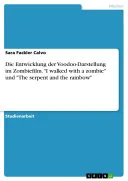
Die Entwicklung der Voodoo-Darstellung im Zombiefilm. "I walked with a zombie" und "The serpent and the rainbow"
 78
78

Die Entwicklung der Voodoo-Darstellung im Zombiefilm. "I walked with a zombie" und "The serpent and the rainbow"
Sara Fackler Calvo's examination of Voodoo in "I Walked with a Zombie" and "The Serpent and the Rainbow" offers a sharp critique of cinematic misrepresentation. The strength of the work lies in its comparative approach, clearly demonstrating the evolution of Voodoo's depiction from a 1943 Hollywood exoticism to a 1988, albeit still sensationalized, exploration of Haitian Vodou. Calvo's analysis of how these films cater to Western anxieties and curiosities about the 'other' is particularly insightful. A limitation, however, is the inherent focus on only two films, which, while effective for a focused study, leaves broader trends in zombie cinema unexplored. The passage discussing the colonial undertones in the portrayal of Haitian spiritual practices in "The Serpent and the Rainbow" is a prime example of the work's critical depth. Ultimately, this paper provides a valuable academic lens for deconstructing the screen's often-flawed Voodoo narratives.
📝 Description
78
Sara Fackler Calvo's 2013 study analyzes Voodoo's shifting image in zombie films.
This academic work examines the cinematic representation of Voodoo, concentrating on Jacques Tourneur's "I Walked with a Zombie" (1943) and Wes Craven's "The Serpent and the Rainbow" (1988). The study traces the evolution of Voodoo's depiction within the zombie film genre over 45 years. It probes the accuracy and underlying motives of these portrayals, moving past simple horror tropes to consider the cultural and historical contexts that informed them.
Authored by Sara Fackler Calvo, the book applies critical media analysis to Voodoo's narrative functions and thematic elements in these films. The author seeks to highlight changes in Voodoo depiction, from early Hollywood views to later, more complex (though still dramatized) representations. While rooted in film studies, the analysis touches on esoteric themes inherent to the subject. It provides a way to understand how non-Western spiritual practices are filtered through a Western cinematic lens, often resulting in misrepresentation or exoticization.
This study engages with the esoteric by examining how Western cinema, particularly the horror genre, has historically filtered and often distorted non-Western spiritual traditions like Voodoo. It questions the accuracy of these portrayals, revealing how cultural anxieties and narrative conventions shape perceptions of occult beliefs. The work situates itself within a critical tradition that analyzes the influence of media on esoteric subjects, moving beyond sensationalism to consider the underlying cultural dynamics.
💡 Why Read This Book?
• Learn how "I Walked with a Zombie" (1943) established early Hollywood's exoticized Voodoo tropes, contrasting with later, more complex cinematic interpretations. • Understand the specific ways "The Serpent and the Rainbow" (1988) engaged with Haitian Vodou, highlighting the influence of Western perspectives on its portrayal. • Gain critical tools to analyze how media constructs and disseminates perceptions of esoteric traditions, moving beyond superficial genre conventions.
⭐ Reader Reviews
Honest opinions from readers who have explored this book.
❓ Frequently Asked Questions
What is the main difference in Voodoo representation between "I Walked with a Zombie" and "The Serpent and the Rainbow"?
The study highlights "I Walked with a Zombie" (1943) presents a more exoticized and Hollywood-ized version of Voodoo, while "The Serpent and the Rainbow" (1988) attempts a more direct, though still dramatized, engagement with Haitian Vodou practices and beliefs.
When was this study first published and by whom?
This academic work by Sara Fackler Calvo was first published on July 18, 2017, originating from a student paper written in 2013 for Friedrich-Alexander-Universität Erlangen-Nürnberg.
Does this book analyze other zombie films besides the two mentioned?
No, the study's focus is specifically on comparing the Voodoo depictions within Jacques Tourneur's "I Walked with a Zombie" (1943) and Wes Craven's "The Serpent and the Rainbow" (1988) over a 45-year span.
What academic field does this study primarily belong to?
The work falls under the field of Media and Communication Studies, specifically focusing on film and television analysis, though it touches upon cultural and esoteric themes.
What is the author's main objective in comparing these two films?
Sara Fackler Calvo aims to investigate and demonstrate how the representation of Voodoo in zombie films has evolved or changed over the 45 years separating the release of these two influential movies.
Is this book suitable for someone with no prior knowledge of Voodoo?
Yes, the study provides context for understanding the cinematic portrayals of Voodoo, making it accessible for newcomers interested in how media shapes perceptions of spiritual practices.
🔮 Key Themes & Symbolism
Cinematic Voodoo Tropes
The study scrutinizes how Hollywood, beginning with films like "I Walked with a Zombie" (1943), constructed a Westernized and often sensationalized image of Voodoo. This includes the common tropes of brain-eating zombies, dark magic, and enslaved practitioners, which often bear little resemblance to the actual Haitian Vodou religion. The work analyzes how these tropes function within narrative structures to create fear and exoticism for Western audiences.
Evolution of Representation
A central theme is the comparative analysis of Voodoo's depiction across a significant time gap, specifically between the 1943 and 1988 films. The study investigates whether later films like "The Serpent and the Rainbow" offered a more nuanced or accurate portrayal, or if they merely updated existing stereotypes with new cinematic techniques. It highlights the persistent influence of cultural biases on media representations.
Cultural Othering in Film
The work explores how Voodoo, as a non-Western spiritual practice, has been historically used in cinema to represent the 'other'—something mysterious, dangerous, and fundamentally alien to Western viewers. It examines the underlying colonial and racial undertones that often accompany these portrayals, contributing to a broader understanding of media's role in shaping societal perceptions of marginalized cultures and beliefs.
Zombie Genre and Esotericism
This study connects the evolution of Voodoo representation directly to the development of the zombie film genre. It examines how the figure of the zombie, often linked to Voodoo in popular imagination, has been reinterpreted over time. The analysis considers how these cinematic interpretations interact with, and often distort, actual esoteric concepts and practices associated with Voodoo.
💬 Memorable Quotes
Direct passages from the work, attributed to the author.
“The work questions the accuracy and underlying motivations behind cinematic Voodoo depictions.”
— This interpretation highlights the critical stance of the study, suggesting it moves beyond surface-level plot analysis to examine the cultural, historical, and ideological forces shaping how Voodoo is presented on screen.
“Comparison of Voodoo representation spans from 1943 to 1988.”
— This factual statement underscores the specific temporal scope of the research, grounding the analysis in the concrete historical context of two landmark zombie films released decades apart.
💡 Key Ideas
Editorial paraphrase of the work's core concepts — not direct quotes.
The investigation into how Voodoo is represented in "I Walked with a Zombie" and "The Serpent and the Rainbow" over 45 years.
This paraphrased concept captures the core research question of the study, emphasizing the comparative historical analysis of Voodoo's cinematic evolution across distinct eras of filmmaking.
Analysis of Voodoo in zombie films reveals shifts from exoticism to more direct, albeit dramatized, engagement.
This paraphrased insight points to a key finding of the study: the changing nature of Voodoo portrayals in cinema over time, noting a transition from purely fantastical elements to attempts at depicting more recognizable Vodou practices, though still filtered through a commercial lens.
The study applies media analysis to understand the narrative functions of Voodoo in selected films.
This quote emphasizes the methodological approach of the work, indicating a focus on film theory and critical media studies to dissect how Voodoo elements are employed to serve the plot and themes of "I Walked with a Zombie" and "The Serpent and the Rainbow."
🌙 Esoteric Significance
Tradition
This work does not align with a specific Western esoteric tradition like Hermeticism or Theosophy. Instead, it critically examines how Western media, particularly cinema, has represented non-Western esoteric and religious systems, specifically Haitian Vodou. It positions itself within critical media studies and cultural analysis, dissecting the *perception* and *misrepresentation* of esoteric practices rather than advocating for or explaining them from within a tradition.
Symbolism
While the book focuses on narrative and thematic elements, implicit symbols emerge. The 'zombie' itself, often conflated with Voodoo, becomes a potent symbol of loss of control, undeath, and the 'other'—a Western projection onto African diaspora religions. The serpent, as in "The Serpent and the Rainbow," often symbolizes forbidden knowledge, danger, or primal forces in various esoteric traditions, but here it is used to titillate and frighten, divorced from its deeper meanings.
Modern Relevance
Contemporary scholars and filmmakers interested in decolonizing media narratives and providing more authentic representations of global spiritual traditions can draw upon this study. It serves as a foundational text for understanding how cinematic tropes have historically obscured accurate portrayals of Vodou, informing current efforts to engage with these practices respectfully and critically in various media forms and academic discussions.
👥 Who Should Read This Book
• Film studies students and scholars analyzing genre evolution and cultural representation. • Researchers of comparative religion interested in how non-Western spiritual practices are portrayed in popular culture. • Media consumers seeking to develop critical perspectives on how films shape perceptions of Voodoo and other esoteric traditions.
📜 Historical Context
Published in 2017, Sara Fackler Calvo's study emerges from a rich academic discourse on media representation and cultural studies, particularly concerning the depiction of non-Western religions and practices. The era of its origin, the early 2010s, saw continued academic interest in postcolonial critiques of media and a growing body of scholarship on the zombie genre's evolution beyond mere horror. The analysis of "I Walked with a Zombie" (1943) places it within early Hollywood's fascination with the exotic and the 'primitive,' often influenced by anthropological theories that were themselves products of colonial-era thinking. Jacques Tourneur's film, while a classic, participated in this trend. Wes Craven's "The Serpent and the Rainbow" (1988) arrived in a period where Hollywood was beginning to engage more directly, though still problematically, with global cultures, partly in response to academic critiques and shifting audience expectations. Competing schools of thought included straightforward genre film criticism that focused on scares and narrative mechanics, versus more culturally sensitive analyses that questioned representation. Contemporary scholars like Susan Sontag, whose "Illness as Metaphor" (1978) and "The Volcano Lover" (1992) touched on the cultural construction of disease and the exotic, provided intellectual currents that informed such critical approaches to media.
📔 Journal Prompts
The cinematic portrayal of Voodoo in "I Walked with a Zombie" versus "The Serpent and the Rainbow".
How does the trope of the zombie function as a symbol of cultural fear in media?
Analyze the narrative purpose of Voodoo elements in a chosen zombie film.
Reflect on the ethical considerations of representing sacred or esoteric practices in popular media.
Compare the filmic depiction of Voodoo to academic descriptions of Haitian Vodou.
🗂️ Glossary
Voodoo
A syncretic religion developed among enslaved Africans in the Caribbean, particularly Haiti, blending traditional African beliefs with Catholicism. Often misrepresented in Western media.
Zombie
In popular culture, often depicted as an undead reanimated corpse. In the context of Voodoo films, it is frequently linked to sorcery and loss of free will, though this is a sensationalized interpretation.
Exoticism
The practice of presenting foreign cultural elements as strange, mysterious, and alluring, often to satisfy a Western audience's fascination with the 'other'.
Cinematic Representation
The way subjects, themes, or cultural practices are depicted and interpreted through the medium of film, including visual elements, narrative, and sound.
Media Analysis
The process of examining media texts to understand their content, form, production, and effects on audiences, often employing critical or theoretical frameworks.
Haitian Vodou
The specific religious tradition practiced in Haiti, which has been the subject of much misrepresentation in Western media under the broader term 'Voodoo'.
Genre Film
A film that adheres to established conventions and tropes of a particular film genre, such as horror, science fiction, or westerns.