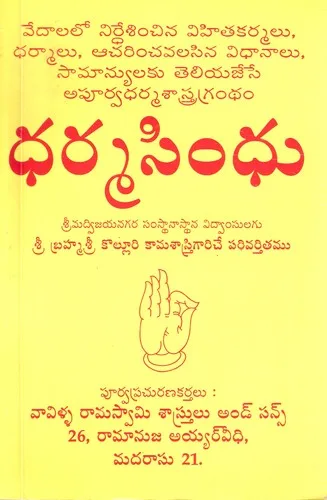
Dharmasindhu
 75
75

Dharmasindhu
Kāśīnātha Upādhyāya’s Dharmasindhu attempts to provide a comprehensive overview of Hindu Dharmaśāstra, a task of considerable magnitude given the vastness and complexity of the subject. The book’s strength lies in its systematic approach, breaking down the intricate web of dharma into digestible sections. Upādhyāya’s focus on the scriptural underpinnings of social and religious duties offers a valuable reference point for scholars and practitioners alike. However, the work, while informative, can sometimes feel encyclopedic rather than analytical, presenting a large volume of material without always engaging critically with the historical evolution or varied interpretations of these laws. A particular passage detailing the nuances of Shraddha ceremonies, for instance, is meticulously laid out, showcasing the author's adherence to textual tradition. Nevertheless, the absence of extensive comparative analysis with later commentaries or regional variations limits its scope for advanced research. Dharmasindhu is a solid, if somewhat dry, compilation of traditional Hindu legal and ethical principles.
📝 Description
75
Kāśīnātha Upādhyāya's Dharmasindhu, published in 1984, analyzes Hindu dharmaśāstra principles.
Published in 1984, Dharmasindhu by Kāśīnātha Upādhyāya is a detailed examination of Hindu dharmaśāstra. The book investigates the rules and customs that shape religious and social obligations as presented in ancient Indian texts. It functions as a comprehensive collection, giving thorough explanations and interpretations of dharma, its various forms, and how it applies to everyday life within traditional Hindu legal and ethical structures. This work is aimed at scholars of Indology, students of comparative religion, and practicing Hindus who want a deeper grasp of scriptural directives. It is especially useful for those studying Hindu law, ethics, and ritual. The book offers a scholarly yet accessible overview of complex legal ideas. Individuals curious about the historical evolution of Hindu social order and religious practices will find it a valuable resource. The text emerged during a time of renewed academic focus on classical Indian writings and philosophies, entering into a conversation with centuries of commentary on the dharmaśāstras, such as the works of Manu and Yājñavalkya, by providing a modern synthesis.
Dharmasindhu engages with the vast tradition of dharmaśāstra, a genre of Sanskrit literature concerned with law, ethics, and duty in traditional Indian society. It builds upon and synthesizes centuries of commentary on foundational texts like the Manusmṛti and Yajnavalkyasmṛti. The book reflects a post-colonial academic interest in indigenous knowledge systems, offering a modern scholarly analysis of these ancient traditions. It situates itself within the ongoing discourse on the practical application of dharma, connecting scriptural injunctions to daily life and ritual observances.
💡 Why Read This Book?
• Gain a structured understanding of Hindu Dharmaśāstras, focusing on concepts like Varna and Ashrama as defined by Kāśīnātha Upādhyāya, offering a clear scriptural basis for social and religious duties. • Explore the intricacies of Samskara (rites of passage) and Shraddha (ancestral rites) as presented in the 1984 publication, providing detailed procedural and ethical guidelines rooted in ancient texts. • Grasp the application of dharma in daily life through the book's systematic examination of duties and observances, enabling a practical connection to the philosophical underpinnings of Hindu tradition.
⭐ Reader Reviews
Honest opinions from readers who have explored this book.
❓ Frequently Asked Questions
What is the primary focus of Dharmasindhu by Kāśīnātha Upādhyāya?
Dharmasindhu primarily focuses on the principles and practices of Hindu Dharmaśāstras, offering detailed explanations and interpretations of dharma, social duties, and religious observances as prescribed in ancient Indian scriptures.
When was Dharmasindhu first published, and what was the academic climate like?
The book was first published in 1984, a period characterized by a resurgence of academic interest in classical Indian texts and a critical examination of indigenous knowledge systems.
What are some of the key concepts explored in Dharmasindhu?
Key concepts include Varna (social class), Ashrama (stages of life), Samskara (rites of passage), and Shraddha (ancestral rites), all examined through the lens of scriptural injunctions and ethical considerations.
Who would benefit most from reading Dharmasindhu?
Scholars of Indology, students of comparative religion, and practitioners of Hinduism seeking a deep understanding of scriptural laws, ethics, and rituals would find this book particularly beneficial.
Does Dharmasindhu discuss the historical evolution of Hindu law?
While it presents a modern synthesis of traditional Dharmaśāstras and references ancient scriptures, the book primarily focuses on detailing established principles rather than extensively charting the historical evolution or varied interpretations of Hindu law.
What is the author's approach to the subject matter in Dharmasindhu?
Kāśīnātha Upādhyāya adopts a systematic and scholarly approach, meticulously outlining scriptural injunctions and traditional interpretations related to dharma, social duties, and religious practices.
🔮 Key Themes & Symbolism
Dharmaśāstra Principles
The book functions as a comprehensive guide to the foundational texts and principles of Hindu Dharmaśāstra. It meticulously details the scriptural basis for societal structure, individual conduct, and religious obligations. Kāśīnātha Upādhyāya emphasizes the interconnectedness of dharma with concepts like karma and moksha, providing readers with a clear framework for understanding the ethical and legal guidelines that have shaped Hindu civilization for millennia.
Life Stages and Duties (Ashrama)
A central theme is the exploration of the four Ashramas – Brahmacharya (student), Grihastha (householder), Vanaprastha (forest dweller), and Sannyasa (renunciate). Dharmasindhu elaborates on the specific duties, rituals, and societal expectations associated with each stage, illustrating how an individual's life path is structured according to scriptural dictates and spiritual progression.
Rites of Passage (Samskara)
The text provides extensive coverage of the Samskaras, the sacraments that mark significant transitions in a Hindu’s life, from conception and birth to marriage and death. Kāśīnātha Upādhyāya details the ceremonies, mantras, and offerings associated with each Samskara, underscoring their role in purification, spiritual development, and integration into the community.
Ancestral Veneration (Shraddha)
Shraddha rituals, dedicated to ancestors, are given considerable attention. The book outlines the precise procedures, timings, and offerings required for performing these rites correctly, highlighting their importance in maintaining familial continuity and ensuring the well-being of both the living and the deceased within the cosmic order.
💬 Memorable Quotes
Direct passages from the work, attributed to the author.
“Each Ashrama presents distinct duties and spiritual opportunities.”
— This captures the essence of the Ashrama system, emphasizing that life is divided into sequential stages, each with its own set of responsibilities and a unique path for spiritual growth and contribution to society.
“Samskaras purify the individual and mark transitions in life.”
— This statement highlights the function of life-cycle rituals in cleansing an individual from impurities and formally acknowledging significant personal milestones, integrating them more fully into their social and spiritual context.
“Respect for ancestors through Shraddha sustains the lineage.”
— This interpretation points to the vital role of ancestral rites in preserving family ties and ensuring a continuous connection between generations, reflecting a belief in the ongoing influence of ancestors on the living.
💡 Key Ideas
Editorial paraphrase of the work's core concepts — not direct quotes.
The performance of dharma leads to spiritual merit and societal order.
This paraphrased concept underscores the core tenet that adherence to prescribed duties and righteous conduct is not merely an ethical obligation but a means to personal spiritual advancement and the maintenance of cosmic and social harmony.
Scriptural injunctions form the bedrock of righteous action.
This paraphrased idea emphasizes the author's reliance on ancient texts as the ultimate authority for defining righteous conduct and ethical principles within the Hindu tradition.
🌙 Esoteric Significance
Tradition
While Dharmasindhu is primarily a work of orthodox Hindu Dharmaśāstra, its meticulous detailing of rituals, life-cycle observances, and ethical frameworks can be viewed through an esoteric lens. It represents the exoteric manifestation of a complex spiritual system, where external practices are understood to have internal, transformative effects. The tradition it upholds is Vedic and Puranic Hinduism, focusing on the practical application of cosmic laws and duties for individual and collective well-being.
Symbolism
Key symbols include the Varna system, representing not just social stratification but also differentiated spiritual potentials and duties. The Ashramas symbolize the stages of spiritual evolution throughout a human life. Samskara, the purification rites, symbolize the ongoing process of spiritual cleansing and transformation, marking progress on the path to liberation or union with the divine.
Modern Relevance
Contemporary practitioners of various yoga traditions and students of comparative spirituality often refer to Dharmasindhu for understanding the socio-religious context from which these practices arose. Modern Hindu reform movements and diasporic communities utilize such texts to maintain cultural and religious identity. Scholars of Indic religions continue to cite it for its detailed exposition of traditional norms and rituals.
👥 Who Should Read This Book
['• Students of Indology and South Asian Studies: To gain a foundational understanding of Hindu legal and ethical texts and their societal implications.', '• Practitioners of Hinduism: To deepen their knowledge of religious duties, rituals, and life-cycle observances (Samskaras) as prescribed by scripture.', '• Scholars of Comparative Religion: To analyze the structure and content of Hindu Dharmaśāstras in comparison with other religious legal systems.']
📜 Historical Context
Kāśīnātha Upādhyāya's Dharmasindhu, first published in 1984, arrived during a period when post-colonial Indian academia was actively re-evaluating and re-contextualizing classical Sanskrit texts. The book emerged within a scholarly environment that sought to provide accessible, yet authoritative, interpretations of traditional legal and religious literature, moving beyond colonial-era analyses. It engages with a lineage of scholarship stretching back to ancient commentators on texts like the Manu Smriti and Yājñavalkya Smriti. While not a direct response to a specific contemporary movement, its publication contributed to the ongoing discourse on Hindu jurisprudence and ethics, offering a systematic compilation that could be utilized by both academic researchers and practitioners. The work stands as a proof of the enduring relevance of Dharmaśāstras in understanding Indian society and religious thought, providing a structured overview that complements the often more fragmented or specialized studies available.
📔 Journal Prompts
Reflect on the concept of Varna as presented by Kāśīnātha Upādhyāya and its role in societal structure.
Consider the duties associated with the Grihastha Ashrama and how they might manifest in modern life.
Analyze the symbolic significance of a specific Samskara, such as Vivaha (marriage), as described in the text.
Evaluate the importance of Shraddha rituals for maintaining familial and spiritual continuity.
How does the scriptural basis for dharma, as outlined in Dharmasindhu, compare to other ethical frameworks you are familiar with?
🗂️ Glossary
Dharmaśāstra
A genre of Sanskrit literature dealing with dharma, encompassing duties, laws, ethics, and customs in Hinduism. It forms a part of the Vedanga.
Dharma
A complex concept referring to righteousness, duty, moral law, cosmic order, and the intrinsic nature of reality. It guides individual conduct and societal functioning.
Varna
The four primary social classes in Hinduism: Brahmin (priests/scholars), Kshatriya (warriors/rulers), Vaishya (merchants/farmers), and Shudra (laborers/servants). Each has prescribed duties.
Ashrama
The four stages of life prescribed for a twice-born Hindu: Brahmacharya (student), Grihastha (householder), Vanaprastha (retired/forest dweller), and Sannyasa (renunciate).
Samskara
Rites of passage that mark significant life events and facilitate spiritual purification and development, from conception to death.
Shraddha
Rituals performed to honor and propitiate ancestors, typically involving offerings of food and water, believed to ensure their well-being and continued connection to the family.
Upa-karma
An annual ceremony performed by students of the Vedas to renew their sacred thread and pay homage to their teachers and ancestors.
🔮 Readers Also Liked
Browse all →








More by Kāśīnātha Upādhyāya
All books →
More Free Occult Philosophy Books
View all →