Destructive emotions
 82
82

Destructive emotions
Daniel Goleman’s curation of the Dalai Lama’s thoughts on "Destructive Emotions" offers a compelling, if somewhat uneven, exploration of emotional regulation from a Buddhist perspective. The book’s primary strength lies in the Dalai Lama’s direct, unpretentious articulation of complex spiritual concepts, making them accessible without dilution. His explanations of anger, for instance, as a natural but ultimately harmful reaction, are particularly sharp. However, the framing by Goleman, while intended to bridge worlds, occasionally feels like an academic overlay that interrupts the flow of the Dalai Lama's wisdom. A passage discussing the neurobiological underpinnings of suffering, while informative, can feel tangential to the core spiritual message. The limitation here is that the synthesis, while valuable, sometimes sacrifices the raw power of the direct teachings for a Western intellectual audience. Despite this, the book remains a valuable resource for anyone seeking a contemplative approach to managing inner turmoil. It provides a practical framework for cultivating resilience through understanding the mind.
📝 Description
82
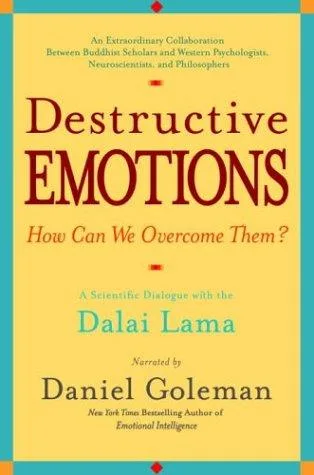
Daniel Goleman compiled dialogues from the 14th Dalai Lama on destructive emotions, published in 2003.
Daniel Goleman's "Destructive Emotions" compiles discussions between the 14th Dalai Lama, Tenzin Gyatso, and Western scientists. These dialogues, originating from the Mind, Life Institute's meetings that began in the 1980s, aim to connect Buddhist contemplative practices with modern neuroscience and psychology. The book addresses specific negative emotions like anger, greed, and hatred. It examines their origins and effects, proposing antidotes rooted in spiritual insight and scientific understanding.
The work is suitable for readers interested in the convergence of psychology, philosophy, and contemplative practices. It offers value to those seeking to understand the roots of human suffering and ethical guidance derived from a long spiritual lineage. The book also appeals to those curious about how ancient wisdom can inform contemporary issues. Prior familiarity with Buddhism or Goleman's work on emotional intelligence is not a prerequisite for engaging with its content.
This book emerges from dialogues that sought to bridge Tibetan Buddhist contemplative traditions, particularly those of the Dalai Lama, with Western scientific inquiry into the mind. The Mind, Life Institute fostered direct engagement between monastic wisdom and secular research, a significant development in the late 20th century. This effort allowed for the examination of profound contemplative techniques and philosophical insights concerning the nature of consciousness and emotion within a modern scientific framework.
💡 Why Read This Book?
• You will learn to differentiate between fleeting emotional reactions and deeply ingrained mental afflictions, as articulated by the Dalai Lama in his analysis of afflictive emotions, allowing for more precise self-awareness. • You will gain insight into specific contemplative practices like mindfulness (vipassanā), as discussed within the Mind, Life Institute dialogues, offering a structured method for observing and de-escalating negative emotional states. • You will understand the Buddhist concept of emptiness (śūnyatā) not as nihilism, but as a means to dismantle the ego's grip on destructive desires and aversions, fostering a more detached and compassionate perspective.
⭐ Reader Reviews
Honest opinions from readers who have explored this book.
❓ Frequently Asked Questions
What is the core message of Daniel Goleman's "Destructive Emotions"?
The book's core message, derived from the Dalai Lama's teachings, is that destructive emotions like anger and greed are mental afflictions that can be understood, de-escalated, and ultimately transformed through contemplative practices such as mindfulness and compassion.
When was Daniel Goleman's "Destructive Emotions" first published?
Daniel Goleman's "Destructive Emotions" was first published in 2003, compiling teachings from the Dalai Lama.
How does "Destructive Emotions" relate to Daniel Goleman's earlier work?
It builds upon Goleman's previous focus on emotional intelligence, moving from the identification and management of emotions to their deeper spiritual and ethical dimensions, drawing on Buddhist philosophy.
Who is the primary speaker or teacher in "Destructive Emotions"?
The primary speaker is the 14th Dalai Lama, Tenzin Gyatso, whose teachings on the nature and antidotes to destructive emotions form the book's foundation.
What specific practices are recommended in the book for dealing with negative emotions?
The book highlights contemplative practices such as mindfulness (vipassanā) for observing mental states without judgment, and the cultivation of compassion (karuṇā) as antidotes to destructive emotions.
Does the book require prior knowledge of Buddhism?
While prior knowledge can be helpful, the book is written to be accessible to a general audience, with Goleman providing context and explanations for Buddhist concepts for Western readers.
🔮 Key Themes & Symbolism
The Nature of Afflictive Emotions
The work meticulously dissects emotions such as anger, hatred, and greed, not as inherent personality traits, but as temporary mental afflictions arising from ignorance and attachment. The Dalai Lama, drawing from centuries of Buddhist analysis, explains how these states cloud judgment, cause suffering, and damage relationships. The book emphasizes that understanding the impermanent and conditioned nature of these emotions is the first step toward disarming their power over the individual.
Antidotes Through Contemplation
Central to the book is the exploration of practical methods for countering destructive emotions. Mindfulness (vipassanā) is presented as a key practice, enabling one to observe the arising and passing of emotions without immediate identification or reaction. The cultivation of positive states, particularly compassion (karuṇā) and wisdom (prajñā), is advocated as a direct counteragent to aversion and attachment, fostering a more balanced and resilient mental disposition.
Mind-Science Dialogue
"Destructive Emotions" is a product of the "Mind, Life Institute" dialogues, initiating a significant bridge between Tibetan Buddhist contemplative traditions and Western scientific inquiry, particularly neuroscience and psychology. This interdisciplinary approach seeks to validate ancient insights through modern empirical methods, exploring the biological and psychological underpinnings of emotional states and the efficacy of meditative practices in altering brain function and emotional well-being.
The Concept of Emptiness
The book touches upon the profound Buddhist concept of emptiness (śūnyatā), explaining it not as a void but as the absence of inherent, independent existence. This understanding is presented as crucial for dismantling the ego's self-centered perspective, which often fuels destructive emotions. By recognizing the interdependent and constructed nature of reality and the self, individuals can loosen the grip of desire, aversion, and the suffering they engender.
💬 Memorable Quotes
Direct passages from the work, attributed to the author.
“Anger is a powerful emotion that can overwhelm reason.”
— This highlights the immediate, visceral impact of anger, suggesting it disrupts rational thought processes and can lead to impulsive, often regrettable, actions.
“We must understand the causes of our suffering to overcome it.”
— This points to the Buddhist principle of causality in suffering, asserting that identifying the root conditions of negative emotions is essential for their eventual eradication.
“Compassion is not mere sentimentality, but a deep-seated wish for others to be free from suffering.”
— This clarifies that compassion, in this context, is an active, profound ethical stance rather than a passive feeling, emphasizing its transformative potential.
“The mind is like a turbulent lake; through practice, it can become calm.”
— This metaphor illustrates the potential for mental discipline, suggesting that the agitated state of the mind is not immutable and can be settled through consistent practice, like meditation.
“Attachment to transient things leads to dissatisfaction.”
— This speaks to the Buddhist doctrine of impermanence, positing that clinging to that which is temporary is a direct source of suffering and disappointment.
🌙 Esoteric Significance
Tradition
The work is deeply rooted in the Tibetan Buddhist tradition, specifically drawing from Mahayana philosophy. It aligns with the tradition's emphasis on the mind as the locus of suffering and liberation. While not strictly Hermetic or Kabbalistic, it shares with these traditions a focus on inner transformation and the understanding of hidden mental processes. Its departure from purely doctrinal exposition lies in its direct engagement with scientific discourse, seeking empirical validation for contemplative insights, a characteristic of modern esoteric movements that bridge ancient wisdom with contemporary knowledge.
Symbolism
While "Destructive Emotions" is more philosophical than symbolic, the concept of the mind itself functions symbolically. It is depicted as a 'monkey mind' – restless, easily distracted, and prone to wild leaps – a common metaphor for the untrained consciousness. The antidotes, such as compassion (karuṇā) and wisdom (prajñā), can be seen as symbolic representations of the enlightened mind, the goal of the spiritual path. The dialogue format itself symbolizes the integration of disparate knowledge systems, bridging the inner world of contemplation with the outer world of scientific inquiry.
Modern Relevance
Contemporary thinkers and practitioners in secular mindfulness, positive psychology, and even certain branches of neuroscience continue to draw heavily on the principles articulated in "Destructive Emotions." The work's emphasis on emotional regulation, the cultivation of compassion, and the scientific study of meditation's effects on the brain is foundational to current research and therapeutic modalities. Schools of thought focused on ethical development and well-being often cite the Dalai Lama's accessible explanations of Buddhist ethics as a vital resource for personal and societal transformation.
👥 Who Should Read This Book
• Individuals exploring the intersection of psychology and Eastern philosophy will find this book offers a unique bridge, providing spiritual insights into emotional regulation informed by scientific dialogue. • Practitioners of meditation and mindfulness seeking to deepen their understanding of the mental states they observe will gain valuable context from the Dalai Lama's detailed analysis of destructive emotions. • Those interested in comparative religion and ethics will benefit from a clear exposition of Buddhist perspectives on suffering, morality, and the path to inner peace, presented in an accessible format.
📜 Historical Context
Published in 2003, "Destructive Emotions" emerged during a period of burgeoning interest in mindfulness and contemplative practices within Western academic and popular spheres. The book's origin in the "Mind, Life Institute" dialogues, which commenced in 1987 between the Dalai Lama and Western scientists, represented a significant intellectual current aiming to integrate Buddhist wisdom with empirical research. This era saw figures like Jon Kabat-Zinn popularizing mindfulness-based stress reduction (MBSR) outside monastic settings. The work’s reception was largely positive, building on the widespread influence of Daniel Goleman's "Emotional Intelligence" (1995), which had already made the concept of EQ a household term. While Goleman's framing aimed to bridge traditions, some critics noted the inherent challenge in fully translating nuanced Buddhist philosophy into Western psychological paradigms. The book appeared alongside a growing body of research validating the psychological benefits of meditation, positioning it as a key text in this cross-cultural intellectual exchange.
📔 Journal Prompts
The turbulent lake of the mind: how does its agitation manifest in your daily experience?
Anger's disruption: identify a recent instance where anger overwhelmed your reason.
Compassion's active wish: how can you translate a desire for others' freedom from suffering into tangible action today?
Understanding suffering's causes: reflect on a personal source of dissatisfaction linked to attachment.
The mind's conditioning: observe a recurring thought pattern and consider its impermanent nature.
🗂️ Glossary
Dukkha
A fundamental concept in Buddhism, often translated as 'suffering,' 'dissatisfaction,' or 'stress.' It refers to the inherent unsatisfactoriness of conditioned existence, arising from impermanence and attachment.
Vipassanā
A type of meditation practice in Buddhism, known as insight meditation. It involves observing reality as it is, focusing on the impermanent nature of phenomena, and cultivating clear seeing.
Karunā
A Sanskrit and Pali word meaning compassion, often described as a deep wish for all sentient beings to be free from suffering. It is considered one of the four 'immeasurables' or 'divine abodes' in Buddhism.
Prajñā
A Sanskrit term meaning 'wisdom' or 'insight.' In Buddhism, it refers to the profound understanding of the true nature of reality, particularly the concepts of emptiness and impermanence.
Śūnyatā
A central concept in Mahayana Buddhism, translated as 'emptiness' or 'voidness.' It signifies the lack of inherent existence or independent self-nature in all phenomena.
Mind, Life Institute
An organization that fosters dialogue between contemplative traditions, particularly Buddhism, and modern science, focusing on the nature of consciousness, the mind, and the brain.
Afflictive Emotions
Mental states that are considered harmful and disruptive, leading to suffering for oneself and others. Examples include anger, hatred, greed, jealousy, and ignorance.
🔮 Readers Also Liked
Browse all →









More by Daniel Goleman
All books →



More Free Spiritual Development Books
View all →