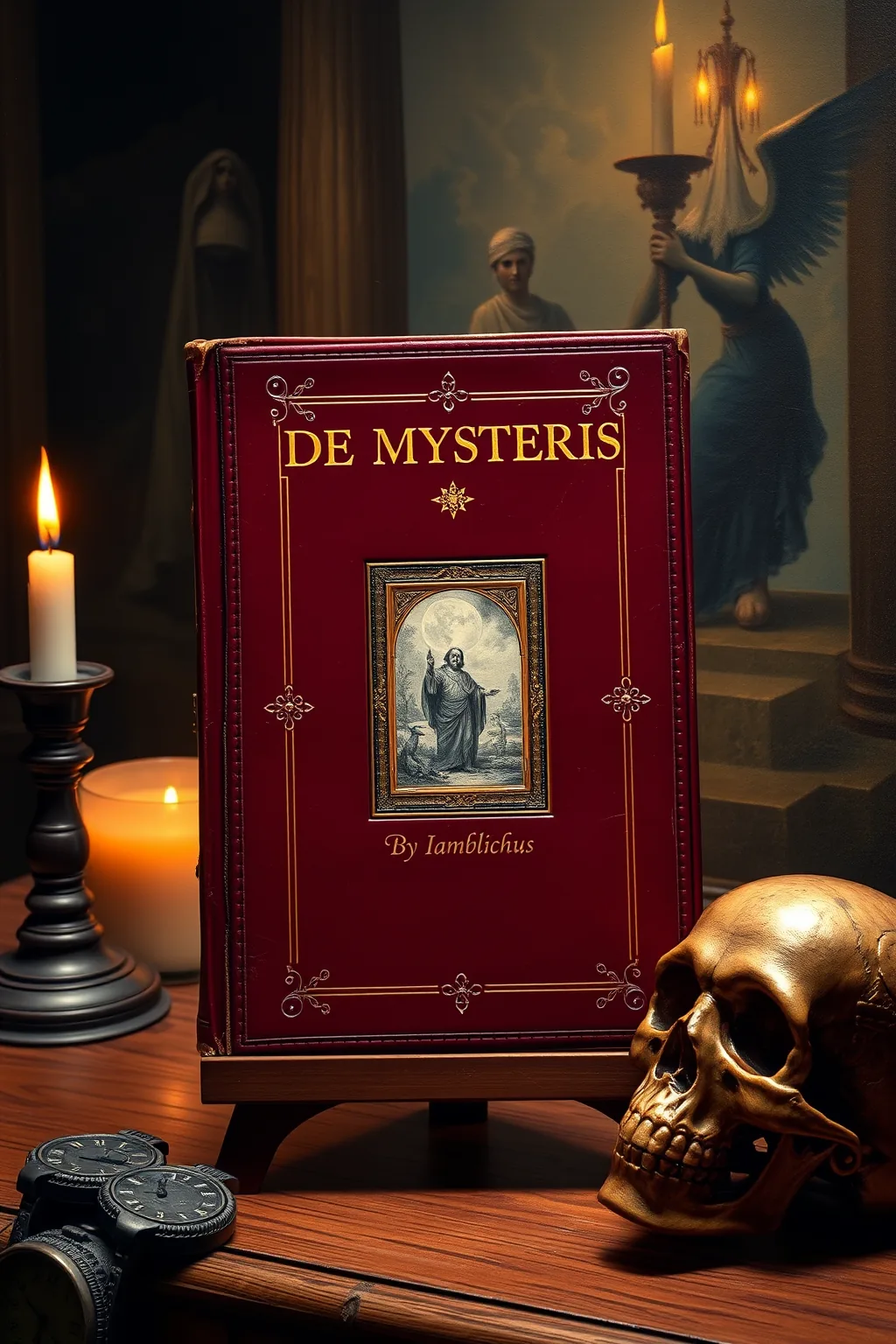
De mysteriis
 80
80

De mysteriis
Iamblichus's "De Mysteriis" remains a formidable pillar of Neoplatonic thought, offering a systematic defense of theurgic practice that is both intellectually rigorous and deeply spiritual. The text’s strength lies in its detailed philosophical architecture, meticulously constructing a case for how ritual can bridge the chasm between the mortal and the divine. The argument concerning the inherent, non-arbitrary power of divine names and symbols, as presented in Book IV, is particularly compelling, moving beyond mere symbolic interpretation to a belief in their operative efficacy. However, the sheer density of the work, coupled with its philosophical milieu, can present a significant barrier to entry for the uninitiated. The translation by Emma C. Clarke, while scholarly, often retains a certain academic distance that may obscure the visceral, transformative intent of theurgy itself. Despite this, the work's sustained exposition on the soul's ascent through ritual provides an unparalleled glimpse into ancient spiritual technology. "De Mysteriis" is an indispensable, albeit challenging, primary source for understanding the practical metaphysics of the late antique world.
📝 Description
80
Iamblichus wrote De Mysteriis in the early 4th century CE to defend theurgy.
Iamblichus's De Mysteriis argues for the practice of theurgy, a ritual magic intended to invoke divine presence and foster spiritual ascent. This text, a key work in Neoplatonism, details the philosophical foundations and practical applications of ancient Greek ritual traditions. It discusses the nature of deities, the function of theurgy in bridging the human and divine, and the effectiveness of sacred rites and spoken invocations. The treatise asserts that symbols, divine names, and rituals possess an inherent power to influence both the cosmos and the individual soul. Composed in the early 4th century CE, the work engages with an ongoing debate within Neoplatonism concerning the validity of these practices. Iamblichus, a student of Porphyry, sought to integrate Platonic philosophy with existing religious customs from Greece and the Near East. The book addresses the philosophical justifications for ritual action and communion with the divine in antiquity, presenting a structured defense of these concepts.
De Mysteriis is situated within the intellectual currents of late antiquity, particularly Neoplatonism. Iamblichus, building on the work of Plotinus and Porphyry, sought to reconcile Platonic philosophical ideals with traditional religious practices. At a time when pagan intellectualism coexisted with the rise of Christianity, this work defends theurgy not as mere superstition, but as a divinely sanctioned system for human spiritual improvement. It stands as a significant text for understanding the philosophical rationales behind ritual and the pursuit of divine knowledge in the ancient world, particularly among those who sought to maintain and interpret Hellenistic religious traditions.
💡 Why Read This Book?
• Gain a structured understanding of theurgic philosophy, as Iamblichus meticulously lays out its principles, moving beyond vague spiritual notions to specific ritual efficacy tied to divine names and symbols, as discussed in Book IV. • Explore the Neoplatonic cosmology and its relation to ritual action, learning how Iamblichus integrates the hierarchy of being, from the One to matter, with the practical aims of spiritual ascent and divine communion. • Understand the historical debate surrounding ancient ritual practices, as this work directly addresses critiques of theurgy, positioning it within the philosophical landscape of the early 4th century CE and its intellectual currents.
⭐ Reader Reviews
Honest opinions from readers who have explored this book.
❓ Frequently Asked Questions
What is theurgy according to Iamblichus in "De Mysteriis"?
Theurgy, as described by Iamblichus, is a divine science or practice of ritual action intended to facilitate the soul's ascent towards the divine. It involves the correct use of sacred rites, prayers, hymns, and divine names to invoke and commune with higher spiritual beings.
Who was Iamblichus and when did he write "De Mysteriis"?
Iamblichus was a prominent Syrian Neoplatonist philosopher who lived from c. 245 to c. 325 CE. "De Mysteriis Aegyptiorum" (On the Mysteries of the Egyptians) was written during the early 4th century CE.
What philosophical school does "De Mysteriis" belong to?
The work is a foundational text of Neoplatonism, a school of philosophy that developed from the teachings of Plato. Iamblichus significantly expanded upon the ideas of earlier Neoplatonists like Plotinus and Porphyry.
What is the primary purpose of the rituals described in "De Mysteriis"?
The primary purpose of theurgy, as detailed in the book, is to purify the soul, facilitate its return to the divine source, and achieve spiritual knowledge and union with the gods through divinely sanctioned practices.
How does "De Mysteriis" differ from Porphyry's views on magic?
"De Mysteriis" is famously a response to Porphyry's criticisms of theurgy. Iamblichus defends the efficacy and divine nature of these practices, arguing they are essential for salvation, whereas Porphyry expressed more skepticism about their philosophical validity.
What role do divine names play in Iamblichus's theurgy?
Iamblichus asserts that divine names possess inherent power, derived from the gods themselves. The correct utterance or contemplation of these names, often in their original sacred languages, is crucial for invoking divine presence and enacting spiritual change.
🔮 Key Themes & Symbolism
Theurgy as Divine Science
Iamblichus presents theurgy not as mere superstition but as a rigorous, divinely inspired science integral to the soul's salvation. He argues that certain rituals, incantations, and the use of divine names are not arbitrary but possess inherent power to connect humanity with the divine hierarchy. This elevates ritual from a mundane act to a cosmic operation, essential for spiritual purification and ascent. The work meticulously defends this practice against philosophical critiques, positioning it as a necessary bridge between the sensible and intelligible worlds.
Hierarchy of Being and Divine Mediation
Central to "De Mysteriis" is the Neoplatonic concept of a hierarchical cosmos, originating from the ineffable One. Iamblichus details the various orders of gods and daimons that mediate between the ultimate divine source and the material world. Theurgy serves as the mechanism by which humans can interact with these intermediaries, ascend through these levels, and ultimately approach the divine. Understanding this cosmic structure is crucial for performing effective ritual, as each level requires specific modes of address and invocation.
The Power of Sacred Language and Symbols
Iamblichus places immense importance on the power of sacred language, including divine names, hymns, and rituals, often emphasizing their efficacy in their original, untranslated forms. He posits that these elements possess an intrinsic, sympathetic connection to the divine realities they represent. The work explores how specific symbols, gestures, and material substances, when used within the theurgic framework, can act as conduits for divine energy and facilitate spiritual transformation, aligning the practitioner with cosmic forces.
Soul's Purification and Ascent
The ultimate goal of theurgy, as expounded in "De Mysteriis," is the purification and liberation of the soul from its material encumbrances. Iamblichus details how the soul, through its connection to the divine, can shed its earthly attachments and ascend through the cosmic spheres. Theurgy provides the practical means for this ascent, offering a path that complements philosophical contemplation by actively engaging with the divine realm through sacred actions and initiations.
💬 Memorable Quotes
Direct passages from the work, attributed to the author.
“The gods are not to be invoked by us by means of a discourse consisting of words, but by means of a participation in divine things.”
— This highlights Iamblichus's emphasis on experiential, ritualistic engagement over purely intellectual understanding. True connection with the divine comes through direct participation in sacred practices, not just philosophical discourse.
“For indeed, the totality of the universe is one, and the divine nature is one, and the soul is one.”
— This statement underscores the Neoplatonic concept of cosmic unity. Iamblichus posits an interconnectedness between the divine, the cosmos, and the human soul, suggesting that theurgy works by aligning these unified elements.
“The Egyptians, and the Chaldeans, and the Hebrews, and the Assyrians, and almost all barbarians, who are lovers of the divine, have transmitted to us sacred rites.”
— This emphasizes Iamblichus's view that theurgy is an ancient, widespread practice found across many cultures, not a novel invention. He draws authority from these diverse traditions to validate theurgic practices.
“We must be silent, and admire the sacred rites.”
— This short excerpt reflects a sense of awe and reverence central to theurgic practice. It suggests that the efficacy of the rites often surpasses human comprehension, demanding humble adoration.
💡 Key Ideas
Editorial paraphrase of the work's core concepts — not direct quotes.
The divine names are powerful, and are the first principles of the divine mysteries.
This paraphrase captures Iamblichus's belief in the inherent power of divine names. He argues these names are not mere labels but potent keys that unlock access to the divine realm and its mysteries.
🌙 Esoteric Significance
Tradition
"De Mysteriis" is a core part of Western Esotericism, firmly rooted in the Neoplatonic tradition. It represents a significant development within this lineage, moving beyond the more purely intellectual and contemplative focus of earlier Neoplatonists like Plotinus. Iamblichus integrates Platonic metaphysics with the practical, ritualistic elements of ancient Greek, Egyptian, and Chaldean religious practices, establishing theurgy as a legitimate and vital path to spiritual realization within this philosophical framework.
Symbolism
Key symbols in "De Mysteriis" include divine names, sacred animals, and celestial bodies. Divine names are considered potent keys, embodying the essence of the deities they represent and holding power to invoke their presence. Sacred animals, often associated with specific gods (e.g., the lion with Apollo or Helios), act as powerful symbols and intermediaries. Celestial bodies and their movements are understood as reflections of divine order and influence, crucial for timing and understanding the cosmic forces at play in theurgic operations.
Modern Relevance
Contemporary esoteric practitioners and scholars of Western Esotericism frequently draw upon "De Mysteriis." Modern Neoplatonists and those involved in Hermetic, Kabbalistic, or magical traditions often study Iamblichus to understand the theoretical underpinnings of ritual and divine invocation. His work continues to inform discussions on the relationship between philosophy and religion, the nature of consciousness, and the efficacy of ritual in spiritual development, influencing contemporary magical orders and academic discourse.
👥 Who Should Read This Book
• Students of Neoplatonism and ancient philosophy seeking a primary source on the practical application of Platonic ideas in the late antique world. • Practitioners of Western Esotericism interested in the historical and philosophical foundations of ritual magic, theurgy, and divine invocation. • Scholars of comparative religion and classical studies looking to understand the complex interplay between philosophy, religion, and magical practices in the Hellenistic and Roman periods.
📜 Historical Context
Composed in the early 4th century CE, Iamblichus's "De Mysteriis" emerged during a key era for late antique philosophy and religion. Neoplatonism, established by Plotinus and Porphyry, was a dominant intellectual current, seeking to reconcile Platonic thought with various religious traditions. Iamblichus, a student of Porphyry, diverged from his teacher by vigorously defending theurgy, a practice of ritual magic aimed at divine communion. This work was a direct response to Porphyry's skepticism, articulated in his Letter to Anebo. The period was marked by increasing syncretism and the rise of Christianity, which would soon become the dominant religion of the Roman Empire. While pagan philosophical schools like Neoplatonism continued to flourish, they faced growing pressure. "De Mysteriis" thus stands as a monumental defense of a sophisticated, ritualistic approach to spirituality within a complex intellectual landscape, engaging with traditions beyond Greek philosophy, such as Egyptian and Chaldean cosmology.
📔 Journal Prompts
The role of divine names in invoking presence.
The perceived efficacy of sacred rites versus philosophical discourse.
Iamblichus's concept of the soul's purification through theurgy.
The Neoplatonic hierarchy of being and its ritual implications.
The Chaldean Oracles' influence on Iamblichus's theurgy.
🗂️ Glossary
Theurgy
A system of ritual magic and spiritual practice aimed at invoking the presence of divine beings and facilitating the soul's ascent to the divine. It is considered a divine science, distinct from lower forms of magic.
Neoplatonism
A philosophical system derived from Plato's teachings, emphasizing the concept of 'The One' as the ultimate source of all reality, and advocating for spiritual ascent through contemplation and mystical union.
Daimon
In Neoplatonism, a class of spiritual beings that mediate between the gods and humans. They can be benevolent or malevolent, and understanding their nature is crucial for theurgy.
Logos
The divine reason or creative principle that orders the universe. In Neoplatonism, it is often associated with Intellect (Nous) and plays a role in the mediation between The One and the material world.
Intelligible World
The field of Forms or Ideas, which is eternal and unchanging, accessible through intellect and contemplation, as opposed to the sensible, material world.
Sensible World
The material, physical universe perceived through the senses, which is seen as a lower, less perfect reflection of the Intelligible World.
Ineffable One
The ultimate source of all existence in Neoplatonism, which is beyond all description, thought, and being. It is the absolute transcendent principle.
🔮 Readers Also Liked
Browse all →









More Free Occult Philosophy Books
View all →