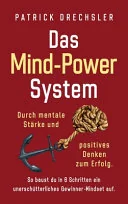
Das Mind-Power-System
 78
78

Das Mind-Power-System
Patrick Drechsler's "Das Mind-Power-System" offers a structured approach to mental conditioning, drawing heavily from established psychological tenets. The book's strength lies in its clear articulation of how belief systems can become self-fulfilling prophecies, a concept explored by researchers like Albert Bandura as early as the 1970s. Drechsler effectively translates these academic findings into actionable advice. However, the system occasionally borders on oversimplification, presenting complex psychological mechanisms as easily manipulated levers. A passage detailing the process of reframing negative self-talk, while practical, could benefit from acknowledging the deeper roots of such thought patterns. Ultimately, "Das Mind-Power-System" provides a useful, if somewhat optimistic, manual for mental self-management.
📝 Description
78
Patrick Drechsler's 2021 book, Das Mind-Power-System, proposes a method for mental self-mastery.
Published in 2021, Patrick Drechsler's Das Mind-Power-System outlines a framework for directing mental faculties towards personal and professional advancement. The core assertion is that deliberate thought patterns, ingrained beliefs, and one's attitude are critical drivers of success. Drechsler uses psychological concepts to illustrate how internal conviction shapes external achievements.
This work targets individuals aiming to boost their personal effectiveness and gain more control over their life's trajectory. It is especially useful for those interested in self-improvement, reaching objectives, and grasping the psychological foundations of achievement. Readers seeking concrete methods to adjust their thinking and build self-assurance will find practical guidance within its pages. The book connects mental states directly to observable outcomes. It explains concepts such as self-efficacy, the conviction in one's ability to execute necessary actions in prospective situations. Techniques for recognizing and altering restrictive beliefs, encouraging positive self-dialogue, and nurturing a mindset geared towards ambitious goals are likely discussed.
While drawing on mid-20th century psychological research like Albert Bandura's self-efficacy and Julian Rotter's locus of control, Drechsler systematizes these ideas for contemporary self-help. The book's emphasis on manipulating internal states to affect external reality places it within a broader tradition of mind-over-matter philosophies. It echoes principles found in New Thought and certain branches of Western esotericism that posit consciousness as a primary force in shaping material existence. The system aims to make these concepts actionable for everyday life.
💡 Why Read This Book?
• Learn to cultivate self-efficacy, a concept explored by Albert Bandura, to increase the likelihood of achieving your set goals. • Discover practical methods for identifying and altering limiting beliefs that may be hindering your progress, as detailed in the system's core principles. • Gain an understanding of how psychological frameworks, established in the mid-20th century, can be directly applied to enhance professional and personal success.
⭐ Reader Reviews
Honest opinions from readers who have explored this book.
❓ Frequently Asked Questions
What is the core principle of Patrick Drechsler's "Das Mind-Power-System"?
The core principle is that directing one's beliefs, attitudes, and thought processes effectively leads to greater professional and personal success, a concept rooted in psychological research on mental strength.
When was "Das Mind-Power-System" first published?
The book "Das Mind-Power-System" by Patrick Drechsler was first published on February 26, 2021.
Which psychological concepts does the book relate to?
It relates to concepts like mental strength and self-efficacy, referencing the work of psychologists such as Albert Bandura, Julian B. Roter, and Martin Seligman.
Who is Patrick Drechsler?
Patrick Drechsler is the author of "Das Mind-Power-System," a work published in 2021 that explores the power of mental conditioning for personal and professional achievement.
What is the main benefit of applying "Das Mind-Power-System"?
The main benefit is accelerating progress in one's career and personal life by consciously steering one's beliefs, attitudes, and thought processes into productive channels.
Does the book offer practical advice for self-improvement?
Yes, the book focuses on providing actionable strategies derived from psychological research to help individuals strengthen their mental fortitude and achieve their objectives.
🔮 Key Themes & Symbolism
Mental Fortitude
The book emphasizes the cultivation of mental fortitude as a primary driver of success. It posits that developing robust internal conviction and a resilient mindset is not merely beneficial but essential for navigating life's challenges and seizing opportunities. This theme is explored through practical exercises aimed at building confidence and reinforcing positive self-perception, drawing on the psychological understanding that belief in one's abilities directly influences outcomes.
Directed Thought Processes
Central to Drechsler's system is the notion of actively directing one's thoughts, beliefs, and attitudes. This is presented as a skill that can be learned and honed, moving beyond passive acceptance of mental patterns. The work likely provides techniques for identifying and reshaping negative or unproductive thought loops, replacing them with constructive mental frameworks that align with desired goals, thereby leveraging the mind as a tool for achievement.
Self-Efficacy and Goal Achievement
The book draws a direct line between an individual's belief in their own capabilities (self-efficacy) and their capacity to achieve goals. It builds upon the research of psychologists like Albert Bandura, who demonstrated that those convinced of their own competence set higher goals and persist longer. The system offers methods to bolster this self-efficacy, making it a starting point for unlocking personal and professional potential.
Attitude as a Catalyst
"Das Mind-Power-System" frames attitude not as a passive state but as an active catalyst for change. It suggests that a deliberate, positive, and growth-oriented attitude can fundamentally alter one's trajectory. This theme explores how adopting specific mindsets can unlock new possibilities and create momentum, effectively positioning the reader to influence their circumstances through internal shifts.
💬 Memorable Quotes
Direct passages from the work, attributed to the author.
“Gedanken sind Macht”
— This opening statement, translating to 'Thoughts are Power,' captures the book's core premise: that mental processes hold significant influence over one's reality and achievements.
“Die Psychologie kennt dafür den Ausdruck mentale Stärke.”
— This highlights that the book's subject matter is grounded in psychological principles, specifically identifying 'mental strength' as the recognized term for these powerful cognitive capabilities.
“Menschen, die von ihren eigenen Fähigkeiten überzeugt sind, ihre Ziele höher setzen.”
— This concept, linked to Bandura's work, explains that confidence in one's abilities directly correlates with ambition, leading individuals to pursue more significant and challenging goals.
“Bereits in den 1970er Jahren konnten renommierte Psychologen ... aufzeigen, dass Menschen ... ihre Ziele höher setzen.”
— This references the historical roots of the book's concepts, pointing to mid-20th-century psychological research as evidence for the impact of self-belief on goal setting and achievement.
💡 Key Ideas
Editorial paraphrase of the work's core concepts — not direct quotes.
Wer es schafft, seine Überzeugungen, Einstellungen und Denkprozesse in die richtigen Bahnen zu lenken, kommt beruflich und privat auf die Überholspur.
This paraphrase suggests that mastering one's beliefs, attitudes, and thought patterns is the key to accelerating personal and professional advancement, placing individuals on a fast track to success.
🌙 Esoteric Significance
Tradition
While "Das Mind-Power-System" is framed within modern psychology, its emphasis on the power of directed thought aligns with certain esoteric traditions that focus on mental discipline and manifestation. It echoes principles found in Hermeticism, particularly the concept of 'As Above, So Below,' suggesting a correspondence between inner states and outer reality. The system's focus on will and intention also speaks to practices found in ceremonial magic, albeit secularized. It departs from traditional esoteric lineages by grounding its methods in empirical psychological research rather than metaphysical or spiritual dogma.
Symbolism
The book itself doesn't heavily rely on overt esoteric symbols. However, the concept of the 'mind' functions as a potent, almost alchemical, symbol for transformation. The 'Überholspur' (fast lane) can be interpreted as a modern metaphor for accelerated spiritual or personal evolution. The act of 'directing' thought processes implies the use of the will, a key faculty in many esoteric systems, akin to wielding a magical tool to shape one's reality.
Modern Relevance
Drechsler's work is highly relevant to contemporary self-help movements, the burgeoning field of positive psychology, and mindfulness-based interventions. Thinkers and practitioners focusing on cognitive reframing, neuro-linguistic programming (NLP), and manifestation techniques often draw upon similar principles. Its accessible approach makes the core ideas of self-efficacy and mental control relevant to coaches, therapists, and individuals engaged in personal growth seeking practical, psychologically-informed strategies.
👥 Who Should Read This Book
• Individuals interested in self-improvement and personal development seeking practical, psychologically-grounded techniques to enhance their lives. • Professionals aiming to boost their career trajectory by understanding and applying principles of mental strength and self-efficacy. • Students of psychology or personal growth who want to see how foundational research from figures like Albert Bandura is translated into accessible self-help strategies.
📜 Historical Context
The intellectual range of the mid-20th century was significantly shaped by the rise of humanistic and cognitive psychology. Figures like Albert Bandura, with his important work on social cognitive theory and self-efficacy, alongside Julian B. Roter and Martin Seligman exploring locus of control and learned helplessness, provided empirical foundations for understanding how internal states influence behavior and outcomes. Published in 2021, Patrick Drechsler's "Das Mind-Power-System" emerges in an era where self-help and personal development literature are abundant, yet it directly engages with these foundational psychological principles. Unlike purely motivational tracts, it aims to systematize these concepts, offering a practical framework for their application. This work appears in a period where cognitive behavioral therapy (CBT) and related modalities are widely recognized, demonstrating a continued evolution and popularization of ideas first rigorously explored decades prior. The book's focus on actionable mental techniques reflects a broader cultural interest in mind-body connections and the potential for personal agency.
📔 Journal Prompts
The concept of 'mentale Stärke' and its application to your current challenges.
Identifying and reframing limiting beliefs discussed in the system.
Assessing your own self-efficacy in pursuing a specific goal.
The influence of your attitudes on your daily experiences.
Strategies for directing your thought processes toward desired outcomes.
🗂️ Glossary
Mind-Power-System
Patrick Drechsler's framework for harnessing mental faculties, including beliefs, attitudes, and thought processes, to achieve personal and professional success.
Mentale Stärke
The German term for 'mental strength,' referring to the psychological capacity to direct one's thoughts, beliefs, and attitudes effectively for improved outcomes.
Selbstwirksamkeit (Self-Efficacy)
The belief in one's own capability to organize and execute the courses of action required to manage prospective situations, a key concept explored in the book.
Denkprozesse
The German term for 'thought processes,' referring to the sequences of mental operations involved in reasoning, problem-solving, and decision-making that can be intentionally directed.
Überholspur
Literally 'fast lane,' used metaphorically in the book to describe accelerated success and advancement in personal and professional life.
Einstellungen
The German term for 'attitudes,' referring to a settled way of thinking or feeling about someone or something, which influences behavior and can be consciously modified.
Überzeugungen
The German term for 'beliefs,' referring to deeply held convictions or assumptions that shape perception and action, which the book suggests can be strategically cultivated.
This book appears in 1 collection
🔮 Readers Also Liked
Browse all →









From the “Mind Power” Collection
View all →





More Free Occult Philosophy Books
View all →