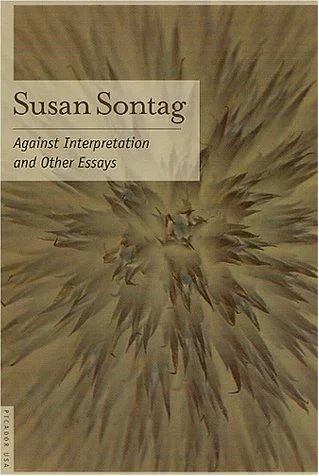
Against Interpretation
 72
72

Against Interpretation



Sophia Crane (Associate Editor) — Susan Sontag's "Against Interpretation" remains a cornerstone for those exploring the deeper currents of aesthetic experience, particularly through an esoteric lens. Crane's essay "Art and Orthodoxy" within this collection masterfully dissects how rigid interpretive frameworks can act as a form of spiritual censorship, obscuring the immediate, magical encounter art can facilitate. The book's enduring power lies in its call to a more direct, sensory engagement with creative works, echoing the primal, ritualistic origins of art. It is an essential read for scholars and practitioners alike who seek to reclaim the transformative, incantatory potential of art, moving beyond intellectualization to a profound, embodied understanding.
📝 Description
72
Published in 1966, Susan Sontag's "Against Interpretation" critiques how we consume art.
Susan Sontag’s 1966 essay collection, "Against Interpretation," challenges conventional approaches to understanding art. Sontag argues that over-analysis, particularly through Freudian or Marxist lenses, can obscure the true impact of a work. She suggests that art’s power lies not in its decipherable content but in its sensory and emotional force. Instead of dissecting meaning, Sontag advocates for a direct, unmediated experience of art. She believes that art, in its original forms, functioned more like ritual or magic, aiming for visceral response rather than intellectual grasp.
The essays in this collection urge readers to approach creative works with a heightened receptivity. Sontag proposes that by resisting the urge to interpret, we can achieve a more profound connection with art. This involves acknowledging the work's immediate, often physical, effect on the viewer or listener. The goal is not to extract a hidden message but to be transformed by the sheer presence and form of the artwork. This approach promises an escape from intellectual rigidity and a rediscovery of art's raw, elemental power.
While not explicitly a text on esoteric practices, "Against Interpretation" resonates with certain mystical traditions that emphasize direct experience over intellectual dogma. Sontag's call to bypass analytical frameworks and engage with art on a visceral, intuitive level mirrors contemplative practices that seek immediate apprehension of truth. Her idea that art can function as a conduit for powerful, unmediated experience aligns with concepts of sacred objects or rituals that aim to induce altered states of consciousness or a direct connection to underlying realities, moving beyond symbolic meaning to felt presence.
💡 Why Read This Book?
Unlock the primal, ritualistic power of art. "Against Interpretation" liberates you from intellectual shackles, inviting direct, embodied engagement with creative works. Ideal for seekers, scholars, and practitioners who yearn to experience art as a conduit for magic and transformation, revealing hidden layers of meaning beyond the confines of analysis. Read this to reclaim art's potent, incantatory essence.
⭐ Reader Reviews
Honest opinions from readers who have explored this book.
❓ Frequently Asked Questions
What is the central argument of 'Against Interpretation'?
The book argues against the prevailing tendency to over-interpret art, suggesting that such analysis often diminishes its immediate, sensory, and even magical impact, urging a more direct and experiential engagement.
How does Sontag connect art to ritual?
Sontag posits that the earliest forms of art were intrinsically linked to ritual and magic, serving as instruments of incantation and spiritual practice, and advocates for a return to this more primal mode of artistic encounter.
Who is the intended audience for this book?
The book is aimed at intellectually curious readers, artists, critics, philosophers, and anyone interested in challenging conventional approaches to art and understanding its deeper, transformative power.
What are the benefits of reading 'Against Interpretation'?
Reading this book can lead to a more profound and direct appreciation of art, fostering a deeper understanding of its sensory and emotional impact, and encouraging a more liberated and intuitive aesthetic experience.
Is this book difficult to understand?
While intellectually rigorous, Sontag's prose is often vivid and compelling. The concepts require thoughtful engagement, but the rewards of deeper aesthetic perception are substantial.
🔮 Key Themes & Symbolism
The Liberation from Interpretation
Sontag's central thesis champions a radical shift away from the intellectual dissection of art towards a more direct, sensory, and visceral experience. She critiques the prevalent hermeneutic approach, which seeks to uncover hidden meanings, arguing that this process often sterilizes the artwork, reducing it to a mere cipher for analysis. By advocating for 'interpretation of the work of art as such,' she encourages readers to engage with the artwork's form, its sensuousness, and its immediate impact, thereby reclaiming its potent, almost magical, capacity to evoke and transform. This theme resonates deeply with esoteric traditions that prioritize direct gnosis and intuitive understanding over dogma and intellectualization.
Art as Primordial Ritual and Incantation
Drawing a parallel between early human experience and contemporary artistic engagement, Sontag posits that art's origin is rooted in magic and ritual. She suggests that art was initially an instrument of incantation, a means to shape reality and connect with the numinous. This perspective reframes art not as a decorative or intellectual pursuit, but as a potent force capable of enacting change and invoking states of consciousness. For the esoteric reader, this connection to ritual underscores art's potential as a tool for spiritual practice, a conduit for channeling energies, and a means to access deeper, unseen domains of existence.
The Alchemy of Aesthetic Experience
This collection functions as an alchemical primer, guiding the reader through a transformative process of de-interpretation and re-engagement with art. Sontag's essays act as catalysts, dissolving preconceived notions and rigid analytical frameworks, much like a solvent breaks down base materials. The goal is not to create gold (a definitive meaning), but to transmute the reader's perception, fostering a more vibrant, alive, and embodied relationship with the aesthetic. This alchemical journey encourages the discovery of hidden potential within both the artwork and the self, leading to a more profound and mystical understanding of beauty and truth.
💬 Memorable Quotes
Direct passages from the work, attributed to the author.
“In place of a hermeneutics we need an erotics of art.”
— This profound statement calls for a shift from intellectual analysis to sensual, embodied experience, urging a passionate and direct encounter with art's immediate power, akin to a mystical awakening.
“The earliest experience of art must have been that it was incantatory, magical; art was an instrument of ritual.”
— This highlights art's primal, potent function as a tool for invoking, shaping, and connecting with deeper realities, echoing the core of many ancient esoteric practices.
“To interpret is to lay waste to the imagery of the world.”
— This powerful metaphor suggests that excessive interpretation destroys the spontaneous, magical perception of art, reducing its vital essence to sterile intellectual constructs.
“The world is a sensory experience, and art is an intensified sensory experience.”
— Sontag emphasizes art's capacity to heighten our awareness of the world, urging us to embrace its direct sensory impact rather than attempting to decipher it intellectually.
“The most luminous things in the most advanced art are precisely those that are the most difficult to talk about.”
— This points to the ineffable, mystical core of art that transcends language, suggesting that true understanding lies in direct experience and intuitive apprehension, not mere description.
🌙 Esoteric Significance
Tradition
While not explicitly tied to a single esoteric tradition, Sontag's work profoundly carries the core tenets of Gnosticism and certain mystical philosophies. Her emphasis on direct experience over dogma, on intuitive understanding over intellectualization, and on art as a conduit for primal, revelatory power aligns with the Gnostic pursuit of immediate knowledge (gnosis) and the rejection of intermediaries that obscure truth. The idea of art as incantatory and ritualistic also connects with shamanic practices and the Hermetic principle of 'as above, so below,' suggesting art can bridge the material and spiritual realms.
Symbolism
Sontag implicitly engages with the concept of symbolism not as fixed signs to be decoded, but as evocative elements that contribute to the artwork's overall sensory and emotional charge. She cautions against reducing complex symbols to simplistic interpretations, instead urging the reader to experience their complex resonance. The 'imagery' she seeks to preserve can be seen as the symbolic language of the subconscious and the collective unconscious, a language that speaks directly to the soul through form, color, and sound, bypassing the rational mind's need for explicit definition.
Modern Relevance
In an era saturated with information and hyper-analysis, Sontag's call to 'erotics of art' is more vital than ever. Her critique of interpretation finds new life in the digital age, where art is constantly dissected, commodified, and mediated through endless streams of commentary. Her insistence on direct, embodied experience serves as a crucial antidote to passive consumption, encouraging a more mindful and transformative engagement with creative works. For practitioners of esoteric arts, her ideas offer a framework for understanding the potent, often ineffable, power of symbolic expression and ritualistic creation, reminding us that true understanding often lies beyond the reach of mere words.
👥 Who Should Read This Book
This vital collection is essential for anyone seeking a deeper, more resonant connection with art and culture. **Seekers** will find it a guide to uncovering the hidden, mystical dimensions of creative works, moving beyond superficial understanding to genuine experience. **Scholars and critics** will be challenged to re-evaluate their analytical methods, embracing a more intuitive and embodied approach to interpretation. **Practitioners** of various esoteric disciplines will discover how art can serve as a potent tool for ritual, transformation, and spiritual awakening, aligning with ancient traditions of symbolic power and direct gnosis. **Beginners** curious about the philosophy of art will gain a foundational understanding of critical thought and discover a pathway to a richer aesthetic life.
📜 Historical Context
Published in 1966, "Against Interpretation" emerged during a period of intense cultural and intellectual ferment in the United States. The post-war era saw a growing detachment from traditional modes of understanding, a questioning of established authorities, and a burgeoning interest in subjective experience and counter-cultural movements. Sontag, a prodigious and influential voice, responded to the academic and critical tendency to reduce art to intellectual exercises, particularly within the burgeoning fields of literary criticism and film studies. Her essays challenged the prevailing "content"-focused analysis, advocating instead for a focus on form and sensory experience. This resonated with a generation seeking new ways to engage with the world, aligning with burgeoning philosophical inquiries into phenomenology, existentialism, and the power of the senses, and laid groundwork for later postmodern and deconstructionist thought, while also touching upon the enduring human fascination with art's inherent, almost magical, power.
📔 Journal Prompts
Reflect on a piece of art that you initially struggled to 'understand.' How did your perception change when you focused on its sensory impact rather than its potential meaning?
Consider the idea of art as 'incantatory.' In what ways can art be seen as a form of ritual or magic in your own life or in society?
Sontag argues against over-interpretation. Where do you see the line between insightful analysis and 'laying waste to the imagery' of a work?
If art is an 'erotics,' what does this suggest about the nature of genuine aesthetic pleasure and its connection to the body and senses?
How can you consciously practice an 'erotics of art' in your daily engagement with visual media, music, or literature?
🗂️ Glossary
Hermeneutics
The theory and methodology of interpretation, especially the interpretation of biblical texts, wisdom literature, and philosophical texts. Sontag critiques its application to art as often reductive.
Erotics of Art
Sontag's proposed alternative to hermeneutics, emphasizing a direct, sensory, and passionate engagement with art, focusing on its immediate impact and visceral experience.
Incantatory
Relating to or of the nature of incantation; magical or spellbinding. Sontag uses this to describe the primal power of art.
Content vs. Form
A critical distinction where 'content' refers to the subject matter or message, and 'form' refers to the structure, style, and sensory elements of a work. Sontag prioritizes form.
Sensuous
Relating to or affecting the senses rather than the intellect. Sontag champions this as a primary mode of experiencing art.
This book appears in 2 collections
🔮 Readers Also Liked
Browse all →





From the “Ritual Magic” Collection
View all →







More Free Magic & Ritual Books
View all →