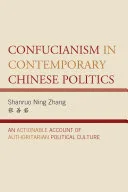
Confucianism in Contemporary Chinese Politics
 82
82

Confucianism in Contemporary Chinese Politics
Shanruo Ning Zhang’s analysis of Confucianism’s role in contemporary Chinese politics provides a much-needed corrective to superficial understandings of the nation’s governance. The author’s central thesis—that authoritarian political culture can perform functions akin to democratic systems by drawing on Confucian frameworks—is robustly supported by a diverse array of data, including extensive interviews and analysis of Party Congress Reports. A particular strength lies in the meticulous dissection of how concepts like filial piety and hierarchical order translate into political mechanisms. However, the sheer density of the data, while commendable, occasionally leads to a somewhat dry presentation, making the theoretical leaps less immediately apparent than they could be. Despite this, the work’s examination of the Party Congress Reports as a mechanism for reinforcing political culture is a standout contribution. This book offers a vital, if demanding, perspective on Chinese political realities.
📝 Description
82
Shanruo Ning Zhang's 2016 book examines Confucianism's influence on contemporary Chinese politics.
Published in 2016, Confucianism in Contemporary Chinese Politics by Shanruo Ning Zhang analyzes how traditional Confucian political culture continues to shape modern China's governance. The author argues that authoritarian political structures in China can perform functions similar to those in democratic systems, rather than being purely repressive. Zhang's work moves past simple oppositions to show how established ethical frameworks interact with and mold current political realities.
This book is for academics, policymakers, and students of East Asian politics, comparative political theory, and cultural studies. It appeals to those wanting a deeper grasp of China's political landscape, looking beyond superficial views to the cultural foundations guiding its development. Readers interested in the connection between philosophy and statecraft will find considerable content here.
The book appeared during a time of renewed focus on Confucianism in China, often presented as a source of national identity and moral direction. This revival coincided with global economic shifts and ongoing questions about the legitimacy and future of the Chinese Communist Party's rule. Zhang's study critically examines this contemporary reevaluation, placing it within a longer historical context of political thought and practice.
While not strictly esoteric in the sense of occult or mystical traditions, this book engages with the deeper, often unstated philosophical and ethical underpinnings that inform a political system. It treats Confucianism not merely as historical doctrine but as a living tradition whose concepts of social order, virtuous leadership, and ritual continue to operate within contemporary statecraft, influencing the 'logic' of governance. This approach considers the ideational architecture of a political culture, which can be seen as an esoteric dimension to understanding state power and legitimacy beyond purely material or institutional analysis.
💡 Why Read This Book?
• Gain an understanding of how Confucian concepts like the Mandate of Heaven are reinterpreted and utilized within the Chinese Communist Party's political discourse, offering insights beyond standard Western political science frameworks. • Learn about the specific data sources, such as Public Hearing Meeting records from 2010-2015, that Zhang employs to demonstrate the functional operations of Confucian political culture, providing a concrete basis for the book's arguments. • Discover how traditional ethical frameworks, particularly those emphasizing hierarchical order and virtue in leadership, are argued to serve practical functions within China's authoritarian political system, challenging simplistic notions of governance.
⭐ Reader Reviews
Honest opinions from readers who have explored this book.
❓ Frequently Asked Questions
What is the primary argument of Confucianism in Contemporary Chinese Politics?
The book argues that Confucian political culture performs functions similar to democratic political culture within China's contemporary authoritarian system, utilizing a wide range of data to illustrate this point.
What kind of data does Shanruo Ning Zhang use in this book?
Zhang draws on surveys, interviews, archival materials, Public Hearing Meeting records, and Chinese Communist Party Congress Reports to support her arguments.
When was Confucianism in Contemporary Chinese Politics first published?
The book was first published on March 29, 2016.
How does the book relate Confucianism to authoritarianism?
It examines how Confucian political culture operates within and influences the development of China's authoritarian political system, suggesting functional parallels with democratic cultures.
Who is the author of Confucianism in Contemporary Chinese Politics?
The author is Shanruo Ning Zhang.
What is the esoteric angle of this book?
While primarily a political science text, its examination of deeply ingrained cultural and ethical philosophies as drivers of political systems offers an esoteric lens on societal organization and power.
🔮 Key Themes & Symbolism
Authoritarianism and Confucianism
This theme explores the intricate relationship between China's authoritarian political structure and the enduring influence of Confucianism. The work posits that traditional Confucian values, such as emphasis on hierarchy, order, and the moral cultivation of leaders, are not antithetical to but rather functional components of the contemporary authoritarian state. Zhang investigates how these values are invoked and operationalized to maintain political stability and legitimacy, offering a nuanced perspective that moves beyond simplistic East-West political dichotomies.
Political Culture as Functional
A central argument is that political culture, particularly one steeped in Confucian tradition, performs vital functions within a state. This theme challenges the notion that only democratic cultures are inherently functional or beneficial. The book demonstrates how elements of Confucian political culture contribute to governance by providing frameworks for social order, leadership expectations, and collective identity, even within an authoritarian context. The analysis relies on empirical data to substantiate these functional claims.
Data-Driven Political Analysis
This theme highlights the rigorous empirical methodology employed by Shanruo Ning Zhang. The book is built upon a foundation of diverse data sources, including extensive survey data, in-depth interviews with political actors and citizens, archival research, official records like Public Hearing Meeting minutes, and seminal documents such as the Chinese Communist Party Congress Reports. This commitment to empirical evidence grounds the theoretical arguments in tangible realities of Chinese political life.
Influence on Political Development
The book critically examines how Confucian political culture actively shapes and influences the trajectory of China's political development. It moves beyond describing the mere presence of Confucian ideas to analyzing their dynamic role in shaping institutions, policies, and the very nature of political discourse. Understanding this influence is presented as crucial for comprehending the unique characteristics and future direction of Chinese governance in the 21st century.
💬 Memorable Quotes
Direct passages from the work, attributed to the author.
“The authoritarian political culture performs functions similar to the democratic political culture.”
— This statement expresses the book's provocative central thesis, suggesting that the mechanisms of control and social cohesion found in authoritarian regimes can draw upon ethical and cultural traditions in ways analogous to how democratic systems function.
“Drawing on a wide range of data—surveys, interviews, archives, Public Hearing Meeting records, and the Party Congress Reports of the Chinese Communist Party—to substantiate and illustrate these arguments.”
— This emphasizes the empirical rigor of the study, indicating that the author's claims are grounded in extensive, multi-faceted research into the practical workings of Chinese politics.
“Confucianism in Contemporary Chinese Politics examines the ways in which Confucian political culture operates in contemporary Chinese politics.”
— This straightforward description points to the book's primary objective: to dissect the mechanisms and manifestations of Confucian influence within the current political environment of China.
“The work analyzes how traditional ethical frameworks interact with and shape contemporary political realities.”
— This interpretation underscores the book's sophisticated approach, highlighting its exploration of the interplay between historical philosophical traditions and the practical, evolving nature of modern governance.
💡 Key Ideas
Editorial paraphrase of the work's core concepts — not direct quotes.
The author argues that Confucian political culture operates in contemporary Chinese politics and influences its development.
This paraphrase highlights the book's core focus: not just the passive existence of Confucianism, but its active, dynamic role in shaping the ongoing evolution of China's political landscape.
🌙 Esoteric Significance
Tradition
While not strictly an esoteric text in the Western occult sense, this book studies the 'esoteric' underpinnings of political power by examining how deeply ingrained philosophical and ethical systems (Confucianism) act as unseen forces shaping societal structures. It approaches the 'spirit' or underlying principles of governance, akin to how Hermetic philosophy explores universal laws governing existence, but applied to the area of political science and cultural sociology.
Symbolism
The book implicitly engages with symbols of authority and order inherent in Confucianism. Concepts like 'filial piety' (孝, xiào) and the emphasis on 'ritual' (禮, lǐ) function as symbolic frameworks that organize social and political relationships. These are not merely abstract ideals but are interpreted as operational motifs that guide behavior and legitimize hierarchical structures within the state apparatus.
Modern Relevance
Contemporary thinkers and political analysts studying East Asian governance, particularly China, continue to draw upon works that analyze the deep cultural roots of political systems. Scholars interested in the 'performance' of politics, the role of ideology in authoritarian states, and the selective revival of tradition for statecraft find resonance in Zhang's empirical approach. It informs studies on soft power, cultural diplomacy, and the resilience of non-Western political models.
👥 Who Should Read This Book
• Scholars of comparative politics and East Asian studies seeking to understand the cultural underpinnings of Chinese governance beyond superficial analyses. • Students of political philosophy interested in how ancient ethical systems are actively employed and reinterpreted within modern statecraft. • Policymakers and analysts focused on China who require a nuanced, data-driven perspective on the interplay between culture, ideology, and political development.
📜 Historical Context
Published in 2016, Shanruo Ning Zhang's work arrived during a period of significant intellectual re-engagement with Confucianism within China, often promoted by the state as a source of national identity and social harmony. This occurred against a backdrop of global economic shifts and ongoing debates about political legitimacy. The book engaged with scholarship examining the resurgence of traditional values in post-Mao China, offering a counterpoint to purely modernization or Westernization theories. While the book itself did not face overt censorship, its arguments about the functional utility of authoritarian political culture, derived from Confucianism, implicitly engaged with critical perspectives on the Chinese Communist Party's governance model. Contemporaries like Daniel Bell, who also explored Confucianism's political relevance, operated in similar intellectual spaces, though Zhang's focus remained distinctly on the operational aspects within the PRC's specific political system.
📔 Journal Prompts
The functional aspects of authoritarian political culture, as explored through Confucianism.
Analysis of Party Congress Reports as a mechanism for reinforcing political culture.
The translation of traditional ethical frameworks like filial piety into contemporary political practice.
The author's use of diverse data sources (surveys, interviews, archives) to substantiate arguments.
The concept of political culture performing functions analogous to democratic systems.
🗂️ Glossary
Confucian Political Culture
The set of values, beliefs, norms, and practices derived from Confucian philosophy that influence the conduct of politics and governance within a society, particularly in China.
Authoritarian Political Culture
A political culture characterized by strong central power, limited political freedoms, and a focus on order and stability, often contrasted with democratic political culture.
Democratic Political Culture
A political culture associated with democratic systems, emphasizing citizen participation, individual rights, rule of law, and accountability of leaders to the populace.
Party Congress Reports
Official documents and pronouncements issued by the Chinese Communist Party during its national congresses, outlining policy directions, ideological frameworks, and assessments of the political situation.
Public Hearing Meeting Records
Official transcripts or summaries of public forums or hearings organized by government bodies or Party organs to solicit feedback or present information on specific policies or issues.
Filial Piety (孝, xiào)
A core Confucian virtue emphasizing respect, obedience, and care for one's parents and elders, often extended metaphorically to the relationship between subjects and rulers.
Ritual (禮, lǐ)
In Confucianism, a broad concept encompassing propriety, etiquette, ceremonies, and social norms that regulate interactions and maintain social harmony and order.