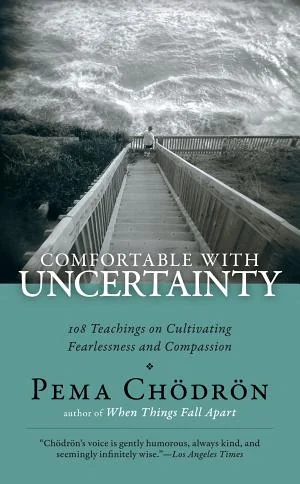
Comfortable with Uncertainty
 80
80

Comfortable with Uncertainty
Pema Chödrön’s "Comfortable with Uncertainty" functions less as a book and more as a collection of accessible, gentle nudges toward a more resilient way of being. Chödrön, drawing from her extensive background in Tibetan Buddhism, consistently returns to the core idea that life’s inherent messiness is not an obstacle to spiritual practice, but its very substance. One particular strength lies in her ability to distill complex philosophical ideas into relatable anecdotes, such as her discussion of how we often "shrink the enemy" by projecting our own fears onto external circumstances. However, the book’s structure, comprised of short teachings, can sometimes feel repetitive, with similar points revisited across different chapters. While this repetition aids memorization, it may test the patience of readers seeking a more linear progression. The work's true power lies in its simple, direct encouragement to meet discomfort head-on, rather than flee from it. "Comfortable with Uncertainty" offers a steady hand in turbulent times.
📝 Description
80
Pema Chödrön's 2008 book, Comfortable with Uncertainty, teaches how to meet life's unpredictability.
Published in 2008, Comfortable with Uncertainty is Pema Chödrön's guide to facing life's unpredictable nature. It is not a theoretical work but a collection of teachings drawn from Tibetan Buddhist philosophy. Chödrön helps readers understand and work with the discomfort that arises when situations are unclear or overwhelming. The book suggests viewing uncertainty not as something to fix, but as a natural part of existence to accept.
This book suits individuals dealing with anxiety or stagnation due to life's uncertainties. It offers a framework for handling personal challenges, whether during transitions, difficult decisions, or general feelings of being overwhelmed. Readers familiar with Buddhist ideas will find accessible exposition, while newcomers will get a gentle introduction to applying these teachings to everyday problems. It is for the introspective seeker.
Pema Chödrön's work stems from the Tibetan Buddhist tradition, particularly the lineage of Chögyam Trungpa Rinpoche. Her teachings aim to translate these ancient contemplative practices for a Western audience, focusing on practical application in modern life. The book's message aligns with a broader interest in mindfulness and acceptance, positioning it within contemporary contemplative spirituality.
💡 Why Read This Book?
• You will learn practical methods for reframing fear and anxiety by directly engaging with the concept of "shrinking the enemy," a key teaching from the Tibetan Buddhist tradition, rather than avoiding difficult emotions. • You will gain a deeper understanding of "coddling the Buddha-nature," a practice for recognizing and nurturing inherent goodness within yourself and others, offering a unique perspective on self-compassion beyond conventional advice. • You will discover the transformative potential of "tonglen" meditation, a specific Buddhist practice for transforming suffering, as detailed in the book's teachings, providing a tangible tool for cultivating empathy and reducing personal distress.
⭐ Reader Reviews
Honest opinions from readers who have explored this book.
❓ Frequently Asked Questions
What is Pema Chödrön's core teaching in 'Comfortable with Uncertainty'?
The core teaching is to embrace life's inherent unpredictability and discomfort, rather than resisting it. Pema Chödrön, drawing from Tibetan Buddhist principles, encourages facing uncertainty with curiosity and courage as a path to greater wisdom and compassion.
How does the book relate to Buddhist philosophy?
The book is deeply rooted in Tibetan Buddhist philosophy, particularly the teachings of Chögyam Trungpa Rinpoche. It translates core Buddhist concepts like impermanence and suffering into practical guidance for everyday Western life, making them accessible.
What is the 'brave way of ripening' mentioned in the book?
The 'brave way of ripening' is Chödrön's term for courageously meeting difficult situations and emotions as they arise, allowing them to teach us and foster personal growth, rather than trying to suppress or escape them.
Is 'Comfortable with Uncertainty' suitable for beginners to Buddhism?
Yes, the book is highly accessible for beginners. While it draws from Buddhist teachings, Chödrön explains concepts clearly and uses relatable examples, making it a gentle entry point for those new to these ideas.
What is the significance of the year 2008 for this book?
2008 marks the original publication year of 'Comfortable with Uncertainty.' This timing placed the book's message of embracing uncertainty amidst a backdrop of global economic instability and heightened public anxiety.
Does the book offer specific meditation techniques?
Yes, the book discusses and explains specific meditation practices such as 'tonglen' (giving and taking), which is presented as a method for transforming personal and collective suffering by cultivating empathy.
🔮 Key Themes & Symbolism
Embracing the Unknown
The central tenet of the book is the radical acceptance of life's inherent uncertainty. Chödrön challenges the common human desire for security and predictability, framing them as the root of much suffering. Instead, she proposes that by directly confronting and even welcoming the unknown, we open ourselves to greater wisdom, resilience, and compassion. This involves learning to sit with discomfort, rather than immediately seeking to escape it, viewing the unpredictable nature of existence as fertile ground for spiritual growth.
Working with Difficult Emotions
Chödrön provides practical guidance on how to engage with challenging emotions like fear, anxiety, and anger. Rather than suppressing these feelings or identifying with them, she advocates for observing them with curiosity and kindness. Concepts like "shrinking the enemy" illustrate how we often project our internal struggles onto external situations. The book encourages a non-reactive stance, fostering a sense of inner spaciousness that allows difficult emotions to arise and pass without overwhelming us.
The Practice of Compassion
Compassion, both for oneself and others, is a recurring theme. Chödrön suggests that true compassion arises from acknowledging our shared vulnerability and the universality of suffering. Practices like "tonglen" (giving and taking) are presented as potent methods for cultivating empathy by actively engaging with the pain of others and offering them relief, thereby transforming our own habitual patterns of self-concern and isolation.
Nurturing Inner Goodness
The book emphasizes the concept of "coddling the Buddha-nature," a reminder of the inherent goodness and potential for awakening within each individual. This involves treating oneself with the same kindness and patience one might offer a beloved child, especially during difficult times. It's about recognizing and supporting the nascent seeds of wisdom and compassion that already exist, allowing them to flourish through consistent, gentle practice.
💬 Memorable Quotes
Direct passages from the work, attributed to the author.
“The only way to make sense out of change is to plunge into it, move with it, and join the dance.”
— This captures the active, engaged approach to life's flux that Chödrön advocates. It suggests that resistance is futile and that embracing change, much like a dance, leads to a more harmonious and insightful experience of existence.
“It is by going down into the abyss of suffering that we find the most exquisite flowers.”
— This interpretation reflects the book's core message about confronting difficulties. It suggests that true growth and profound understanding (the 'exquisite flowers') are found not by avoiding pain, but by courageously facing and integrating our experiences of suffering.
“We are just an ordinary person, learning as we go.”
— This interpretation underscores Chödrön's emphasis on humility and self-acceptance. It normalizes the struggle and learning process inherent in spiritual growth, reassuring readers that imperfection is part of the path.
💡 Key Ideas
Editorial paraphrase of the work's core concepts — not direct quotes.
The essence of Buddhism is the practice of mindfulness and compassion.
This paraphrased concept highlights Pema Chödrön's consistent focus on the two pillars of Buddhist practice. It underscores her approach of making these profound principles accessible and applicable to everyday challenges faced by individuals.
Letting there be nothing but the present moment.
This paraphrased idea points to the practice of radical presence. It encourages readers to release attachments to the past and anxieties about the future, focusing instead on the immediate reality of 'now' as the only true ground for experience.
🌙 Esoteric Significance
Tradition
The work is firmly rooted in the Vajrayana tradition of Tibetan Buddhism, a lineage often considered esoteric due to its complex philosophical systems, tantric practices, and emphasis on the guru-disciple relationship. Chödrön's contribution lies in translating these intricate teachings into accessible language for a Western audience, particularly focusing on the Mahayana concepts of compassion and emptiness as applied to everyday life. She departs from highly ritualistic or scholastic interpretations, emphasizing the experiential and psychological dimensions of Buddhist practice.
Symbolism
A key symbolic motif is the 'dance' of life, representing the dynamic, ever-changing nature of existence that one can learn to move with rather than resist. The 'abyss of suffering' serves as a symbol for confronting difficult experiences directly, suggesting that useful insights and growth ('exquisite flowers') emerge from such encounters. The concept of 'shrinking the enemy' symbolizes the psychological projection of internal fears and conflicts onto external situations or individuals, a common obstacle on the spiritual path.
Modern Relevance
Contemporary mindfulness and wellness movements frequently draw upon the principles articulated by Chödrön. Therapists and coaches often incorporate her ideas on acceptance and working with difficult emotions. Furthermore, secularized Buddhist practices, popular in tech industries and corporate wellness programs, echo her emphasis on resilience and presence. Thinkers and practitioners in fields ranging from positive psychology to trauma-informed care find value in her non-judgmental approach to human experience.
👥 Who Should Read This Book
• Individuals experiencing significant life transitions (e.g., career changes, relationship endings, grief) seeking a compassionate framework for navigating instability and fear. • Practitioners of mindfulness and meditation who wish to deepen their understanding of acceptance and working with challenging emotional states beyond basic techniques. • Seekers of spiritual wisdom who are drawn to Buddhist philosophy but prefer practical, accessible teachings over dense academic or ritualistic texts.
📜 Historical Context
Published in 2008, Pema Chödrön’s "Comfortable with Uncertainty" arrived during a period marked by significant global anxieties, including the burgeoning financial crisis and ongoing geopolitical tensions. Chödrön, already a renowned Buddhist teacher and an American nun in the Tibetan tradition of Chögyam Trungpa Rinpoche, offered a counter-narrative to the prevailing atmosphere of fear. Her work resonated widely, tapping into a growing Western interest in mindfulness and contemplative practices that had been gaining traction since the late 20th century, influenced by figures like Jon Kabat-Zinn. While not directly engaging with academic Buddhist studies, her accessible teachings provided a practical, non-dogmatic spiritual path. The book's message of finding peace amidst chaos stood in contrast to more existentialist philosophies that might emphasize inherent meaninglessness or the burden of freedom, offering instead a path of gentle acceptance and inner resilience.
📔 Journal Prompts
The experience of 'shrinking the enemy' in my own life.
Moments when I resisted the 'dance' of change and its consequences.
How the practice of 'coddling the Buddha-nature' might apply to a current challenge.
Exploring the 'abyss of suffering' and potential lessons within it.
Applying the principle of 'letting there be nothing but the present moment' to a specific worry.
🗂️ Glossary
Buddha-nature
In Tibetan Buddhism, the inherent potential for awakening or enlightenment that exists within all sentient beings. It is the fundamental goodness and purity that underlies our experience, often obscured by obscurations of ignorance and negative emotions.
Tonglen
A Tibetan Buddhist meditation practice that involves visualizing taking in the suffering of others with the in-breath and sending out relief, happiness, and well-being with the out-breath. It cultivates compassion and reduces self-centeredness.
Shrinking the Enemy
A concept describing the tendency to project our own fears, insecurities, and negative qualities onto others, thereby creating an 'enemy' figure. This practice helps recognize how we externalize internal struggles.
Impermanence (Anicca)
A fundamental Buddhist teaching stating that all conditioned phenomena are in a constant state of flux and change. Nothing is permanent; everything arises, exists for a time, and ceases.
Mindfulness
The practice of paying attention to the present moment intentionally and non-judgmentally. It involves awareness of thoughts, feelings, bodily sensations, and the surrounding environment.
Vajrayana
A branch of Mahayana Buddhism, prominent in Tibet, characterized by complex philosophical teachings, tantric practices, and the use of symbolic rituals and visualizations to achieve enlightenment.
The Brave Way of Ripening
A phrase used by Chödrön to describe the courageous approach of fully experiencing and learning from difficult situations and emotions, rather than avoiding them, thereby fostering personal and spiritual growth.
🔮 Readers Also Liked
Browse all →









More by Pema Chödrön
All books →





More Free Occult Philosophy Books
View all →