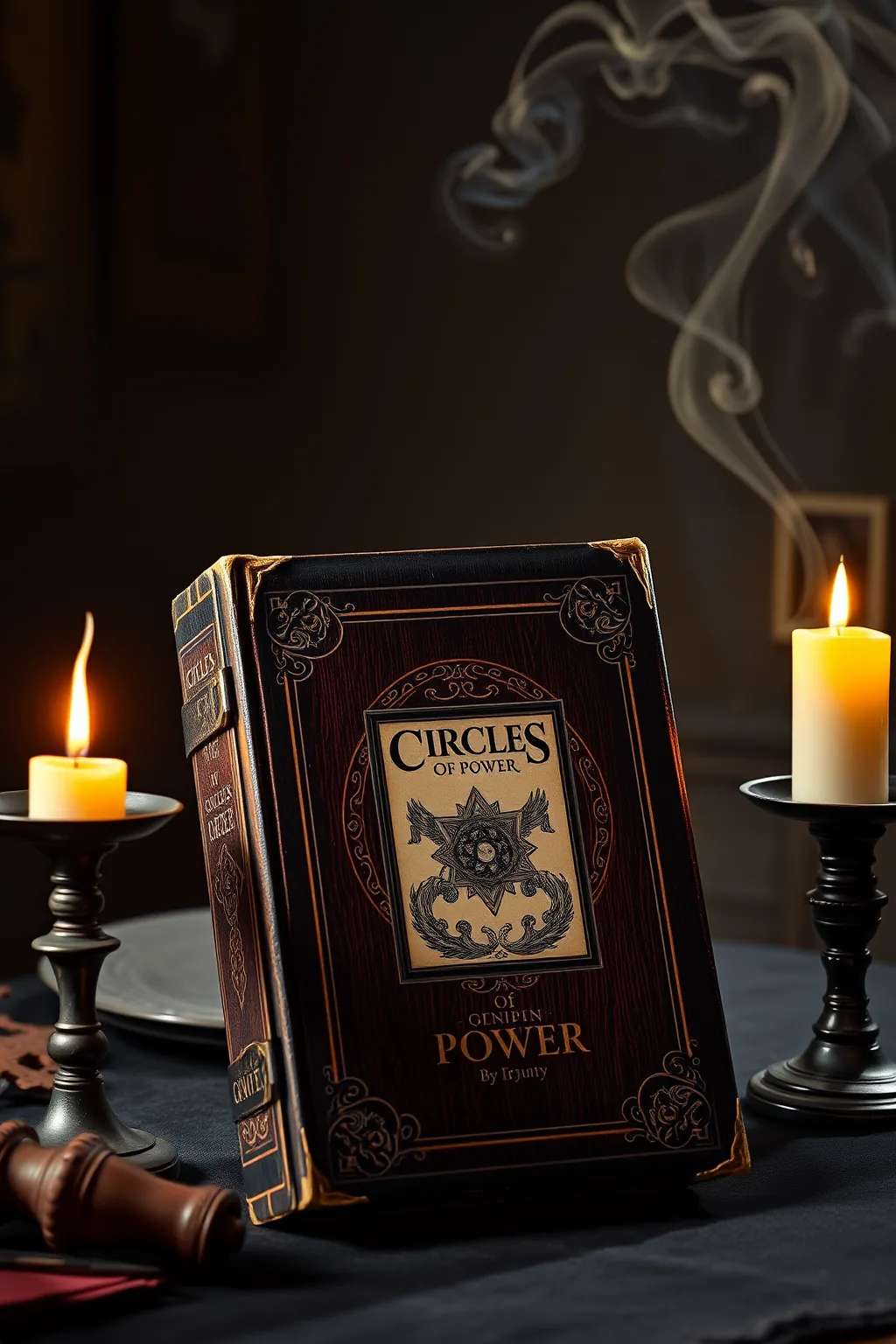
Circles of Power
 75
75

Circles of Power
John Michael Greer's *Circles of Power* attempts a grand synthesis, and largely succeeds in presenting a coherent, if demanding, model of esoteric forces. The book's strength lies in its systematic approach, drawing connections between diverse occult systems with an architect's precision. Greer avoids the pitfalls of merely cataloging traditions, instead building a functional framework. For instance, his discussion of the 'Will-to-Power' as a fundamental cosmic principle, a concept echoing Nietzsche but recontextualized within magical theory, is particularly compelling. However, the book's density can be a significant barrier; it assumes a substantial prior knowledge of esoteric subjects. A reader unfamiliar with basic Kabbalistic or Hermetic terms will struggle immensely. Despite this, the work offers a valuable perspective for those willing to engage with its rigor. *Circles of Power* provides a robust, intellectually satisfying map for the seasoned traveler of the occult landscape.
📝 Description
75
John Michael Greer published Circles of Power in 2017, proposing a unified framework for occult traditions.
Circles of Power, published in 2017, offers a unified framework for understanding the underlying principles of various magical and occult traditions. It is not an introductory text but is aimed at those with existing knowledge of esoteric concepts, particularly Western esotericism. The book is designed for serious practitioners and scholars who seek to synthesize disparate occult philosophies into a coherent worldview. It moves beyond superficial understandings, aiming for a deeper, systemic comprehension of these subjects.
The work addresses the nature of magical energy, the architecture of consciousness, and the dynamics of spiritual evolution. It also examines cyclical patterns governing personal and collective magical endeavors. Greer provides a lexicon for discussing these abstract ideas and suggests methods for their practical application in magical work. The book emphasizes a holistic understanding of power and its manifestation across different planes of existence, aiming for a systemic coherence in occult thought.
Circles of Power emerged in 2017 amid a resurgence of interest in esoteric traditions, both in academia and spiritual circles. This period saw increased online engagement and a desire to connect historical practices with modern life. Greer's work offers a structured approach to systematizing occult ideas, contrasting with more fragmented or eclectic methods prevalent at the time. It engages with concepts previously addressed by figures like Aleister Crowley and Dion Fortune, but with a focus on systemic coherence.
💡 Why Read This Book?
• You will learn to perceive the underlying structural principles connecting disparate magical systems, as detailed in Greer's framework for understanding the 'architecture of consciousness' and its relation to manifest reality. • You will gain a method for analyzing the cyclical nature of magical efficacy and historical occult movements, providing a lens through which to understand the ebb and flow of esoteric influence since the 2017 publication. • You will acquire a practical understanding of how core esoteric concepts, such as the 'Will-to-Power,' can be integrated into personal magical practice, moving beyond theory to applied understanding.
⭐ Reader Reviews
Honest opinions from readers who have explored this book.
❓ Frequently Asked Questions
What esoteric traditions does John Michael Greer draw upon in Circles of Power?
Greer synthesizes elements from Western Hermeticism, Kabbalah, ceremonial magic, and concepts related to the Great Work. He aims to show how these traditions share common structural principles and can be understood within a unified esoteric worldview.
Is Circles of Power suitable for beginners in occult studies?
No, the book is best suited for individuals with a solid foundational knowledge of esoteric subjects. It assumes familiarity with concepts like the Qabalah, the Tarot, and various magical correspondences.
When was John Michael Greer's Circles of Power first published?
The book was first published in 2017, making it a relatively contemporary contribution to esoteric literature that synthesizes older traditions.
What is the 'Will-to-Power' concept as presented by Greer?
Greer reinterprets the 'Will-to-Power,' a concept often associated with Nietzsche, within an esoteric framework. He presents it as a fundamental cosmic drive and a key principle in understanding magical operations and spiritual evolution.
Does Circles of Power offer practical magical exercises?
While primarily a theoretical and philosophical work, the book provides a framework that can inform and enhance practical magical work. It aims to deepen the practitioner's understanding of the forces they engage with.
What distinguishes Greer's approach in Circles of Power from other esoteric texts?
Greer's approach is characterized by its emphasis on systemic coherence and structural analysis. He seeks to build a unified model of esoteric principles rather than simply describing individual practices or traditions.
🔮 Key Themes & Symbolism
The Architecture of Magic
Greer posits that various magical traditions, despite their diverse expressions, share an underlying 'architecture.' This theme explores how concepts like correspondences, divine names, and elemental forces function within a unified, systematic model. The book dissects how these elements interact to form coherent magical languages and practices, emphasizing structure over mere symbolism. It suggests that understanding this architecture is key to unlocking deeper magical efficacy and comprehending the interconnectedness of all esoteric knowledge.
Cyclical Patterns of Power
A central theme is the cyclical nature of power, both in the cosmos and within human endeavors, including magical ones. Greer examines how energies rise and fall, influencing historical movements, individual lives, and the effectiveness of magical operations. This perspective, evident since the book's 2017 publication, offers a framework for understanding periods of spiritual renaissance and decline. It encourages practitioners to align their work with these natural rhythms for greater success, viewing history and personal development through a lens of recurring cosmic tides.
The Will-to-Power as Esoteric Principle
Greer recontextualizes the 'Will-to-Power,' moving it from a purely philosophical concept to a fundamental force within esoteric cosmology. This theme explores how this drive manifests across different planes of existence, from the subtle energies of magic to the evolution of consciousness. It explores how understanding and consciously directing this inherent will is crucial for effective magical practice and spiritual advancement, presenting it as a core engine of creation and transformation within the occult worldview.
Synthesis of Esoteric Traditions
The book's overarching aim is to synthesize disparate esoteric streams, including Hermeticism, Kabbalah, and ceremonial magic. Greer argues that these traditions are not isolated systems but interconnected facets of a single, larger esoteric reality. This theme focuses on identifying common ground, shared archetypes, and universal principles that bind these diverse practices together. The goal is to provide a holistic understanding that transcends sectarian divisions, allowing practitioners to draw from a unified wellspring of occult wisdom.
💬 Memorable Quotes
Direct passages from the work, attributed to the author.
“The currents of magic flow in predictable cycles, waxing and waning with the turn of ages.”
— This highlights Greer's view of occult energies and historical trends as subject to natural, recurring patterns, suggesting a need for practitioners to understand and align with these cosmic rhythms.
“Every tradition offers a unique map, but the underlying territory remains the same.”
— This captures the book's core thesis: that diverse esoteric paths lead to the same fundamental truths and principles, emphasizing the universality of esoteric knowledge despite varied symbolic languages.
“Consciousness is not merely a passive observer but an active architect of reality.”
— This points to the power of the mind and intention in shaping the manifest world, a central tenet in many magical systems that Greer explores systematically.
“The Great Work is less about achieving an external goal and more about the internal transformation it necessitates.”
— This interpretation emphasizes the process-oriented nature of spiritual and magical development, suggesting that the journey of transformation is the primary achievement of the occult path.
“Understanding the structure of power is the first step to wielding it effectively.”
— This aphorism underscores Greer's analytical approach, suggesting that a deep comprehension of how esoteric forces operate is prerequisite to their conscious and controlled manipulation.
🌙 Esoteric Significance
Tradition
Circles of Power is deeply rooted in the Western Esoteric Tradition, drawing significantly from Hermeticism, Kabbalah, and ceremonial magic. Greer seeks to delineate a universal structure underlying these diverse practices, presenting them not as separate entities but as different expressions of fundamental magical laws. This work fits within the tradition by offering a systematic, almost scientific, approach to occult principles, echoing the Hermetic dictum 'As Above, So Below' through its focus on correspondences and macrocosm-microcosm relationships.
Symbolism
Key symbols explored include the Tree of Life from Kabbalah, which Greer uses as a map for consciousness and spiritual development, and geometric forms, representing the fundamental architecture of magical forces. The concept of 'circles' itself, prevalent in ceremonial magic for protection and invocation, is reinterpreted as representing spheres of influence and cycles of power. These symbols are presented not merely as esoteric icons but as functional elements within a coherent system of magical operation.
Modern Relevance
Contemporary practitioners of Western Esotericism, particularly those involved in Hermetic orders or engaged in systemic magical study, frequently reference Greer's work. Thinkers exploring the intersection of consciousness studies, quantum physics, and metaphysics find value in his structured approach. Modern magical organizations that seek to provide a coherent curriculum often draw upon the systemic models Greer outlines, making *Circles of Power* a reference for those building bridges between ancient wisdom and contemporary understanding.
👥 Who Should Read This Book
• Students of comparative esotericism seeking to understand the structural commonalities between diverse magical systems, particularly Hermeticism and Kabbalah. • Experienced occult practitioners looking to refine their theoretical models and integrate disparate knowledge into a more cohesive worldview. • Scholars of religious studies or philosophy interested in systematic explorations of consciousness, power dynamics, and metaphysical frameworks beyond mainstream paradigms.
📜 Historical Context
John Michael Greer's *Circles of Power*, published in 2017, arrived during a resurgence of interest in esoteric subjects, fueled by digital dissemination and a growing dissatisfaction with purely materialistic worldviews. The academic study of Western Esotericism had gained significant traction since the late 20th century, with scholars like Wouter J. Hanegraaff and Antoine Faivre establishing its legitimacy. Greer’s work engages with this scholarly context while speaking to a practitioner audience. It can be seen as contributing to a lineage of esoteric synthesis that includes figures like Aleister Crowley, whose *Book 4* (1912) also attempted a structured presentation of magical principles, and Dion Fortune, known for her systematic explorations of psychic science and occultism. Greer’s approach, however, emphasizes a more architectural and systemic understanding, differentiating it from the more personality-driven or fragmented presentations common in earlier eras. Its reception reflects a contemporary desire for coherent frameworks within the diverse range of modern occultism.
📔 Journal Prompts
The architecture of the magical worldview as presented in the book.
Personal interpretation of the cyclical patterns of power in one's own life.
The role of the Will-to-Power in current personal or global events.
How different esoteric traditions map onto the core structure described by Greer.
Reflecting on the territory behind the map: personal experiences of universal esoteric truths.
🗂️ Glossary
Architecture of Consciousness
Greer's concept describing the underlying structure and interrelations of mental, spiritual, and energetic components of consciousness, viewed as a fundamental aspect of reality.
Will-to-Power
A fundamental cosmic drive or force, reinterpreted by Greer within an esoteric context as the engine of creation, evolution, and magical operation.
Cycles of Power
The theory that esoteric energies, historical trends, and magical efficacy operate in predictable, waxing and waning patterns, similar to natural cycles.
Hermeticism
An esoteric tradition based on the teachings attributed to Hermes Trismegistus, emphasizing principles like correspondence, causation, and the unity of all things.
Kabbalah
A system of Jewish mysticism that explores the divine nature and creation through symbolic interpretations, notably the Tree of Life, influencing Western esotericism.
Ceremonial Magic
A formalized system of ritual magic, often involving specific timing, tools, invocations, and visualizations, aimed at achieving specific spiritual or material results.
The Great Work
The ultimate goal in alchemy and esoteric traditions, often referring to spiritual transformation, enlightenment, or the perfection of the self and the cosmos.
🔮 Readers Also Liked
Browse all →









More by John Michael Greer
All books →




More Free Occult Philosophy Books
View all →