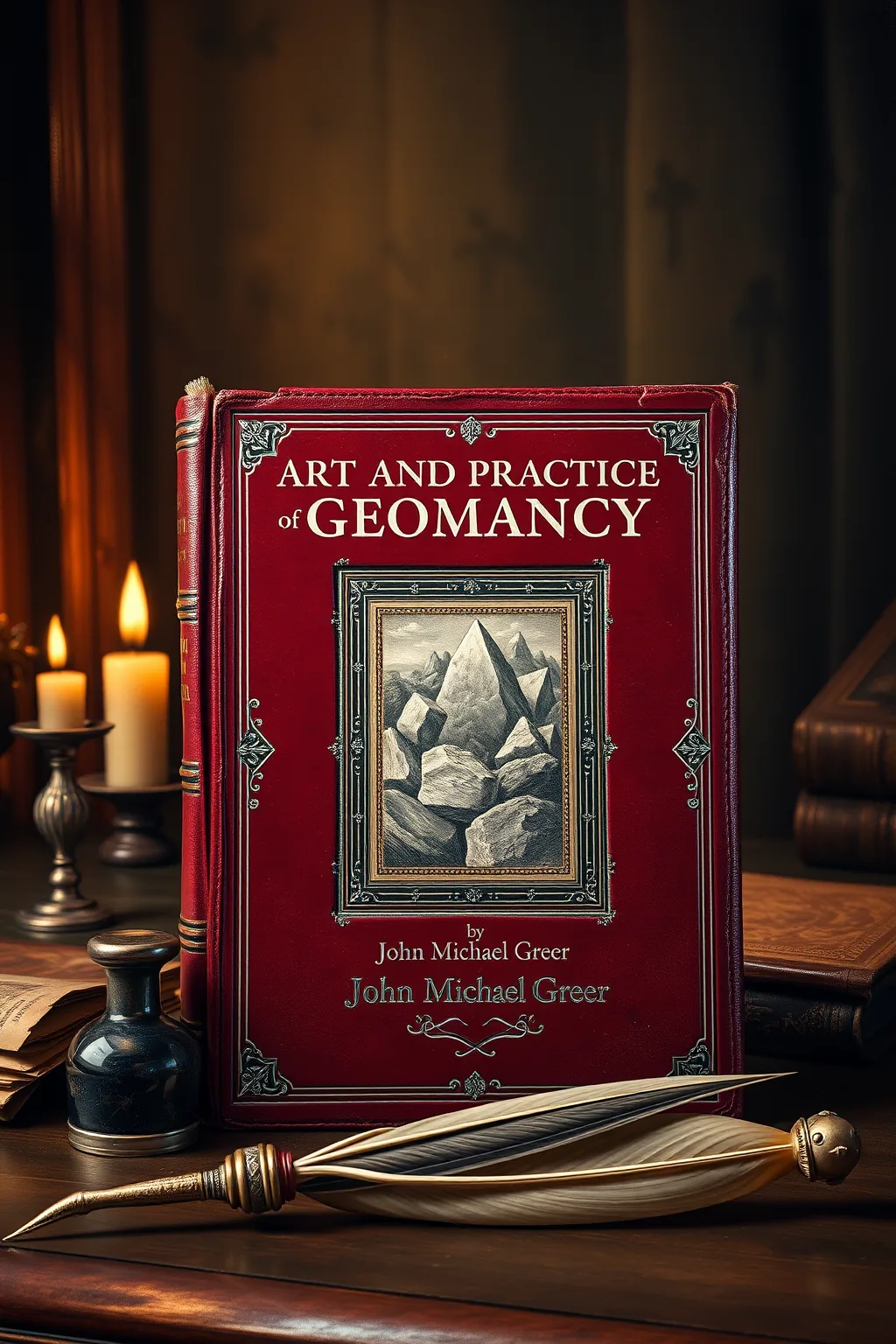
Art and Practice of Geomancy
 62
62

Art and Practice of Geomancy



Silas Hawthorne (Hermetic Studies Editor) — John Michael Greer's 'The Art and Practice of Geomancy' stands as a beacon for serious students of the divinatory arts. Greer's profound scholarship and practical approach demystify this ancient system, presenting Geomancy not as mere fortune-telling, but as a sophisticated method of spiritual inquiry and symbolic interpretation. He expertly guides the reader through the construction and interpretation of geomantic figures, grounding the practice in its historical and esoteric contexts. This work is indispensable for anyone seeking to understand the deep symbolic resonance of this earth-based oracle, offering clear instruction and insightful commentary that elevates the practice to a profound spiritual discipline. A true treasure for the discerning practitioner.
📝 Description
62
John Michael Greer's 2009 book decodes the ancient art of earth divination.
John Michael Greer's 'The Art and Practice of Geomancy' provides a thorough examination of this earth divination system. The book details how geomantic figures are formed and interpreted, connecting them to planetary influences and astrological principles. Greer explains the historical development of geomancy, tracing its roots and evolution through various cultures and traditions. He also covers the practical application of geomancy, showing how to cast charts and derive meaningful insights from them.
The work goes beyond a simple instruction manual, discussing the philosophical underpinnings of geomancy and its place within a broader symbolic worldview. Greer explores the relationship between the terrestrial and celestial realms as understood through geomantic patterns. The book aims to equip readers with the knowledge to understand and use geomancy for personal insight and understanding of the world around them.
Geomancy, the art of divination through earth patterns, is a tradition with roots in medieval Europe and the Islamic world. It is often classified alongside other forms of scrying and pattern-based divination. Greer places geomancy within a Western esoteric framework, linking it to astrology, alchemy, and hermetic philosophy. The practice involves interpreting patterns generated by random or semi-random means, often by marking points on the ground or paper, which are then translated into a system of 16 figures. These figures are then analyzed using astrological and symbolic principles to provide answers or insights.
💡 Why Read This Book?
Embark on a journey to master a potent, earth-centered divination system. 'The Art and Practice of Geomancy' offers clear, step-by-step instructions and deep esoteric insights. It is ideal for spiritual seekers, occult scholars, and practitioners of divination who wish to expand their toolkit with an ancient and powerful oracle. Discover the profound wisdom held within the earth's patterns and unlock a unique lens for understanding life's mysteries.
⭐ Reader Reviews
Honest opinions from readers who have explored this book.
❓ Frequently Asked Questions
What is Geomancy?
Geomancy, or 'earth divination,' is an ancient method of fortune-telling and spiritual inquiry that interprets patterns formed by random points or lines drawn on a surface. These figures are then analyzed through a complex system of rules and correspondences.
Who invented Geomancy?
The exact origins of Geomancy are debated, but its practice is widely believed to have emerged in the Arab world in the early medieval period, drawing upon earlier divination traditions and astrological principles.
What are Geomantic figures?
Geomantic figures are the 16 basic patterns created through a process of random point generation, often using dots or lines. Each figure has a unique name, symbolism, and astrological correspondence.
How is Geomancy different from Tarot?
While both are divinatory systems, Geomancy is fundamentally earth-based and relies on planetary and elemental correspondences, whereas Tarot uses symbolic imagery on cards. Geomancy often feels more grounded and directly connected to the earth's energies.
Is Geomancy difficult to learn?
While it requires study and practice, John Michael Greer's book makes Geomancy accessible. He provides clear explanations and practical exercises, making it achievable for dedicated beginners and enriching for experienced practitioners.
🔮 Key Themes & Symbolism
The Earth as Oracle
This theme explores the profound concept of the Earth itself as a living, breathing oracle, imbued with divine intelligence. Greer posits that the patterns formed by drawing lines or dots on the ground are not random but reflect cosmic influences and the underlying order of the universe. This perspective elevates Geomancy beyond simple fortune-telling, framing it as a method of attuning oneself to the subtle energies and messages emanating from the terrestrial plane, fostering a deep connection with nature and its inherent wisdom. It invites readers to see the mundane as sacred and to interpret the world around them as a divine text.
Symbolic Language of Figures
At the heart of Geomancy lies the intricate language of its 16 primary figures. Each figure is a unique symbolic constellation, possessing its own planetary rulership, elemental affinity, and inherent meaning. Greer meticulously breaks down the construction and interpretation of these figures, revealing how their combinations and relationships within a geomantic chart offer useful insights into questions posed. Understanding this symbolic lexicon is akin to learning an ancient tongue, allowing practitioners to decipher the complex interplay of forces at work in any given situation, from the personal to the cosmic.
Practical Application and Spiritual Growth
Beyond theoretical knowledge, 'The Art and Practice of Geomancy' emphasizes the practical application of this divinatory art. Greer provides clear, actionable guidance for conducting readings, interpreting results, and integrating geomantic wisdom into one's life. The book suggests that engaging with Geomancy is not merely about predicting the future, but about fostering self-awareness, facilitating decision-making, and promoting spiritual growth. By learning to read the earth's signs, practitioners can cultivate a deeper understanding of themselves and their place within the greater cosmic order, leading to a more conscious and empowered existence.
💬 Memorable Quotes
Direct passages from the work, attributed to the author.
“Every line drawn is a conversation with the cosmos.”
— Highlights the symbolic and interactive nature of Geomancy, where the act of creating geomantic figures is seen as a dialogue with universal forces.
“The figures are the alphabet of the terrestrial divine.”
— Emphasizes the symbolic richness of the geomantic figures, presenting them as fundamental elements of a sacred language connecting the earthly realm to the divine.
“To read the earth is to read yourself.”
— Connects the practice of Geomancy to introspection and self-discovery, suggesting that understanding external patterns leads to internal insight.
“Geomancy offers a grounded path to cosmic understanding.”
— Positions Geomancy as a practical yet profound method for gaining knowledge of universal principles through the tangible medium of the earth.
💡 Key Ideas
Editorial paraphrase of the work's core concepts — not direct quotes.
The earth is a living oracle.
This quote captures the core philosophy of Geomancy as presented by Greer, suggesting that the natural world holds inherent wisdom and can be consulted for guidance and understanding.
🌙 Esoteric Significance
Tradition
Geomancy is deeply rooted in hermetic and astrological traditions, often viewed as a form of practical magic and a system of divination that mirrors the macrocosm within the microcosm. It's considered a vital component of Western esotericism, offering a tangible way to engage with planetary influences and elemental forces through a codified symbolic language. Its practitioners see it as a means to channel divine will and gain insight into the underlying patterns of reality.
Symbolism
The core symbolism of Geomancy lies in its 16 figures, each representing distinct archetypal energies and planetary associations. These figures are generated through a process that mimics astrological principles, with each dot and line carrying symbolic weight. The arrangement of these figures in a chart reflects the unfolding of a question, allowing for interpretation based on their elemental qualities, houses, and relationships, thus providing a body of symbolic meaning.
Modern Relevance
In contemporary times, Geomancy offers a grounding counterpoint to the often abstract nature of modern spiritual seeking. It provides a tangible, earth-connected method for introspection and decision-making in a rapidly changing world. Its systematic approach appeals to those seeking order and clarity, while its symbolic depth continues to resonate with practitioners of magic, divination, and spiritual inquiry, offering a timeless tool for navigating life's complexities.
👥 Who Should Read This Book
This book is essential for anyone drawn to the ancient arts of divination and spiritual inquiry. Beginners will find Greer's clear instruction important for mastering the fundamentals of Geomancy. Scholars of occultism and history will appreciate the depth of research and contextualization. Dedicated seekers of esoteric knowledge will discover a powerful oracle and a profound system for self-understanding. Practitioners of Tarot, astrology, or other divinatory methods will find Geomancy a complementary and potent addition to their spiritual toolkit, offering a unique perspective on the unfolding of fate.
📜 Historical Context
The practice of Geomancy flourished during the medieval period, particularly in the Islamic world, where it was integrated with astrological sciences and became a significant form of divination. Its roots are often traced to earlier traditions of scrying and earth-based oracle practices. During the Renaissance, Geomancy, along with other esoteric arts, saw a resurgence in Europe, influencing figures like Paracelsus and Agrippa. It was valued for its perceived direct connection to elemental forces and its ability to provide clear, actionable answers to complex questions. The systematic nature of its figures and their planetary correspondences made it an appealing tool for those seeking to understand the hidden workings of the universe in an era fascinated by occult knowledge and the interconnectedness of all things.
📔 Journal Prompts
When I perform a geomantic reading, what underlying emotional or energetic patterns emerge within me?
How can the geomantic figures I draw reflect my current life challenges and opportunities?
What does the relationship between the terrestrial and celestial spheres, as depicted in Geomancy, reveal about my personal journey?
In what ways can the wisdom gained from a geomantic reading be practically applied to foster positive change in my life?
How does the process of creating geomantic figures influence my state of consciousness and my connection to the present moment?
🗂️ Glossary
Geomantic Figure
One of the 16 basic symbolic patterns generated in Geomancy, each with unique meanings and correspondences, formed by a series of dots or lines.
House
In Geomancy, similar to astrology, the chart is divided into 12 sections or 'houses,' each representing a different area of life or inquiry.
Pugio
The initial stage of geomantic figure generation, where random points or lines are drawn, often used to create the first four figures.
Via Combusta
A specific 'scorched path' within the geomantic houses, often considered an area of difficulty or uncertainty in a reading.
Fortuna Minor
A geomantic figure often associated with good fortune, ease, and positive outcomes, symbolizing a smooth path forward.
This book appears in 4 collections
🔮 Readers Also Liked
Browse all →






More by John Michael Greer
All books →




From the “Geomancy” Collection
View all →








More Free Divination & Tarot Books
View all →