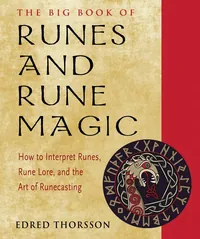
Big Book of Runes and Rune Magic
 80
80

Big Book of Runes and Rune Magic
Edred Thorsson’s "Big Book of Runes and Rune Magic" offers a dense, scholarly approach to the Elder Futhark, a welcome departure from purely speculative texts. Thorsson grounds his work in historical linguistics and mythological sources, particularly evident in his detailed breakdown of the *Aettir* and the individual rune meanings. The section on constructing runic talismans, for instance, provides a clear, actionable framework that avoids the vagueness often found in similar guides. However, the book’s academic tone, while a strength for some, can feel somewhat dry and may deter readers seeking a more intuitive or emotionally resonant connection with the runes. The sheer volume of information, while comprehensive, occasionally risks overwhelming the reader with detail rather than inspiring direct magical engagement. It serves as a rigorous reference more than an inspirational grimoire. Ultimately, it is an indispensable resource for the serious student of runic lore.
📝 Description
80
Edred Thorsson's 1989 "Big Book of Runes and Rune Magic" details the Elder Futhark and its magical uses.
This book reconstructs the Elder Futhark, the earliest runic alphabet, and its later forms, the Younger Futhark and Anglo-Saxon Futhorc. Edred Thorsson explains their historical origins, mythological connections, and practical applications in divination and magic. He structures the material for those serious about engaging with runic systems, assuming some prior knowledge or a willingness to grapple with complex symbolism.
The text traces runic magic to pre-Christian Germanic tribes, referencing the Norse myth of Odin's discovery of the runes. It covers the evolution of runic inscriptions on various objects and their eventual replacement by the Latin alphabet. Thorsson acknowledges the difficulties in reconstructing ancient magical practices due to sparse historical records and the effects of Christianization on pagan traditions.
Central concepts include the *Aettir*, the three divisions of the Elder Futhark, each linked to specific deities. The book aims to provide a structured approach to understanding and using these symbols for magical practice.
Writing within the context of contemporary Asatru and Germanic Neopaganism, Thorsson presents runes not merely as historical script but as active tools for magical work. This perspective aligns with traditions that seek to revive and practice pre-Christian European spiritual and magical systems. The book situates runic lore within a broader framework of Norse mythology and Germanic cultural history, aiming to provide practitioners with a robust system for engaging with these ancient symbols in a modern context.
💡 Why Read This Book?
• Gain a structured understanding of the Elder Futhark's three *Aettir*, learning their individual deities and cosmic associations as presented by Thorsson. • Discover the historical evolution of runic scripts from their Germanic origins through their varied uses, providing context beyond simple divination. • Learn practical methods for runic divination and magic, including the construction of talismans, directly referencing the detailed instructions within the book.
⭐ Reader Reviews
Honest opinions from readers who have explored this book.
❓ Frequently Asked Questions
What is the historical period covered by the Big Book of Runes and Rune Magic?
The book primarily covers the period of runic usage in Germanic societies, from its earliest known inscriptions likely dating back to the 2nd century CE through its decline with Christianization, focusing on the Elder Futhark.
Does Edred Thorsson discuss the mythology behind the runes?
Yes, Thorsson extensively explores the mythological context, particularly the Norse sagas and the myth of Odin's sacrifice to gain knowledge of the runes.
What is an 'Aett' in the context of runes?
An 'Aett' is one of the three groups of eight runes within the Elder Futhark. Each Aett is traditionally associated with specific deities and stages of creation or life.
Is this book suitable for complete beginners to runes?
While comprehensive, the book's academic rigor and depth might be challenging for absolute beginners. It is better suited for those with some foundational interest or willingness to engage deeply.
What are runes used for in this book?
Thorsson details their use in divination, magic, and personal development, including the creation of runic talismans and spells based on their symbolic energies.
When was the Big Book of Runes and Rune Magic first published?
The book was first published in 2018, building upon Edred Thorsson's extensive prior work in the field of runic studies and Germanic Neopaganism.
🔮 Key Themes & Symbolism
Runic Alphabets and Their Structure
The work meticulously details the Elder Futhark, the Younger Futhark, and the Anglo-Saxon Futhorc. It breaks down the Elder Futhark into its three *Aettir*, explaining the symbolic and divine associations of each rune within these groupings. Thorsson emphasizes that runes are more than mere letters; they are potent symbols embodying specific cosmic forces and energies relevant to divination and magical workings. The book provides extensive glossaries for each rune's meaning, covering its divinatory interpretations and magical applications.
Mythological and Historical Underpinnings
Thorsson grounds runic practice in the mythology and history of the ancient Germanic peoples. He explores the legend of Odin's self-sacrifice on Yggdrasil to obtain the runes, linking their discovery to esoteric wisdom. The book traces the historical usage of runes from inscriptions on artifacts like the Golden Horns of Gallehus to their role in daily life and ritual before the dominance of the Latin script. This historical perspective aims to connect modern practice with ancient traditions.
Practical Application in Magic and Divination
Beyond theoretical exploration, the book offers practical guidance for using runes. It covers methods for casting runes for divination, interpreting their meanings in various contexts, and employing them in magical operations. Thorsson details the construction of runic talismans and bindrunes, explaining how to imbue them with specific intentions. The emphasis is on understanding the dynamic power of each rune and how to channel it effectively for personal transformation and magical results.
Esoteric Philosophy and Cosmology
The runes are presented as keys to understanding a Germanic esoteric worldview. Thorsson connects runic symbolism to broader cosmological concepts found in Norse mythology, such as the Nine Worlds and the concept of fate (*wyrd*). The book suggests that working with runes can lead to a deeper understanding of universal forces, the nature of reality, and the practitioner's place within the cosmic order. It promotes a holistic approach where magic, mythology, and philosophy are intertwined.
💬 Memorable Quotes
Direct passages from the work, attributed to the author.
“Each rune possesses a distinct magical energy.”
— This statement highlights the core belief that runes are not simply phonetic characters but active forces capable of influencing reality when properly invoked or understood.
“The *Aettir* represent stages of cosmic manifestation.”
— This interpretation underscores the structured nature of the Elder Futhark, suggesting that its division into three groups of eight reflects a progression or pattern within the universe itself.
“Runic divination requires both knowledge and intuition.”
— This points to the dual nature of effective runic practice, emphasizing that while scholarly understanding is crucial, personal insight and feeling are equally necessary for accurate interpretation.
“Talismans are empowered by the intent of the caster.”
— This highlights the principle of magical will, suggesting that the effectiveness of a runic charm or amulet is significantly amplified by the focused intention and energy directed towards it.
“Understanding the historical context enriches magical practice.”
— This suggests that by studying the origins and historical usage of runes, modern practitioners can gain a deeper, more authentic connection to their magical power and meaning.
🌙 Esoteric Significance
Tradition
Thorsson's work is deeply embedded within the Germanic Neopagan and Asatru traditions, aiming to provide a comprehensive magical system for these paths. It departs from generalized Western esotericism by focusing specifically on the cosmology, mythology, and magical practices derived from ancient Germanic cultures, particularly Norse and Anglo-Saxon sources. While sharing principles of symbolic language and ritual with broader Hermetic or Kabbalistic systems, its focus remains distinctly on the runic alphabets as primary vehicles for spiritual and magical power.
Symbolism
Central symbols include the Elder Futhark itself, viewed as a divine map of creation and consciousness. The *Aettir* are key, representing stages of existence from raw potential to human experience. Individual runes like *Ansuz* (divine inspiration, Odin), *Thurisaz* (force, protection, Thor), and *Algiz* (protection, divine connection) are explored for their many-sided meanings and magical applications in talismans and spells.
Modern Relevance
Contemporary practitioners of Asatru, Germanic Heathenry, and rune magic frequently cite Thorsson's work as foundational. His structured approach to the runes influences modern divination techniques, magical talismans, and personal spiritual development within these communities. Scholars of religion and esoteric studies also engage with his texts to understand the development of modern pagan movements and their engagement with historical sources.
👥 Who Should Read This Book
• Aspiring practitioners of Germanic Heathenry seeking a detailed guide to runic divination and magic. • Students of comparative mythology and ancient European cultures interested in the historical and symbolic dimensions of runic alphabets. • Experienced esotericists looking to expand their repertoire with a system deeply rooted in a specific cultural and mythological context.
📜 Historical Context
Edred Thorsson's work emerged in the late 20th and early 21st centuries, a period marked by a resurgence of interest in Germanic paganism and esoteric traditions, often termed the Asatru or Heathen revival. This movement sought to reconstruct and practice pre-Christian Germanic religions and magical systems. Thorsson became a prominent voice within this milieu, drawing upon scholarship and occult traditions. His approach positioned itself against more syncretic New Age interpretations, aiming for a reconstructionist path rooted in historical and mythological sources. This era also saw engagement with academic fields like Germanic philology and archaeology, though sometimes controversially. Thorsson's writings, including this volume, were influential among practitioners seeking structured magical systems, often contrasted with broader occult movements like Thelema or Golden Dawn-derived Hermeticism, which had different historical trajectories and symbolic languages.
📔 Journal Prompts
The significance of the *Aettir* in your personal cosmology.
Reflecting on the myth of Odin's sacrifice and its connection to the runes.
How the symbolism of *Ansuz* might manifest in your creative pursuits.
The practical application of *Thurisaz* for personal protection.
Interpreting a personal rune casting using the principles outlined for *Algiz*.
🗂️ Glossary
Elder Futhark
The oldest runic alphabet, comprising 24 runes, used by Germanic tribes from approximately the 2nd to the 8th centuries CE. It is the primary focus of many runic magical systems.
Younger Futhark
A later, simplified runic alphabet of 16 runes that evolved from the Elder Futhark, primarily used in Scandinavia during the Viking Age.
Anglo-Saxon Futhorc
A runic alphabet used by Anglo-Saxons, which varied in length but generally contained more runes than the Elder Futhark, adapting to the evolving English language.
Aett
One of the three divisions (groups of eight runes) of the Elder Futhark, each associated with specific deities and symbolic concepts within Germanic mythology.
Wyrd
An Old English and Old Norse concept representing fate, destiny, or a person's predetermined course of life, often seen as influenced by the Norns.
Bindrune
A magical sigil created by combining two or more runes into a single symbol, often used for specific magical intentions or as a talisman.
Talismans
Objects inscribed with symbols, often runes, believed to possess magical properties that offer protection, luck, or influence specific outcomes.
🔮 Readers Also Liked
Browse all →

More by Edred Thorsson
All books →
More Free Divination & Tarot Books
View all →