Vyasa
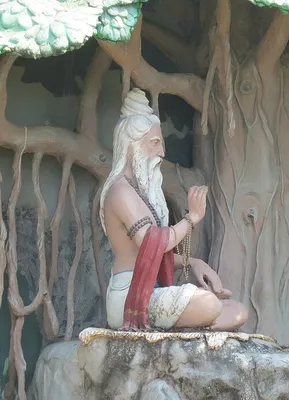
Vyasa is a revered sage traditionally credited with compiling the Vedas, authoring the Mahabharata, and writing the Puranas and Brahma Sutras.
Vyasa, also known as Veda Vyasa or Krishna Dvaipayana, is a central figure in many Hindu traditions. He is traditionally recognized as the compiler of the four Vedas, the author of the epic Mahabharata, the eighteen Puranas, and the Brahma Sutras. Many Hindus consider him a partial incarnation of the deity Vishnu and one of the Chiranjivis, beings believed to be immortal and still alive in the current age. His name, meaning 'compiler' or 'arranger,' reflects his significant role in organizing and disseminating sacred knowledge. He is also associated with the division of the single, ancient Veda into four distinct texts to make its wisdom more accessible to humanity.
The Compiler and Arranger of Sacred Texts
The name 'Vyasa' itself signifies 'compiler' or 'arranger,' highlighting his profound contribution to Hindu scripture. He is most famously known as Veda Vyasa, a title earned from his traditional role in dividing the singular, primordial Veda into four distinct collections: the Rigveda, Samaveda, Yajurveda, and Atharvaveda. This act of categorization was believed to make the divine knowledge more comprehensible to mortals. Beyond the Vedas, Vyasa is credited with composing the eighteen major Puranas, encyclopedic works covering diverse religious and philosophical topics, and the foundational Brahma Sutras of Vedanta philosophy.
Author and Central Figure of the Mahabharata
Vyasa holds a pivotal position as the attributed author of the Mahabharata, one of India's most significant epics. While a later interpolation suggests the deity Ganesha transcribed the work to Vyasa's dictation, scholars often view this as legendary. Vyasa's involvement with the epic extends beyond authorship; he is also a character within it. Notably, he is the grandfather of the Pandavas, the victors of the Kurukshetra War, and potentially the father of the Kauravas, their antagonists, through his role in continuing the Kuru lineage via the Niyoga practice. This intricate familial connection makes the Mahabharata, in essence, a biographical account of his extended family's conflicts.
Mystical Birth and Divine Incarnation
The Mahabharata recounts Vyasa's unique birth. His mother, Satyavati, conceived him with the sage Parasara on an island in the Yamuna River. Born with a dark complexion and mature spiritual radiance, he was named Krishna Dvaipayana. He immediately embraced asceticism, promising his mother he would appear whenever she faced difficulties. Vyasa is also considered by many Hindus to be a partial incarnation (Aṃśāvatāra) of the god Vishnu. As one of the Chiranjivis, he is believed to be an immortal being still present in the world.
Key Ideas
- Compilation and arrangement of sacred texts
- Division of the Veda for accessibility
- Author of the Mahabharata epic
- Partial incarnation of Vishnu
- Concept of Chiranjivis (immortals)
Books by Vyasa
6 free public domain books · Read online or download