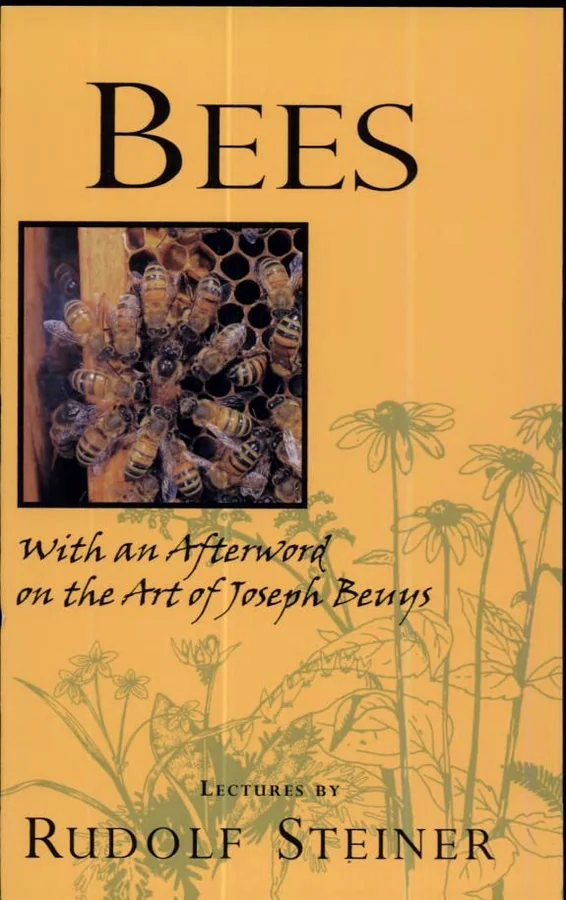
Bees
 73
73

Bees
Steiner's "Bees" offers a perspective that feels disturbingly relevant given contemporary ecological crises. His prediction, made in 1923, about the long-term consequences of mechanizing beekeeping, particularly artificial queen breeding, is starkly accurate. The strength of this collection lies in its ability to re-envision the bee colony not merely as an insect society, but as a dynamic, energetic organism deeply connected to planetary forces. However, the work demands a significant openness to Steiner's specific spiritual-scientific framework, which can be challenging for those unfamiliar with anthroposophy. A particular passage that lingers is the description of the queen bee as the 'heart' of the hive, a biological organ imbued with a spiritual function that orchestrates the colony's life. While his insights into the etheric forces are compelling, they require a leap of faith beyond empirical observation. Ultimately, "Bees" serves as a potent, albeit demanding, call to reconsider our relationship with the natural world through a spiritual lens.
📝 Description
73
Rudolf Steiner delivered eight lectures on bees in Dornach in late 1923.
Rudolf Steiner's "Bees," delivered in Dornach in late 1923, examines the honeybee colony through a spiritual scientific lens. These lectures, part of his Collected Works (CW 351), go beyond conventional entomology. Steiner presents the bee not just as a biological creature but as a manifestation of cosmic and earthly forces. He views the hive as a living organism, a microcosm mirroring larger cosmic processes.
The work addresses the 'etheric' or life forces Steiner believed govern the colony's health and reproduction, contrasting this with purely physical explanations. He also discusses the bee's spiritual role in plant fertilization and the wider environment, suggesting a deep symbiosis. Given during a time of increasing industrialization in agriculture, Steiner's observations on the potential negative effects of mechanizing natural processes, such as artificial queen breeding, now seem prescient. This book stands as a counterpoint to purely mechanistic biological views prevalent in the early 20th century.
This book belongs to the tradition of spiritual science developed by Rudolf Steiner, known as anthroposophy. It places the honeybee within a broader cosmological framework, seeing its existence and activity as deeply connected to earth and celestial forces. Steiner's approach seeks to understand natural phenomena not solely through materialist science but by recognizing subtle, spiritual realities and life forces that animate the organic world. The lectures were given during a period when anthroposophy was gaining traction as an alternative to purely materialistic scientific and philosophical outlooks.
💡 Why Read This Book?
• Gain an esoteric understanding of the honeybee colony as a living, energetic organism, as described by Rudolf Steiner in his 1923 lectures, offering a perspective distinct from conventional biology. • Grasp Steiner's prescient warnings about the future of beekeeping through mechanization, specifically mentioning artificial queen breeding, and its potential impact on bee populations. • Explore the concept of 'etheric forces' as presented by Steiner, providing a spiritual-scientific framework for understanding the vital processes within the hive and the bee's role in nature.
⭐ Reader Reviews
Honest opinions from readers who have explored this book.
❓ Frequently Asked Questions
When did Rudolf Steiner give the lectures that became 'Bees'?
The lectures that form the basis of Rudolf Steiner's book 'Bees' were delivered in Dornach, Switzerland, between November 26 and December 22, 1923.
What did Rudolf Steiner predict about the future of bees?
In his 1923 lectures, Steiner predicted that within fifty to eighty years, the mechanization of natural processes in beekeeping, such as artificial queen breeding, would lead to dire consequences for honeybee populations.
What is the CW number for this collection of lectures?
The lectures on bees by Rudolf Steiner are cataloged under CW 351 in his Collected Works.
What is the main esoteric concept discussed regarding the beehive?
The primary esoteric concept is the beehive as a living organism animated by 'etheric' or life forces, which Steiner believed were distinct from purely physical processes and crucial for the colony's vitality and cosmic connection.
How does Steiner's view differ from modern entomology?
Steiner's view differs by focusing on the spiritual and etheric dimensions of the bee and colony, positing a connection to cosmic forces and planetary processes that go beyond the observable biological and chemical interactions studied in modern entomology.
What year was 'Bees' first published as a book?
Although the lectures were given in 1923, the book 'Bees' by Rudolf Steiner was first published in June 1998.
🔮 Key Themes & Symbolism
The Bee as Cosmic Organism
Steiner posits the honeybee colony not merely as an aggregation of insects but as a unified, living entity that functions as a microcosm of larger cosmic processes. He argues that the colony's vitality is directly linked to etheric forces, which are themselves expressions of solar and planetary influences. This perspective elevates the bee beyond a simple biological specimen to a being engaged in a profound spiritual-material interplay, vital for the earth's life processes. The work encourages readers to perceive the hive's activities as a manifestation of spiritual laws operating within the physical world.
Mechanization and the Loss of Vitality
A central concern in 'Bees' is Steiner's critique of industrializing agricultural practices, particularly within beekeeping. He identified the artificial breeding of queen bees and other mechanized interventions in the 1920s as actions that sever the natural connection to etheric forces. This detachment, he warned, would lead to a decline in bee health and colony vitality over subsequent decades. The book frames this issue not just as an ecological problem but as a spiritual one, stemming from a misunderstanding of the subtle energies that sustain life.
The Spiritual Role of Pollination
Steiner elaborates on the profound spiritual significance of the bee's role in pollination. He suggests that bees are not merely transferring pollen for their own sustenance but are actively participating in the creative, life-giving forces of the plant kingdom. This process, viewed esoterically, is crucial for the reproduction and vitality of plants, and by extension, for the health of the entire terrestrial biosphere. The bee's work is presented as a sacred task, a bridge between the physical and spiritual areas of nature.
Anthroposophy and Nature
This collection serves as a prime example of anthroposophical inquiry into the natural world. It demonstrates how Rudolf Steiner applied his spiritual-scientific method to understand biological phenomena. The lectures invite readers to develop a new way of perceiving nature, one that integrates scientific observation with an understanding of spiritual realities and forces. It encourages a holistic view where the physical manifestation of the bee and its colony is inseparable from its energetic and spiritual essence.
💬 Memorable Quotes
Direct passages from the work, attributed to the author.
“The bee is a being in which the forces of the cosmos are concentrated.”
— This statement expresses Steiner's view that the bee colony is not just an earthly phenomenon but a conduit for universal energies. It suggests that by studying the bee, one can gain insight into the fundamental forces that shape the universe and life itself.
“We are interfering with the natural processes of reproduction through artificial means.”
— This reflects Steiner's concern, voiced in 1923, about the consequences of human intervention in natural cycles. It highlights his belief that such interference, particularly in breeding, disrupts the inherent vitality and spiritual connection of the organism.
“The beehive functions as a single, living entity.”
— This emphasizes Steiner's holistic approach, viewing the colony as more than the sum of its individual bees. It acts as an integrated organism, driven by collective forces and a unified life impulse that transcends individual insect consciousness.
“The etheric body of the bee is particularly active.”
— This refers to Steiner's concept of 'etheric forces' or 'life forces,' which he believed animate living beings. He suggests that the bee's unique physiology and colony structure are deeply connected to and expressive of these subtle, life-sustaining energies.
“The bee's work is essential for the spiritual well-being of the Earth.”
— This expands the bee's importance beyond mere ecological pollination, framing its activity as integral to the spiritual evolution and vitality of the planet. It positions the bee as a crucial partner in cosmic creative processes.
🌙 Esoteric Significance
Tradition
Steiner's work on bees falls within the Western esoteric tradition, specifically rooted in Anthroposophy, which he developed from his earlier engagement with Theosophy. It expands upon Hermetic and Gnostic ideas concerning the interconnectedness of the microcosm (the individual or a specific phenomenon like the bee) and the macrocosm (the universe). Unlike purely Theosophical approaches that might focus on elemental beings or karma, Steiner's method emphasizes observable phenomena through a spiritual-scientific lens, detailing 'etheric' forces and cosmic influences specific to the organism.
Symbolism
The primary symbol is the **beehive** itself, representing a highly organized, unified spiritual-economic organism where individual consciousness is subsumed into a collective life force. The **queen bee** symbolizes the central life-giving impulse, acting as the 'heart' of the hive, orchestrating its energetic processes. The **bee** itself symbolizes a creature deeply connected to cosmic and solar forces, acting as a vital intermediary in the creative processes of nature, particularly through pollination.
Modern Relevance
Contemporary movements in biodynamic agriculture and natural beekeeping often draw inspiration from Steiner's insights into the etheric forces and the holistic nature of the bee colony. Thinkers and practitioners focused on ecological spirituality, permaculture, and conscious agriculture find value in his non-mechanistic approach. The current global crisis of bee populations also prompts renewed interest in Steiner's 1923 predictions and his unique perspective on the vital forces at play within the hive and its relationship to planetary health.
👥 Who Should Read This Book
• Aspiring biodynamic farmers and natural beekeepers seeking a spiritual-scientific foundation for their practices, moving beyond purely conventional agricultural methods. • Students of Anthroposophy and Rudolf Steiner's work looking to understand his specific approach to biology and the spiritual nature of the animal kingdom. • Environmentalists and ecologists interested in alternative perspectives on ecological crises, particularly the decline of bee populations, who are open to non-materialistic explanations.
📜 Historical Context
Delivered in Dornach in late 1923, Rudolf Steiner's lectures on bees emerged during a period of intense industrialization and a growing reliance on mechanistic explanations in science. The early 20th century saw figures like Albert Einstein revolutionizing physics, while in biology, Darwinian evolution and genetics were becoming dominant paradigms. Steiner's work offered a spiritual-scientific counterpoint, emphasizing subtle, etheric forces rather than purely material causality. While not directly engaging with specific contemporaries like Julian Huxley or J.B.S. Haldane in these lectures, his approach stood in contrast to the prevailing materialistic biology and the burgeoning field of ethology. There is no record of widespread contemporary reception, censorship, or specific critical reviews of these particular lectures at the time of their delivery, as they were primarily disseminated within the anthroposophical movement.
📔 Journal Prompts
The etheric forces within the beehive: How can one perceive or work with these subtle energies?
Steiner's 1923 prediction: Reflect on the consequences of mechanizing natural processes in relation to the honeybee.
The queen bee as the hive's 'heart': Explore the symbolic and functional significance of this image.
The bee's cosmic connection: Consider how the bee's activity might reflect broader universal laws.
Comparing esoteric and scientific views: How do Steiner's concepts of 'etheric forces' differ from modern biological explanations of hive activity?
🗂️ Glossary
Anthroposophy
A spiritual philosophy founded by Rudolf Steiner, seeking to understand the spiritual dimensions of human existence and the cosmos through a method he termed 'spiritual science'.
Etheric Forces
In Steiner's terminology, these are subtle, life-giving energies that animate living organisms and are distinct from physical forces. They are believed to be responsible for growth, reproduction, and the characteristic forms of life.
Collected Works (CW)
The comprehensive compilation of Rudolf Steiner's lectures, writings, and published works, systematically organized and numbered.
Dornach
A town in Switzerland near Basel, known as the location of the Goetheanum, the center for the Anthroposophical Society, where Steiner delivered many of his lectures.
Mechanization
In the context of Steiner's critique, this refers to the application of industrial and machine-like processes to natural systems, particularly agriculture and animal husbandry, often leading to a loss of inherent vitality.
Spiritual Science
Rudolf Steiner's term for his methodology, which aims to investigate the spiritual world with the same rigor and clarity as natural science investigates the physical world.
Pollination
The transfer of pollen from the male part of a flower to the female part, enabling fertilization and the production of seeds and fruit. Steiner viewed this process as having profound spiritual significance.
This book appears in 1 collection
🔮 Readers Also Liked
Browse all →





From the “Anthroposophy” Collection
View all →





More Free Theosophy & Anthroposophy Books
View all →