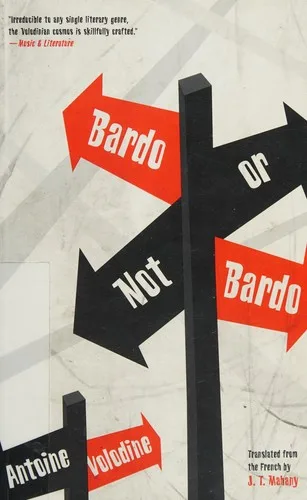
Bardo or not Bardo
 77
77

Bardo or not Bardo
Antoine Volodine’s "Bardo or not Bardo" offers a disquieting and intellectually stimulating encounter with the spaces between realities. The text’s strength lies in its audacious refusal of conventional narrative, forcing readers to confront the fragmented nature of consciousness and existence. Its associative logic and dreamlike imagery create a potent atmosphere, particularly in passages describing the "post-exotic" landscapes that feel simultaneously alien and deeply familiar. However, the work's deliberate obscurity can also be its primary limitation. For readers unaccustomed to its experimental cadence, the lack of clear anchors might prove frustrating, bordering on inaccessible. The concept of "spectrality," while central, is often presented through allusion rather than direct explication, demanding significant readerly effort. Ultimately, "Bardo or not Bardo" is a challenging but rewarding text for those willing to surrender to its unique, disorienting vision.
📝 Description
77
Antoine Volodine's 2016 novel, Bardo or not Bardo, examines consciousness through fragmented visions.
Bardo or not Bardo is not a conventional story but a collection of fractured visions, philosophical thoughts, and dreamlike passages. These elements challenge standard ideas about reality and what comes after death. The book sits at the intersection of speculative fiction and existential thought, providing a disorienting yet thought-provoking look at the unknown.
This text is for readers who embrace ambiguity and seek intellectual and imaginative stimulation. It will appeal to those interested in esoteric philosophies, the nature of awareness, and the transitional spaces between life, death, and possible rebirth. Individuals drawn to surrealist writing, post-structuralist ideas, or interpretations of the bardo states found in Tibetan Buddhism, but desiring a more unusual literary approach, will find "Bardo or not Bardo" particularly resonant.
The novel's central idea uses the Tibetan Buddhist concept of the 'bardo,' the intermediate state between death and rebirth. Volodine adapts this not as a literal spiritual journey but as a literary device to explore fractured consciousness and subjective experience. It draws parallels with esoteric traditions that contemplate altered states of awareness and the dissolution of self, offering a contemporary, literary interpretation of these ancient concerns.
💡 Why Read This Book?
• You will explore the concept of "bardo" not as a singular afterlife state but as a metaphor for pervasive transitional states of consciousness, gaining a new framework for understanding liminal experiences. • You will encounter "post-exoticism" in practice, learning how Volodine deconstructs traditional narrative structures to create a unique literary space beyond conventional cultural boundaries. • You will engage with the motif of "spectrality" as it manifests in fragmented narratives, offering a fresh perspective on how memory, absence, and the past permeate the present.
⭐ Reader Reviews
Honest opinions from readers who have explored this book.
❓ Frequently Asked Questions
What is the primary literary style of Antoine Volodine's "Bardo or not Bardo"?
The book employs a fragmented, dreamlike, and often surrealist style. It eschews traditional narrative linearity, favoring associative logic and atmospheric exploration of consciousness and transitional states.
How does "Bardo or not Bardo" relate to Tibetan Buddhist concepts?
It uses the Tibetan Buddhist concept of the 'bardo' (intermediate states between lives) as a central metaphor, but reinterprets it through a literary and philosophical lens, extending it to any state of transition or uncertainty.
What is "post-exoticism" as presented in this work?
Post-exoticism is a literary concept associated with Volodine that aims to move beyond Western projections onto other cultures, exploring new narrative forms and subjective experiences detached from traditional geopolitical frameworks.
Is "Bardo or not Bardo" a philosophical treatise or a work of fiction?
It exists in a liminal space between the two. While it engages deeply with philosophical concepts concerning consciousness and existence, it does so through highly imaginative, fictionalized, and experimental prose.
When was "Bardo or not Bardo" first published?
The original French edition of "Bardo or not Bardo" by Antoine Volodine was first published in 2016.
What does the term 'spectrality' signify in Volodine's work?
Spectrality refers to the persistent presence of absence, the lingering effects of trauma or memory, and the way 'ghosts' – whether literal or metaphorical – inhabit and shape the present reality.
🔮 Key Themes & Symbolism
The Nature of the Bardo
The work re-imagines the Tibetan Buddhist concept of the bardo, the intermediate state between death and rebirth, not as a singular religious event but as a pervasive condition of existence. Volodine explores these 'bardos' as moments of radical transition, uncertainty, and dissolution of self that can occur within life itself. This theme challenges readers to consider their own experiences of liminality, whether during periods of intense change, trauma, or profound introspection, suggesting that the boundaries between states of being are far more fluid than commonly perceived.
Post-Exoticism and Narrative Deconstruction
As a key text associated with "post-exoticism," the book actively dismantles conventional Western modes of storytelling and representation, particularly those concerning other cultures or subjective experiences. Volodine seeks to create a literature that transcends established geopolitical and cultural divides, offering a vision of the world and consciousness unburdened by colonial perspectives or predictable narrative arcs. This involves experimental use of language, fragmented structures, and the creation of imagined geographies that resist easy categorization.
Spectrality and Lingering Presence
A significant theme is 'spectrality,' the concept of the lingering presence of the absent. This manifests as the persistent influence of past events, traumas, lost individuals, or forgotten memories that haunt the present. Volodine’s prose often evokes a sense of the spectral, where the boundaries between the living and the dead, the present and the past, become blurred. This exploration challenges a linear perception of time and causality, suggesting that what is gone continues to exert a powerful, often unseen, force.
The Dissolution of Self
Throughout the text, there is an exploration of the self's potential dissolution. In these transitional or 'bardo' states, the fixed, coherent ego often fragments, giving way to a more fluid, uncertain identity. This theme aligns with certain esoteric traditions that posit the illusion of a permanent self and encourage its transcendence. Volodine's literary approach provides a visceral, imaginative rendering of this process, prompting readers to question the stability and nature of their own identity.
💬 Memorable Quotes
Direct passages from the work, attributed to the author.
“The path is paved with the ghosts of what will never be.”
— This aphorism captures the book's essence: the future is haunted by unrealized possibilities and lost potential, shaping our present journey in profound, unseen ways.
“We inhabit the pauses between heartbeats, the silences where meaning unravels.”
— This highlights Volodine's focus on liminal spaces and transitional states, suggesting that true understanding or experience lies not in the active moments but in the subtle gaps and transitions.
“Reality is a rumour whispered across the void.”
— This interpretation underscores the book's questioning of objective reality, positing it as an unstable, subjective construct, akin to a fleeting message passed through an immense emptiness.
“To remember is to awaken a dormant spectrality.”
— This suggests that the act of recalling the past is not passive but actively brings forth the 'ghosts' or lingering presences of what has been, influencing the present moment.
“The bardo is not a place, but the air we breathe when we forget our names.”
— This redefines the bardo from a geographical or temporal state to a fundamental condition of existential uncertainty and self-effacement, accessible in moments of profound forgetting.
🌙 Esoteric Significance
Tradition
While not explicitly tied to a single lineage, "Bardo or not Bardo" draws significantly from Tibetan Buddhist cosmology, particularly the concept of the bardo. It reinterprets these teachings through a Gnostic lens of fragmented realities and the search for true knowledge beyond illusory appearances. Volodine's work departs from strict religious dogma, using the bardo as a metaphor for existential and psychological liminality, aligning with modern esoteric thought that seeks to synthesize Eastern spiritual concepts with Western philosophical inquiry.
Symbolism
Key symbols include the "void," representing ultimate potentiality and the ground of being from which all phenomena arise and to which they return; "ghosts" or "specters," symbolizing the persistent influence of the past, memory, and unresolved traumas that inhabit the present consciousness; and "transitional spaces," embodying the bardo itself as a state of flux, uncertainty, and potential transformation beyond fixed identities.
Modern Relevance
The work's exploration of liminality, spectrality, and the deconstruction of the self resonates strongly with contemporary practices in transpersonal psychology, consciousness studies, and certain branches of speculative fiction. Thinkers and practitioners exploring altered states, non-linear narratives of trauma recovery, and philosophical critiques of identity find Volodine's abstract yet evocative prose a valuable touchstone for understanding the fluid nature of reality and subjective experience in the 21st century.
👥 Who Should Read This Book
• Students of comparative religion and esoteric philosophy seeking unconventional interpretations of Buddhist concepts like the bardo. • Literary scholars interested in "post-exoticism" and experimental narrative techniques that challenge geopolitical and cultural boundaries. • Readers drawn to existentialist and surrealist literature who appreciate explorations of consciousness, memory, and the dissolution of the self.
📜 Historical Context
Published in 2016, Antoine Volodine’s "Bardo or not Bardo" emerged within a range of contemporary French literature deeply engaged with existential questions and experimental forms. Volodine, a significant figure in post-Soviet and postmodern literary circles, continued his exploration of themes like memory, trauma, and altered states of consciousness. The work can be seen as a development from the literary movement he helped define, "post-exoticism," which sought to move beyond established Western narratives and create new literary geographies. This approach positioned him in dialogue with writers who, like Georges Perec or Michel Houellebecq, challenged conventional literary and societal norms, though Volodine's focus remained distinctively spectral and philosophical. The book’s reception reflected a continued interest in non-linear narratives and existential inquiry, resonating with a readership seeking alternatives to traditional storytelling, particularly in exploring the boundaries of human experience and perception.
📔 Journal Prompts
The spectrality of forgotten desires: how do unrealized potentials linger?
Reflections on the air we breathe when we forget our names.
Mapping the pauses between known realities.
The rumor of reality: what whispers shape your perception?
Interpreting the ghosts on the path toward what will never be.
🗂️ Glossary
Bardo
In Tibetan Buddhism, an intermediate state between death and rebirth. Volodine reinterprets this as a metaphor for any state of transition, uncertainty, or dissolution of self experienced within life.
Post-Exoticism
A literary concept associated with Antoine Volodine, aiming to deconstruct Western narratives about other cultures and explore new forms of storytelling beyond established geopolitical and cultural divides.
Spectrality
The presence of the absent; the lingering effects of past traumas, memories, or individuals that continue to inhabit and influence the present reality.
Void
In this context, the ultimate ground of being, emptiness, or potentiality from which consciousness and reality emerge and into which they may dissolve.
Liminality
A state of being in-between, on the threshold, or in transition; often characterized by ambiguity, uncertainty, and a breakdown of established categories.
Dissolution of Self
The process or experience of the ego or fixed identity breaking down, becoming fluid, uncertain, or merging with a larger, undifferentiated state.
Fragmented Narrative
A storytelling approach that eschews linear chronology and coherence, presenting events and ideas in a disjointed, non-sequential manner.
🔮 Readers Also Liked
Browse all →








More Free Occult Philosophy Books
View all →