Babylonian magic and sorcery

 78
78

Babylonian magic and sorcery
King's "Babylonian Magic and Sorcery" offers an unvarnished look at ancient Mesopotamian occultism, a welcome departure from more romanticized accounts. Its strength lies in its direct engagement with translated cuneiform texts, providing a scholarly foundation for understanding these practices. The sheer volume of incantations and rituals presented is impressive, though the lack of extensive modern commentary can make the material dense for the uninitiated. A particularly striking aspect is the detailed categorization of demons and their associated ailments, such as the "demon of the south wind" and its effects. While King's scholarship is commendable for its era, the absence of engagement with later archaeological or linguistic developments presents a limitation for contemporary researchers. Nevertheless, it remains a vital, if challenging, resource for serious study.
📝 Description
78
Leonard William King translated Mesopotamian incantations and spells from cuneiform tablets in 1896.
Leonard William King's "Babylonian Magic and Sorcery" compiles and translates ancient Mesopotamian magical texts. Published in 1896, the book draws from cuneiform tablets to present incantations, rituals, and spells. It reveals a civilization deeply concerned with divination, demonology, and influencing unseen forces.
This work is important for anyone studying ancient Near Eastern religions or the history of magic. It offers a direct look at the beliefs and practices of Mesopotamia, moving beyond speculation to primary source material. King's research provides translated evidence of magical traditions from a civilization that predates classical Greece and Rome. The book examines the structure of Babylonian cosmology and the practical uses of magic, including amulets, healing rituals, and protection spells.
Published in 1896, King's book emerged during a period of widespread interest in occultism and comparative religion. At this time, figures like Madame Blavatsky were popularizing esoteric ideas, and scholars like James Frazer were examining ancient beliefs. King's work provided concrete, translated examples of magical practices from Mesopotamia, contributing to a growing body of knowledge about ancient and non-Western spiritual traditions. It connects to the historical study of magic as a system of belief and practice.
💡 Why Read This Book?
• Gain direct access to translated Babylonian incantations and spells, offering a tangible connection to ancient Mesopotamian magical thought, unlike generalized historical accounts. • Understand the specific roles of deities and demons in Babylonian ritual practice, as detailed in the text's cataloging of supernatural entities and their functions. • Appreciate the historical context of occult studies in 1896, seeing how this work contributed to the academic understanding of magic during a period of significant esoteric interest.
⭐ Reader Reviews
Honest opinions from readers who have explored this book.
❓ Frequently Asked Questions
What is the primary focus of Leonard William King's "Babylonian Magic and Sorcery"?
The book's primary focus is the compilation and translation of ancient Babylonian magical texts, including incantations, rituals, and spells derived from cuneiform tablets, offering insight into Mesopotamian occult practices.
When was "Babylonian Magic and Sorcery" first published?
Leonard William King's "Babylonian Magic and Sorcery" was first published in 1896, placing it within a period of intense archaeological discovery and interest in ancient civilizations.
What kind of magical practices are detailed in the book?
The book details various practices such as healing incantations, protective rituals, divination techniques, and the use of amulets, all aimed at influencing the natural and supernatural worlds.
Who would benefit most from reading this book?
Scholars of ancient Near Eastern religions, historians of magic, and esoteric practitioners interested in primary source material on Mesopotamian occultism would benefit most.
Are the texts translated directly from original sources?
Yes, the work is based on translations of original cuneiform tablets, making it a direct source for understanding Babylonian magical traditions as recorded by the ancients.
Does the book discuss the historical reception of Babylonian magic?
While it focuses on the practices themselves, its 1896 publication date provides context for how these ancient traditions were being rediscovered and interpreted by late Victorian scholarship.
🔮 Key Themes & Symbolism
Incantations and Rituals
The core of King's work lies in its extensive collection of Babylonian incantations and rituals. These texts were not mere folklore but were believed to possess potent efficacy. They cover a wide spectrum of human needs, from averting disease caused by malevolent spirits to ensuring good fortune. The meticulous translation allows modern readers to examine the precise wording and structure intended to invoke supernatural aid or ward off harm, revealing a sophisticated understanding of sympathetic and operative magic.
Demonology and Spirit Worlds
A significant theme is the complex Babylonian cosmology populated by numerous deities and, crucially, a vast array of demons. King's text details the classifications of these entities, their specific powers, and the afflictions they were thought to cause. Understanding these spiritual hierarchies and the methods prescribed for appeasing or banishing these beings was central to Babylonian life and magical practice, reflecting a worldview where the unseen profoundly impacted the tangible.
Divination and Prognostication
Babylonian society placed enormous value on foretelling the future, and this book touches upon the magical and ritualistic underpinnings of divination. While not solely focused on astrological charts, it includes practices aimed at interpreting omens and seeking divine guidance through various means. The implication is that magic and foresight were intertwined, with rituals often serving to clarify the will of the gods or to manipulate future outcomes.
The Efficacy of Words
Central to Babylonian magic, as presented by King, is the belief in the power of spoken or written words. Incantations were not simply prayers but potent spells designed to enact change. The specific arrangement of syllables, the invocation of divine names, and the precise articulation of desires were believed to possess inherent power. This emphasis on the performative aspect of language highlights a magical paradigm where utterances could directly influence reality.
💬 Memorable Quotes
Direct passages from the work, attributed to the author.
“Incantations for the sick and the afflicted.”
— This phrase expresses the practical, often desperate, application of magic within Babylonian society, highlighting its role in addressing tangible suffering through supernatural means.
“The great demons who bring destruction.”
— This points to the pervasive fear of malevolent supernatural forces in the Babylonian worldview and the vital need for magical protection and exorcism.
“Amulets against evil influences.”
— This highlights the use of tangible objects imbued with magical properties as a common defense mechanism against perceived spiritual or physical threats.
“Divinatory rites to understand the gods' will.”
— This concept underscores the integration of magic with the desire to comprehend divine intentions, showing how ritual served both to influence and to inquire.
“The proper recitation of spells.”
— This emphasizes the belief that the correct performance and vocalization of magical formulas were critical to their effectiveness in the ancient Mesopotamian context.
🌙 Esoteric Significance
Tradition
This work primarily feeds into the Western Esoteric tradition's interest in ancient magical systems, particularly those predating classical Greece. It offers source material for practitioners and scholars seeking the roots of magical thought, connecting to Hermeticism's pursuit of ancient wisdom and Gnosticism's engagement with cosmology and spiritual hierarchies, albeit from a non-Western perspective.
Symbolism
Key symbols include the 'demon of the south wind,' representing chaotic natural forces and malevolent spiritual influences that required specific incantations for appeasement or banishment. Another motif is the use of amulets, tangible objects believed to embody protective energies or divine favor, serving as personal talismans against unseen dangers.
Modern Relevance
Contemporary practitioners of ritual magic and comparative religion scholars continue to draw on King's translations. The detailed accounts of demonology and spirit interaction inform modern approaches to shadow work and archetypal psychology, while the structure of the incantations provides templates for contemporary spellcraft and ritual design.
👥 Who Should Read This Book
• **Academics of Ancient Near Eastern Studies:** Will find invaluable primary source material for understanding Mesopotamian religion, magic, and daily life, offering direct translations of key texts. • **Students of Comparative Religion:** Can analyze the unique belief systems and magical practices of Babylon, comparing them to other ancient cultures and tracing potential influences. • **Esoteric Practitioners and Historians of Magic:** Gain insight into foundational magical traditions, exploring the historical development of incantations, demonology, and ritual from a pre-classical source.
📜 Historical Context
Leonard William King's "Babylonian Magic and Sorcery," published in 1896, arrived at an important moment for both Assyriology and the study of comparative religion. The late 19th century was characterized by prolific archaeological excavations in Mesopotamia, yielding vast quantities of cuneiform tablets that were only beginning to be deciphered and understood. This era saw scholars like James George Frazer publishing works like "The Golden Bough" (first volume 1890), exploring parallels in magic, religion, and anthropology across cultures. King's work provided specific, translated evidence of magical traditions from one of the world's oldest civilizations, directly engaging with the raw material unearthed. Unlike more speculative esoteric writings of the time, such as those emerging from the Theosophical Society, King's contribution was grounded in textual scholarship, aiming to present the Mesopotamians' own accounts of their magical beliefs and practices.
📔 Journal Prompts
The categorization of Babylonian demons and their associated afflictions.
The structure and intended efficacy of a specific healing incantation.
The role of amulets in warding off perceived negative spiritual influences.
The relationship between divination and magical ritual in ancient Mesopotamia.
The concept of the 'demon of the south wind' and its symbolic meaning.
🗂️ Glossary
Cuneiform
An ancient system of writing characterized by wedge-shaped marks impressed on clay tablets, used by Mesopotamian civilizations like the Babylonians and Assyrians.
Incantation
A series of words said in a ritualistic or magical way, believed to have the power to produce a desired effect or cast a spell.
Demon
In Babylonian belief, a supernatural being, often malevolent, capable of causing illness, misfortune, or other harm to humans.
Amulet
An object believed to protect the wearer or bearer from evil, danger, or disease, often inscribed with magical symbols or texts.
Divination
The practice of seeking knowledge of the future or the unknown by supernatural means, often through interpreting omens or consulting spiritual entities.
Mesopotamia
An ancient region located in the eastern part of the Fertile Crescent, corresponding to modern-day Iraq, Kuwait, and parts of Syria and Turkey, home to Babylonian civilization.
Ritual
A set of actions performed regularly, especially for religious or magical purposes, often involving specific procedures and invocations.
🔮 Readers Also Liked
Browse all →









More by Leonard William King
All books →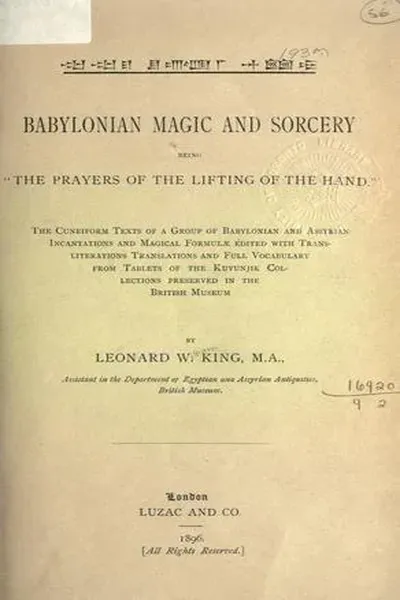
More Free Occult Philosophy Books
View all →