Atemtechniken der Yogis
 75
75

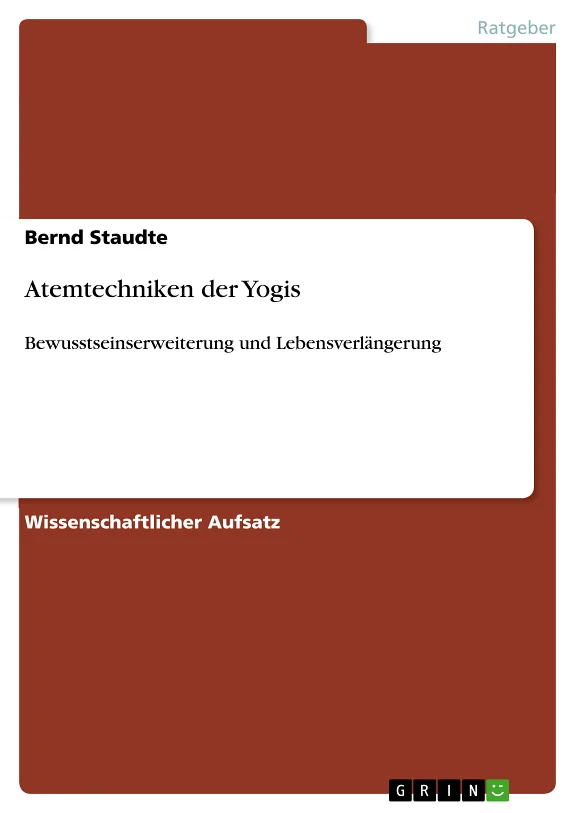
Atemtechniken der Yogis
Bernd Staudte’s "Atemtechniken der Yogis" offers a sharp, if brief, examination of pranayama, moving beyond New Age platitudes to consider the physiological basis of yogic control. Staudte’s assertion that Western "restlessness" has severed our connection to breath is a pertinent observation, particularly when he notes his own practice under a Jain yogi. The work’s strength lies in its direct, unadorned approach to a complex subject. However, its brevity leaves one wishing for more detailed exploration of the specific techniques or Staudte’s personal experiences. The discussion of breath currents, while intriguing, feels underdeveloped. Ultimately, it serves as a concise introduction, prompting further inquiry rather than providing exhaustive answers.
📝 Description
75
Bernd Staudte's 2010 essay, Atemtechniken der Yogis, links yogic abilities to breath mastery.
Published in 2010, Bernd Staudte's scholarly essay Atemtechniken der Yogis examines the physiological and spiritual foundations of yogic breathing techniques. Staudte proposes that the extraordinary capabilities demonstrated by Indian yogis are a direct result of their disciplined control over breath. He contrasts this with the accelerated pace of Western life, suggesting a cultural disconnect from these ancient practices.
The work is intended for individuals interested in the practical and scientific dimensions of esoteric practices. Readers who want to understand the mechanics behind yogic feats, particularly those involving breath, will find this text informative. It also appeals to those curious about the historical and cultural divergences in spiritual disciplines between Eastern and Western societies.
Atemtechniken der Yogis engages with a centuries-old yogic scholarship, particularly the science of pranayama. Staudte presents breath control not just as a spiritual exercise but as a trainable physiological system that underpins yogic powers. This work contrasts yogic discipline with Western materialistic focus, a recurring theme in discussions of Eastern spirituality's reception in the West.
⭐ Reader Reviews
Honest opinions from readers who have explored this book.
❓ Frequently Asked Questions
What is the primary focus of Bernd Staudte's "Atemtechniken der Yogis"?
The primary focus is the scientific examination of yogic breathing techniques (pranayama), positing that yogis' extraordinary abilities stem from controlled manipulation of breath currents within the body.
When was "Atemtechniken der Yogis" first published?
The essay "Atemtechniken der Yogis" by Bernd Staudte was first published on December 7, 2010.
Does the book explain specific yogic breathing exercises?
While the book discusses the principles and effects of yogic breathing, it is presented as a scholarly essay rather than a practical manual with detailed exercise instructions.
What is the author's background related to this topic?
Bernd Staudte reportedly practiced these specific yogic breath techniques directly with an Indian Jain yogi, lending a practical, experiential dimension to his academic analysis.
What distinguishes yogic breathing from normal breathing according to the text?
According to the text, yogic breathing involves a targeted, conscious control over the flow and direction of breath within the body, leading to enhanced physiological and possibly psychic capabilities.
Is this book suitable for beginners in yoga?
It is more suited for those interested in the theoretical and scientific underpinnings of pranayama, rather than for absolute beginners seeking step-by-step yoga instructions.
🔮 Key Themes & Symbolism
Pranayama and Physiological Control
The central theme revolves around pranayama, the yogic science of breath. Staudte argues that the remarkable feats attributed to Indian yogis are not supernatural but are the result of highly developed physiological control over their respiratory system. The essay posits that by consciously directing breath currents, practitioners can achieve states and abilities otherwise inaccessible, challenging a purely spiritual interpretation and leaning towards a bio-energetic understanding rooted in disciplined practice.
East vs. West: Materialism and Spirituality
A significant theme is the perceived divergence between Eastern spiritual traditions and Western materialistic culture. Staudte suggests that the West's relentless pursuit of material creation has led to a loss of connection with fundamental practices like yogic breathing. This creates a barrier, making it difficult for individuals in Western societies to access the profound benefits and altered states of consciousness that Eastern disciplines cultivate, framing the modern Western mindset as a hindrance to spiritual development.
The Jain Yogi's Perspective
The author's personal encounter with an Indian Jain yogi serves as a crucial element, grounding the theoretical discussion in lived experience. This interaction provides a tangible link to the ancient traditions discussed, offering firsthand evidence of the efficacy of these breath control techniques. The inclusion of this personal testimony lends credibility and depth to the essay, illustrating that the practices are not mere abstract concepts but are actively performed and understood by contemporary practitioners.
Scientific Examination of Esoteric Practices
The work aims to bridge the gap between esoteric knowledge and scientific inquiry. By analyzing yogic abilities through the lens of controlled breathing, Staudte attempts to clarify aspects of spirituality. The essay encourages readers to view phenomena often considered miraculous through a more rational, physiological framework, suggesting that understanding the mechanics can unlock the potential for similar achievements through disciplined practice, aligning esoteric sciences with empirical observation.
💬 Memorable Quotes
Direct passages from the work, attributed to the author.
“the targeted control of breath currents in the body”
— This phrase captures the core argument: yogic prowess stems from precise, intentional manipulation of breath, suggesting a physiological mechanism rather than purely mystical intervention.
“The Western world, in its restlessness to create material things, has long lost access to yogic breathing.”
— This highlights the perceived cultural divide, positing that Western society's focus on external, material achievements has led to an atrophy of internal, breath-focused spiritual practices.
“humanity is repeatedly surprised by the achievements of Indian yogis”
— This observation points to the common Western perception of yogic abilities as extraordinary or even miraculous, setting the stage for Staudte's attempt to provide a more grounded explanation.
“based primarily on the targeted control of breath currents in the body”
— This reinforces the central thesis, emphasizing that the key to yogic capabilities lies in the precise, conscious direction of breath, a concept central to the essay's scientific approach.
“The author himself practiced such breathing techniques with an Indian Jain yogi.”
— This detail lends personal credibility and empirical weight to the essay, indicating that the author's analysis is informed by direct, practical experience rather than solely theoretical study.
🌙 Esoteric Significance
Tradition
This work engages with the broad tradition of yogic philosophy and practice, which is a central to Indian esoteric sciences. While not strictly adhering to a single lineage like Advaita Vedanta or Tantra, it draws directly from the yogic emphasis on pranayama as a primary tool for spiritual and physical development. Staudte's approach departs by seeking a scientific, physiological explanation for phenomena often relegated to the purely mystical, attempting to bridge the gap between ancient esoteric knowledge and modern empirical inquiry.
Symbolism
The primary symbol is the breath itself, representing life force (prana) and the connection between the physical and subtle bodies. Staudte focuses on the 'breath currents' (vayus or nadis in yogic terminology) as pathways of energy and consciousness. The contrast between the 'restless' West and the disciplined East can also be seen as symbolic of the internal struggle between materialistic distraction and spiritual focus, with breath control acting as the key to restoring inner equilibrium.
Modern Relevance
Staudte's work is relevant to contemporary discussions in somatic experiencing, breathwork therapy, and biofeedback. Thinkers and practitioners exploring the mind-body connection, particularly those interested in how conscious control of physiological processes can impact mental states and overall well-being, find resonance here. His essay contributes to a growing body of work that validates ancient esoteric practices through modern scientific investigation, influencing fields seeking non-pharmacological approaches to stress reduction and enhanced cognitive function.
👥 Who Should Read This Book
['• Students of comparative spirituality seeking to understand the physiological claims behind yogic abilities, offering a scientific counterpoint to purely faith-based interpretations.', '• Practitioners of breathwork or advanced yoga who wish to explore the theoretical mechanisms of pranayama beyond basic instruction, providing a framework for deeper personal practice.', '• Skeptics or researchers interested in the intersection of esoteric traditions and scientific explanation, offering a grounded analysis of yogic breath control.']
📜 Historical Context
Bernd Staudte's "Atemtechniken der Yogis," published in 2010, emerged within a global landscape where Eastern spiritual practices, particularly yoga, had gained significant traction in the West. The early 21st century saw a continued influx of yogic philosophies and techniques into popular wellness and self-help movements. Staudte’s work, however, sought to move beyond superficial adoption, engaging with the deeper physiological and potentially scientific underpinnings of these practices. It implicitly contrasts with the more devotional or purely physical fitness approaches to yoga prevalent at the time. The essay’s focus on breath control as a trainable skill echoes historical yogic texts but frames it within a modern, analytical perspective, attempting to clarify yogic abilities for a Western audience accustomed to empirical evidence. The specific mention of Jain yogis points to a lineage distinct from more commonly known Hindu yogic traditions, adding a layer of specificity to its exploration.
📔 Journal Prompts
The author's observation of Western "restlessness" and its impact on breath connection.
The concept of "targeted control of breath currents" and its potential physiological effects.
Personal experiences with breathwork and how they align with Staudte's observations.
The contrast between the author's practice with a Jain yogi and Western approaches to spirituality.
How the scientific examination of yogic techniques might alter perceptions of esoteric practices.
🗂️ Glossary
Pranayama
The yogic science of breath control. It involves specific breathing techniques aimed at regulating the flow of vital energy (prana) within the body for physical, mental, and spiritual well-being.
Breath Currents
Refers to the flow and movement of air (and associated vital energy, prana) within the respiratory system and potentially subtler energetic channels within the body, as understood in yogic physiology.
Jain Yogi
A practitioner of yogic disciplines who adheres to the principles of Jainism, an ancient Indian religion that emphasizes non-violence, asceticism, and self-control.
Materialism
A philosophical stance that emphasizes the importance of material possessions and physical comfort, often contrasted with spiritual or intellectual pursuits in discussions of cultural values.
Esoteric
Relating to or accessible only by a select group of people with specialized knowledge or interest; often referring to hidden or secret teachings within a tradition.
Physiological Control
The conscious regulation and management of bodily functions, such as breathing, heart rate, and metabolism, through mental discipline and specific techniques.
Spiritual Disciplines
Practices, often systematic and prolonged, undertaken to cultivate spiritual growth, inner peace, or connection with the divine or ultimate reality.
This book appears in 1 collection
🔮 Readers Also Liked
Browse all →








From the “Prana” Collection
View all →









More Free Occult Philosophy Books
View all →