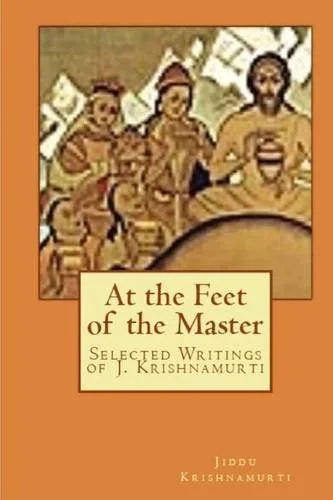
At the feet of the master
 75
75

At the feet of the master
At the Feet of the Master presents a deceptively simple framework for spiritual aspirants. Its strength lies in its direct, almost instructional tone, cutting through philosophical jargon to offer practical advice for the earnest seeker. The delineation of the four qualifications – Discrimination, Desirelessness, Right Conduct, and Love – provides a clear, actionable checklist for self-assessment. However, the text's earnestness can sometimes border on the dogmatic, particularly in its descriptions of the Path and the severe requirements for discipleship. The concept of 'Desirelessness,' while central, might feel abstract or even prohibitive to readers not already steeped in renunciate traditions. Ultimately, the book serves as a potent, albeit challenging, primer for those ready to commit to rigorous inner work.
📝 Description
75
First published in 1910 as Alcyone, 'At the Feet of the Master' offers direct instruction for spiritual disciples.
This spiritual text, written by Jiddu Krishnamurti under the name Alcyone, outlines the initial stages of discipleship. It unfolds as a dialogue where an older student guides a younger one preparing for initiation. The book addresses individuals seeking to understand spiritual development and live a more disciplined life, particularly those drawn to esoteric philosophies. It details the requirements for undertaking the spiritual path and the internal work involved.
The work delineates four essential qualifications for aspirants: discrimination, desirelessness, right conduct, and love. It introduces the concept of the 'Inner President' (higher self) and the 'Outer President' (personality). The book further distinguishes between the Path of Desire and the Path of Renunciation, identifying the latter as the true spiritual way. It also discusses the nature of the mind, the significance of service, and the ultimate aim of becoming a 'Master'.
Emerging in 1910, 'At the Feet of the Master' appeared during a period of significant Western interest in Eastern philosophies, particularly through the Theosophical Society. Jiddu Krishnamurti, then associated with this movement, penned the work under the pseudonym Alcyone. The book offered a structured guide to inner transformation, synthesized from global spiritual traditions. It became a key text for those seeking a systematic approach to spiritual growth, distinguishing itself from more abstract philosophical writings of the era.
💡 Why Read This Book?
• You will gain a structured understanding of the four primary qualifications for spiritual discipleship, as outlined in the 'qualifications' section, enabling a clear self-assessment of your readiness for inner work. • You will encounter the core Theosophical concept of the 'Path of Renunciation' versus the 'Path of Desire', offering a specific esoteric framework for understanding spiritual progression absent in secular self-help. • You will learn about the symbolic representation of the 'Inner President' and 'Outer President', providing a concrete internal model for understanding the relationship between the higher self and personality in esoteric psychology.
⭐ Reader Reviews
Honest opinions from readers who have explored this book.
❓ Frequently Asked Questions
What is the original publication year of At the Feet of the Master?
At the Feet of the Master was first published in 1910, under the pseudonym Alcyone. It later became widely known as a work by Jiddu Krishnamurti.
Who is Master Alcyone?
Master Alcyone was the pseudonym used by Jiddu Krishnamurti when he authored At the Feet of the Master. The name Alcyone is also associated with a star in the Pleiades constellation, a grouping often referenced in esoteric traditions.
What are the four main qualifications for the spiritual path discussed in the book?
The book identifies four key qualifications for those aspiring to the spiritual path: Discrimination (Viveka), Desirelessness (Vairagya), Right Conduct (Sadhana), and Love (Prema). These are presented as essential for progress.
Is this book suitable for beginners in spirituality?
Yes, it is specifically aimed at those beginning their serious spiritual journey or aspiring to discipleship. Its direct language and structured approach make it accessible, though the concepts require sincere contemplation.
What is the significance of the 'Inner President' and 'Outer President'?
The 'Inner President' represents the higher spiritual self or the Christ within, while the 'Outer President' is the personality or the physical vehicle. The book emphasizes aligning the Outer with the Inner President.
Does the book discuss meditation or specific practices?
While not a manual of specific techniques, the book strongly emphasizes the 'Right Conduct' qualification, which implies disciplined living and focused intention, forming the groundwork for inner practices like meditation.
🔮 Key Themes & Symbolism
The Four Qualifications
This theme is central to the book, outlining the essential virtues required for advancement on the spiritual Path. Discrimination (Viveka) involves discerning the real from the unreal, the eternal from the transient. Desirelessness (Vairagya) means freedom from attachment to the fruits of action and worldly pleasures. Right Conduct (Sadhana) refers to living ethically and purposefully, aligning one's actions with spiritual goals. Love (Prema) is the ultimate expression, encompassing compassion and selfless service towards all beings. These are presented not merely as ideals but as practical necessities for the aspirant.
The Nature of the Path
The work distinguishes between two fundamental paths: the Path of Desire and the Path of Renunciation. The Path of Desire is characterized by seeking worldly attainments, power, and pleasure, leading only to further entanglement. The Path of Renunciation, conversely, involves detachment from the ephemeral and a steadfast focus on spiritual liberation and service. This concept is crucial for understanding the book's ethical framework and its emphasis on inner transformation over external achievement.
Discipleship and the Master
At the Feet of the Master is fundamentally a guide for those aspiring to become disciples – students dedicated to a spiritual Master. It describes the relationship between the disciple and the Master, emphasizing obedience, service, and the disciple's readiness to receive guidance. The ultimate goal presented is not merely personal enlightenment but reaching the state of Mastery, where one can effectively help humanity, embodying the principles taught.
Inner vs. Outer Reality
A core teaching involves the distinction between the true, inner reality and the illusory, outer world of form and sensation. The book urges the reader to look beyond appearances and focus on the eternal, spiritual truths. Concepts like the 'Inner President' (higher self) and 'Outer President' (personality) illustrate this dichotomy, advocating for the mastery of the lower self by the higher, guiding the personality towards its divine purpose.
💬 Memorable Quotes
Direct passages from the work, attributed to the author.
“The Path is one of suffering, and the only way to conquer suffering is to desire it.”
— This provocative statement highlights the paradoxical nature of spiritual discipline. It suggests that true liberation comes not from avoiding hardship, but from embracing the challenges of the Path with a detached resolve, thereby neutralizing their power to cause suffering.
“Discrimination is the power which helps you to distinguish between the real and the unreal, the permanent and the impermanent.”
— This defines the first crucial qualification for the aspirant. It emphasizes the necessity of developing a keen intellect capable of penetrating illusion and focusing on the eternal truths, rather than being swayed by transient phenomena.
“Desirelessness does not mean the absence of all desires, but the absence of selfish desires.”
— This clarifies a potentially misunderstood concept. It differentiates between desires rooted in ego and attachment, and the inherent aspiration towards spiritual growth and service, which is seen as a higher, purified desire.
“Right Conduct is the path of service, of helping others.”
— This links ethical behavior directly to spiritual progress. It posits that true spiritual practice involves active compassion and selfless contribution to the well-being of humanity, rather than purely introspective pursuits.
“Love is the force that binds the disciple to the Master, and the Master to the heart of the world.”
— This highlights the supreme importance of Love as the ultimate unifying principle. It transcends mere affection, representing a divine force that connects the individual aspirant to the spiritual hierarchy and to all sentient beings.
🌙 Esoteric Significance
Tradition
This work is deeply embedded within the Theosophical tradition, which itself draws heavily from Hinduism (particularly Vedanta and Yoga) and Buddhism, synthesized with Hermetic and Neoplatonic ideas. It presents a structured approach to the spiritual Path of Discipleship, a concept central to Theosophy's hierarchical understanding of spiritual evolution. While departing from some of the more complex cosmological doctrines of Theosophy, it retains its focus on the aspirant's inner development and moral purification as prerequisites for higher knowledge.
Symbolism
Key symbols include the 'Path,' representing the journey of spiritual evolution, often bifurcated into the Path of Desire and the Path of Renunciation. The 'Inner President' (higher self) and 'Outer President' (personality) symbolize the divine spark within and its human vehicle, respectively. The 'Master' figure represents the realized human being, an advanced soul guiding others, embodying the ultimate goal of the Path. These symbols serve to concretize abstract spiritual concepts for the aspirant.
Modern Relevance
While originating in the early 20th century, the book's clear articulation of essential spiritual qualities continues to inform modern esoteric and mindfulness practices. Contemporary spiritual teachers and movements focusing on self-discipline, ethical living, and the cultivation of inner awareness often echo its core tenets. Aspiring practitioners in various yoga traditions, Buddhist studies, and even secular self-development circles may find its foundational principles relevant for establishing a serious inner discipline.
👥 Who Should Read This Book
• Aspiring disciples of any spiritual tradition seeking a clear, foundational text on the requirements for inner transformation and ethical living. • Students of comparative religion and esoteric philosophy interested in the Theosophical perspective on the spiritual Path and the role of a Master. • Individuals feeling a call towards deeper spiritual commitment who need practical guidance on cultivating virtues like discrimination, desirelessness, right conduct, and love.
📜 Historical Context
First published in 1910, At the Feet of the Master emerged during a fervent period of Western engagement with Eastern spirituality, largely catalyzed by the Theosophical Society. Jiddu Krishnamurti, writing as Alcyone, was a young figure within this milieu. The book offered a structured, accessible guide to discipleship, contrasting with the more complex philosophical expositions often encountered. Its earnest tone and clear delineation of spiritual requirements quickly resonated with a generation seeking practical esoteric knowledge. It gained significant traction within Theosophical circles and beyond, becoming a widely translated and influential text for spiritual seekers. While contemporary movements like the New Thought movement offered different paths to self-improvement, Krishnamurti's work provided a more rigorous, renunciate framework rooted in ancient Eastern disciplines.
📔 Journal Prompts
The four qualifications: Assess your current strength in Discrimination, Desirelessness, Right Conduct, and Love.
Reflect on the distinction between the Path of Desire and the Path of Renunciation in your own life.
Consider the relationship between your 'Outer President' and your deepest aspirations.
How does the concept of service, as described under Right Conduct, manifest in your daily activities?
What does 'desirelessness' mean to you beyond the absence of wanting things?
🗂️ Glossary
Discrimination (Viveka)
The ability to discern the real from the unreal, the eternal from the transient. It is the faculty that allows the aspirant to see through illusion and focus on the spiritual truth.
Desirelessness (Vairagya)
Freedom from selfish desires and attachments to worldly outcomes or pleasures. It signifies a state of detachment that allows for unbiased spiritual pursuit.
Right Conduct (Sadhana)
Living an ethical, disciplined, and purposeful life aligned with spiritual goals. It encompasses moral integrity, service, and the consistent application of spiritual principles in action.
Love (Prema)
The highest spiritual virtue, signifying unconditional compassion, selfless service, and a deep connection to all beings. It is seen as the ultimate force that binds the disciple to the Master and the world.
Inner President
Symbolizes the higher spiritual self, the divine spark within the individual, representing wisdom, intuition, and the true guiding principle.
Outer President
Represents the personality, the physical body, and the lower mind. The goal is to bring the Outer President under the control and guidance of the Inner President.
The Path
Refers to the journey of spiritual evolution and self-realization. The book distinguishes between the ultimately unfulfilling Path of Desire and the true spiritual Path of Renunciation.
🔮 Readers Also Liked
Browse all →




More by Jiddu Krishnamurti, Tang fa nao, Master Alcyone
All books →
More Free Theosophy & Anthroposophy Books
View all →