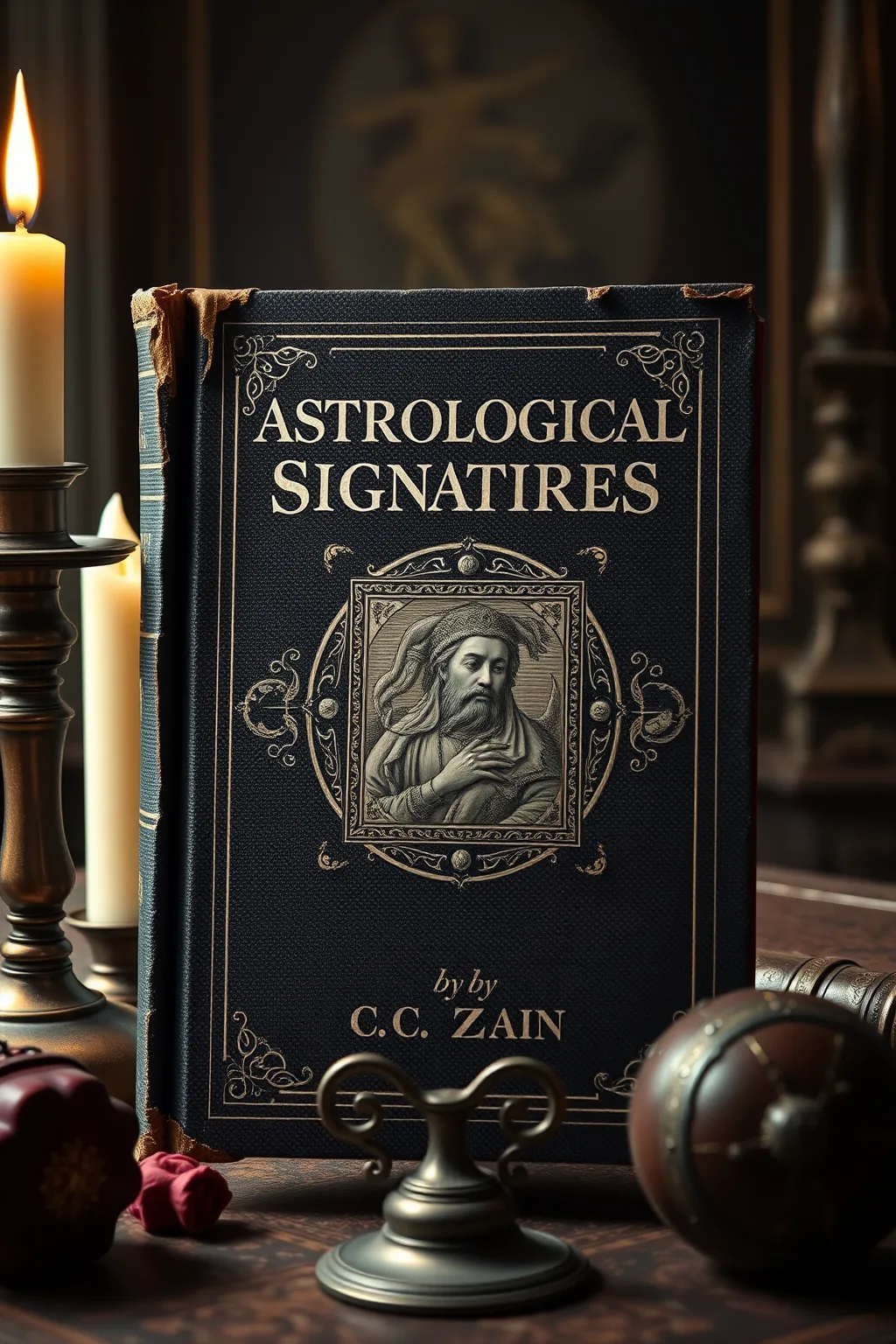
Astrological Signatures
 74
74

Astrological Signatures
C. C. Zain's Astrological Signatures approaches its subject matter with an academic rigor uncommon in popular astrology texts. The strength of the book lies in its systematic exposition of astrological principles as a symbolic language, moving beyond fortune-telling to explore cosmic architecture. Zain's detailed analysis of planetary and zodiacal 'signatures' offers a unique perspective on how celestial forces might imprint potential on terrestrial existence. However, the text's density and reliance on a specific esoteric framework can present a significant barrier to entry for readers unfamiliar with occult traditions. The chapter on 'The Twelve Houses' offers a particularly concrete example of how Zain maps abstract astrological concepts onto specific life areas, but the underlying metaphysical assumptions require considerable acceptance from the reader. Ultimately, Astrological Signatures is a valuable resource for dedicated esoteric students, though its specialized nature limits its broad appeal.
📝 Description
74
C. C. Zain's Astrological Signatures, published in 1976, proposes astrology as a fundamental language of the universe.
Published in 1976, Astrological Signatures by C. C. Zain investigates the esoteric principles behind astrological symbolism. The book moves past simple horoscopes to map the connections between celestial patterns and earthly events. Zain posits a system where cosmic forces leave specific imprints on individuals and occurrences, viewing astrology as a universal language rather than just a predictive tool.
This text is for serious students of esoteric philosophy, occultism, and comparative religion who want to grasp astrology's symbolic structure. It appeals to those seeking a more philosophical and metaphysical approach than common astrological interpretations offer. Readers familiar with Hermeticism, Theosophy, or Kabbalah will find recognizable ideas, while newcomers will encounter a structured system.
Zain systematically examines the archetypal energies of zodiac signs and planets. He details 'signatures' as inherent force patterns that appear in both the macrocosm and microcosm, suggesting a unified cosmic order. The text also touches upon the practical application of these principles, though its primary focus remains on the underlying symbolic architecture.
Astrological Signatures emerged in the mid-1970s, a period marked by renewed interest in occult and spiritual studies. This era saw many authors attempting to combine ancient wisdom traditions with contemporary scientific and philosophical ideas. Zain's work contributed to this intellectual milieu by presenting a systematic method for understanding astrological symbolism, distinguishing it from more popular astrological trends of the time. It aligns with a broader movement to synthesize esoteric knowledge and provide a metaphysical framework for understanding reality.
💡 Why Read This Book?
• Understand the concept of 'planetary signatures' as described by C. C. Zain, learning how specific celestial bodies are believed to imprint distinct energies and potentials on individuals and events, a core tenet of his astrological system. • Grasp the esoteric function of the 'Twelve Houses' as detailed in the text, recognizing how they represent specific planes of manifestation and experience within the cosmic order, moving beyond basic astrological interpretations. • Explore the foundational principles of astrological symbolism as presented in the 1976 publication, gaining insight into how esoteric traditions view the zodiac and planets not just as predictive tools, but as a universal symbolic language.
⭐ Reader Reviews
Honest opinions from readers who have explored this book.
❓ Frequently Asked Questions
What is the core philosophy behind C. C. Zain's Astrological Signatures?
The core philosophy posits that celestial bodies and zodiacal signs act as 'signatures,' imprinting specific archetypal energies and potentials onto all aspects of existence, from individuals to events.
When was Astrological Signatures first published?
Astrological Signatures by C. C. Zain was first published in 1976, a period of significant interest in esoteric studies.
Is Astrological Signatures a beginner's guide to astrology?
No, it is more suited for advanced students of esoteric philosophy and occultism seeking a metaphysical framework for astrology, rather than a basic introduction.
What distinguishes Astrological Signatures from modern astrological books?
It distinguishes itself by focusing on astrological principles as a symbolic language and cosmic architecture, rather than popular predictive or psychological interpretations prevalent today.
What esoteric traditions influenced C. C. Zain's work in Astrological Signatures?
Zain's work draws heavily from Hermeticism and Theosophy, integrating their concepts of universal laws and symbolic correspondences into his astrological framework.
Does the book offer practical applications of astrological signatures?
Yes, the book explores how understanding these signatures can aid in personal development and spiritual growth by aligning individuals with cosmic patterns.
🔮 Key Themes & Symbolism
Cosmic Signatures
The central theme is the concept of 'signatures' – inherent patterns of force and influence emanating from celestial bodies and zodiacal signs. Zain posits that these signatures are not mere influences but fundamental archetypes that imprint potentials onto all of creation. This framework suggests a universe governed by a systematic, symbolic language where the macrocosm directly mirrors and shapes the microcosm. Understanding these signatures is presented as key to comprehending destiny and the underlying order of existence.
Astrology as Symbolic Language
This work elevates astrology beyond predictive charts to a profound symbolic language. Zain argues that the zodiac, planets, and their configurations are not random occurrences but components of a divine grammar. By deciphering these symbols, one can gain insight into the laws of the universe and the nature of consciousness. The book treats astrological elements as glyphs representing fundamental forces and principles that can be studied and understood on a metaphysical level.
The Twelve Houses as Planes of Manifestation
The book systematically examines the Twelve Houses, presenting them not just as areas of life but as distinct planes or dimensions where cosmic energies manifest. Each house corresponds to specific archetypal experiences and stages of unfoldment. This detailed mapping allows readers to see how the abstract principles of astrology are concretely applied to the structure of human experience and the physical world, offering a more structured view of destiny.
Esoteric Cosmology
Astrological Signatures is rooted in an esoteric cosmology that views the universe as a unified, intelligent system. Zain integrates concepts from Hermeticism and Theosophy to build a model where celestial mechanics are intrinsically linked to spiritual evolution. The work suggests that by studying astrological patterns, individuals can better understand their place within this grand cosmic design and work towards spiritual realization.
💬 Memorable Quotes
Direct passages from the work, attributed to the author.
“The celestial bodies and signs are not merely influences, but are the very substance of the forces they represent.”
— This statement emphasizes Zain's view that astrological entities are not external pressures but fundamental constituents of reality. It suggests a direct correspondence between the symbol and the symbolized, implying a deep ontological connection.
“Each zodiacal sign is an archetypal pattern imprinted upon the ether, awaiting its vehicle of expression.”
— This highlights the idea of potentiality within astrology. The signs are seen as pre-existing forms or blueprints that manifest through specific circumstances, individuals, or events in the material world.
“The Twelve Houses delineate the stages of the soul's journey through the material plane.”
— This interpretation frames the Houses not just as life areas but as a spiritual curriculum. It suggests a teleological view of astrological houses, guiding the soul's evolution from beginning to end.
“Understanding astrological signatures is the key to unlocking the science of correspondences.”
— This points to the book's broader aim: to reveal the interconnectedness of all things through the lens of astrology. It positions the study of signatures as a method for perceiving universal laws.
“The planets act as distributors of the zodiacal energies, modulating their expression.”
— This explains the dynamic relationship between planets and signs in Zain's system. Planets are seen as agents that refine and channel the raw archetypal energies of the zodiac into specific forms.
🌙 Esoteric Significance
Tradition
Astrological Signatures is deeply rooted in the Western Esoteric Tradition, drawing heavily from Hermeticism and Theosophy. It aligns with the Hermetic principle of 'As Above, So Below,' viewing celestial patterns as direct reflections of terrestrial realities and spiritual laws. The work echoes Theosophical ideas about cosmic evolution and the symbolic nature of the universe. Zain's approach departs from purely predictive astrology, instead framing it as a key to understanding the underlying metaphysical structure of existence and the soul's journey.
Symbolism
The book places significant emphasis on astrological symbolism, particularly the 'signatures' of planets and zodiacal signs. The Sun, for instance, is presented not just as a leading figure but as the symbol of the divine spark and higher consciousness. The sign Aries, beyond its typical interpretations, symbolizes the initial impulse of force and pioneering spirit within the cosmic order. The Twelve Houses are interpreted as symbolic stages of manifestation, charting the soul's progression through various planes of experience.
Modern Relevance
Contemporary practitioners of traditional astrology, Hermeticists, and students of comparative religion find value in Zain's systematic approach. His work is referenced by those seeking a deeper metaphysical understanding of astrological principles beyond modern psychological or pop-culture interpretations. Thinkers involved in the resurgence of classical astrology and those exploring the symbolic languages of various spiritual traditions may draw upon Astrological Signatures for its structured cosmology and detailed symbolic analysis.
👥 Who Should Read This Book
• Students of Western Esotericism: Those studying Hermeticism, Theosophy, or classical astrology will find a structured framework that aligns with these traditions and deepens their understanding of cosmic correspondences. • Comparative Religion Scholars: Researchers interested in the symbolic systems and metaphysical underpinnings of various spiritual traditions will find astrology presented as a universal symbolic language. • Advanced Astrological Practitioners: Astrologers seeking to move beyond basic interpretation and explore the deeper philosophical and metaphysical roots of their craft will benefit from Zain's systematic approach.
📜 Historical Context
Published in 1976, C. C. Zain's Astrological Signatures emerged during a period when esoteric studies were experiencing a resurgence, partly fueled by the counterculture of the 1960s. This era saw a broad interest in spiritual philosophies, occult traditions, and alternative worldviews. Zain's work contributed to this milieu by offering a systematic, metaphysical interpretation of astrology, moving beyond the more popular, often simplified, sun-sign astrology that was gaining traction. It engaged with the intellectual currents of Theosophy and Hermeticism, which sought to synthesize ancient wisdom with modern understanding. While not directly engaging with specific public controversies, the book implicitly stood in contrast to burgeoning psychological astrology, presenting a more classical, cosmic-order-focused perspective. Its reception was likely within dedicated esoteric circles, appreciating its rigorous structure and metaphysical depth.
📔 Journal Prompts
The concept of planetary signatures and their potential imprints.
Mapping the archetypal energies of the twelve zodiacal signs.
The symbolic meaning of the Twelve Houses as planes of manifestation.
Personal reflection on the 'As Above, So Below' principle in astrological study.
The role of C. C. Zain's astrological cosmology in understanding universal laws.
🗂️ Glossary
Signatures
In Zain's system, the inherent archetypal forces and potentials imprinted by celestial bodies and zodiacal signs onto all levels of existence, shaping characteristics and destinies.
Macrocosm
The universe as a whole; the greater world. In esoteric philosophy, it is often seen as mirroring the microcosm (humanity or the individual).
Microcosm
The individual human being or a smaller system that reflects the principles of the macrocosm. Zain uses this to connect celestial patterns to personal characteristics.
Archetype
A primordial, universal model or pattern of an idea, image, or symbol that influences human consciousness and behavior, often associated with celestial configurations in esoteric thought.
Plane of Manifestation
A level or dimension of reality where specific types of energies or potentials are expressed. In Astrological Signatures, the Twelve Houses are described as such planes.
Esoteric Cosmology
A worldview or system of understanding the universe based on hidden, inner, or spiritual principles, often contrasting with exoteric or materialist views.
Science of Correspondences
The study of the relationships and analogies between different areas of existence (e.g., celestial, terrestrial, human), believing that understanding one illuminates the others.
🔮 Readers Also Liked
Browse all →









More by C. C. Zain
All books →




More Free Occult Philosophy Books
View all →