And Still We Rise
 79
79

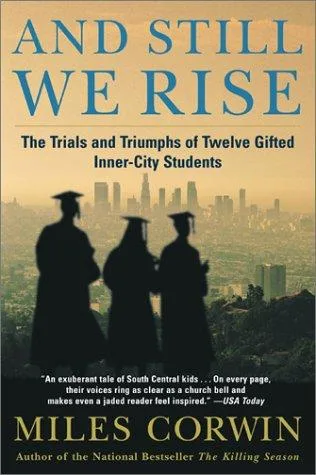
And Still We Rise
Miles Corwin's And Still We Rise offers a compelling, if at times academically dense, examination of human resilience. The author’s strength lies in his ability to connect individual psychological processes to broader historical and symbolic patterns. His discussion of "narrative reconstruction" is particularly insightful, illustrating how survivors of trauma actively rewrite their personal histories to forge a path forward. However, the book’s primary limitation is its consistent reliance on a somewhat detached, analytical tone. While this lends credibility, it occasionally distances the reader from the raw emotional weight of the subject matter. A passage detailing the symbolic use of fire in post-disaster rebuilding efforts highlights both Corwin's analytical prowess and his tendency toward abstraction. Ultimately, And Still We Rise provides a valuable framework for understanding perseverance, albeit one that prioritizes intellectual dissection over emotional evocation.
📝 Description
79
In 2008, Miles Corwin examined how the human spirit persists through hardship in 'And Still We Rise'.
And Still We Rise, published in 2008, analyzes the psychological and symbolic ways individuals and communities endure severe adversity. Miles Corwin moves past simple survival narratives, focusing instead on the internal and external resources people use to not only withstand difficult circumstances but also to actively rebuild and transform them. The book connects historical accounts with psychological insights.
This work is for readers interested in human resilience, especially those who appreciate understanding the symbolic aspects of struggle and renewal. It will interest students of comparative psychology, mythology, and existential philosophy. Anyone seeking to grasp the deeper currents of human endurance during times of societal upheaval or personal crisis will find substantial material here. It is an analytical study of enduring spirit, not a self-help manual.
While not explicitly labeled as esoteric, Corwin's 2008 text engages with traditions that explore the symbolic underpinnings of human experience and transformation. The focus on 'narrative reconstruction' and 'symbolic anchoring' aligns with psychological and philosophical frameworks that examine how individuals and groups create meaning and stability through shared stories and archetypes. This approach echoes in depth psychology and certain mythic studies, which investigate the persistent patterns of human consciousness and resilience in the face of existential challenges.
💡 Why Read This Book?
• Understand the concept of "narrative reconstruction" as presented by Corwin, learning how individuals actively reframe past traumas to build a sustainable future identity. • Explore "symbolic anchoring" and its function in providing stability during periods of societal or personal chaos, drawing examples from Corwin's analysis. • Grasp the idea of "generative suffering," not as an endorsement of pain, but as a framework for understanding how adversity can, under certain conditions, catalyze growth.
⭐ Reader Reviews
Honest opinions from readers who have explored this book.
❓ Frequently Asked Questions
What is Miles Corwin's primary focus in "And Still We Rise"?
Miles Corwin's primary focus in "And Still We Rise" is the psychological and symbolic mechanisms that enable individuals and communities to persevere and transform through significant adversity, as explored in his 2008 publication.
What does "narrative reconstruction" mean in the context of this book?
Narrative reconstruction, as discussed by Corwin, refers to the active process by which individuals reframe their past experiences, particularly traumas, to construct a coherent and forward-looking personal story.
How does "symbolic anchoring" help people cope with hardship?
Symbolic anchoring, according to the work, provides individuals and groups with stable points of reference—often through shared symbols or rituals—that offer a sense of continuity and meaning amidst overwhelming external chaos.
What historical period influenced the writing of "And Still We Rise"?
The book, published in 2008, was written during a time of global economic instability and ongoing international conflicts, which likely influenced its thematic focus on resilience and renewal.
Is "And Still We Rise" a practical self-help guide?
No, "And Still We Rise" is primarily an analytical study and exploration of human endurance. While it offers profound insights, it is not structured as a direct self-help manual.
What is the concept of "generative suffering" in Corwin's work?
Corwin uses "generative suffering" to describe the potential for profound personal or collective growth that can emerge from enduring immense hardship, emphasizing it as a catalyst rather than an endorsement of pain.
🔮 Key Themes & Symbolism
Narrative Reconstruction
This theme examines how individuals and groups actively re-edit their life stories to integrate traumatic experiences and create a viable future. Corwin illustrates that survival is not merely about enduring events, but about consciously reshaping the narrative of those events to foster personal growth and agency. It emphasizes the power of storytelling in psychological healing and resilience, moving beyond passive victimhood to active authorship of one's life path after crisis.
Symbolic Anchoring
Corwin explores the critical role of symbols and shared rituals in providing stability during times of profound disruption. These anchors offer a sense of continuity, meaning, and collective identity when external structures collapse. The book suggests that by clinging to or creating potent symbols, individuals can maintain psychological equilibrium and a connection to a larger human narrative, preventing complete disintegration in the face of overwhelming change.
Generative Suffering
This concept, central to the book's thesis, posits that extreme hardship, while inherently painful, can act as a powerful catalyst for transformation. It is not about romanticizing pain but understanding its potential to break down old structures and create space for new growth and deeper understanding. The work examines how certain individuals and societies, through processes of narrative reconstruction and symbolic anchoring, can harness suffering to emerge stronger and more evolved.
The Interplay of Agency and Force
And Still We Rise consistently explores the dynamic tension between individual free will and the overwhelming pressures of external circumstances. Corwin investigates how agency is maintained or reclaimed even when faced with seemingly insurmountable forces, whether personal, social, or historical. This theme highlights the psychological fortitude required to act and create meaning within constraints, demonstrating that resilience often lies in how one responds to, rather than escapes from, difficult realities.
💬 Memorable Quotes
Direct passages from the work, attributed to the author.
“The story we tell ourselves about what happened is often more critical than what happened itself.”
— This highlights the core concept of narrative reconstruction, suggesting that our internal interpretation and retelling of events significantly shape our psychological reality and capacity for future action.
“In the rubble, the most enduring structures are often made of shared memory and belief.”
— This speaks to symbolic anchoring, emphasizing that during times of destruction, collective intangible elements like shared history and common faith provide the most stable foundations for rebuilding.
“When the ground shifts, we find our footing not by standing still, but by learning to dance with the tremors.”
— This captures the essence of agency within adversity, suggesting that resilience involves adaptation and active engagement with instability rather than passive resistance.
“The past is not a cage, but a foundation upon which the future is built.”
— This reiterates the theme of narrative reconstruction, positioning historical experience as a resource for future development rather than a source of permanent limitation.
💡 Key Ideas
Editorial paraphrase of the work's core concepts — not direct quotes.
Suffering is not the end, but a crucible from which new forms can be forged.
This paraphrases the idea of generative suffering, framing hardship not as a terminal state but as a transformative process that can lead to the creation of something new and stronger.
🌙 Esoteric Significance
Tradition
While "And Still We Rise" is not explicitly rooted in a single esoteric tradition, its focus on symbolic anchoring and narrative reconstruction aligns with archetypal psychology, a field influenced by Carl Jung's exploration of the collective unconscious and universal symbols. It also touches upon Gnostic themes of overcoming material hardship through inner fortitude and reinterpretation of one's reality. The work can be seen as a secularized interpretation of perennial philosophical ideas about transformation through trial.
Symbolism
The book frequently employs archetypal symbols of destruction and renewal. Fire, for instance, represents not only devastation but also purification and the potential for a new beginning, a common motif in alchemical and mythic traditions. The concept of the "ruin" itself becomes a symbol of breakdown that precedes rebuilding, echoing the death-rebirth cycles found in nature and spiritual narratives. Water, in its dual capacity for destruction (flood) and cleansing, also serves as a potent symbol of transformation and renewal.
Modern Relevance
Contemporary thinkers in fields such as positive psychology, trauma studies, and even certain branches of existential philosophy draw on Corwin's concepts. The emphasis on narrative as a tool for healing and resilience appeals to therapeutic approaches that prioritize client storytelling. His ideas on "symbolic anchoring" can inform community resilience initiatives and disaster recovery planning, highlighting the psychological need for shared meaning and continuity in crisis.
👥 Who Should Read This Book
• Students of archetypal psychology and Jungian thought, seeking to understand how universal symbols manifest in narratives of hardship and recovery. • Individuals grappling with personal or collective trauma, looking for analytical frameworks that illuminate the process of making meaning from suffering. • Comparative religion scholars and philosophers interested in how themes of death, rebirth, and endurance are explored through secular, psychological lenses.
📜 Historical Context
Miles Corwin's "And Still We Rise," published in 2008, emerged during a period marked by significant global economic volatility, exemplified by the subprime mortgage crisis, and ongoing international conflicts. This era saw a heightened public discourse on resilience, coping mechanisms, and the human capacity to endure and adapt to complex, often unsettling, realities. The intellectual climate was receptive to psychological and philosophical explorations of meaning-making in the face of uncertainty. Corwin's work engaged with a broader trend of examining existential themes, potentially contrasting with more purely clinical psychological approaches by emphasizing symbolic and narrative dimensions. While not directly engaging with a specific contemporary author in its public reception, its themes aligned with broader discussions on post-traumatic growth and societal recovery that were prevalent in academic and popular circles.
📔 Journal Prompts
The concept of narrative reconstruction and its application to personal history.
Symbolic anchoring in moments of personal or collective crisis.
The potential for "generative suffering" in overcoming obstacles.
Reflecting on the interplay between personal agency and external forces.
How shared memories and beliefs serve as anchors during upheaval.
🗂️ Glossary
Narrative Reconstruction
The psychological process of actively reinterpreting and reframing past events, particularly traumas, to create a coherent and forward-looking personal story that fosters resilience and agency.
Symbolic Anchoring
The use of shared symbols, rituals, or collective memories to provide a sense of stability, continuity, and meaning during periods of intense external disruption or personal crisis.
Generative Suffering
The idea that extreme hardship, while inherently painful, can act as a catalyst for profound personal or collective growth, transformation, and the emergence of new capacities.
Archetypal Psychology
A school of psychology, influenced by Carl Jung, that explores universal patterns and images (archetypes) residing in the collective unconscious, often manifesting in myths, dreams, and symbols.
Agency
The capacity of individuals to act independently and make their own free choices, particularly in the context of overcoming external constraints or overwhelming circumstances.
Existential Philosophy
A philosophical approach that emphasizes individual existence, freedom, and choice, often exploring themes of meaning, anxiety, and the human condition in a seemingly indifferent universe.
Perseverance
Persistence in doing something despite difficulty or delay in achieving success; steadfastness in the face of adversity.
🔮 Readers Also Liked
Browse all →








![Roald Dahl's Tales of the Unexpected [24 stories]](/img/thumb/roald-dahls-tales-of-the-unexpected-24-stories-roald-dahl-509219.webp)
More Free Occult Philosophy Books
View all →