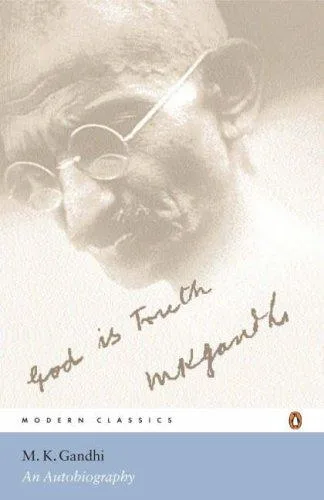
An autobiography
 76
76

An autobiography
Gandhi’s "An Autobiography" offers a stark, unvarnished account of a life dedicated to moral experimentation. The strength of the work lies in its relentless self-scrutiny; Gandhi lays bare his youthful follies and spiritual searching with an honesty that is both disarming and instructive. He doesn't shy away from detailing his experiments with diet, his struggles with sexual urges, or his profound griefs, making his eventual development of Satyagraha all the more compelling. A particular passage detailing his vow of celibacy and its psychological ramifications is remarkably candid. However, the book's almost obsessive focus on personal asceticism and spiritual minutiae, while central to his project, might prove challenging for readers solely interested in political strategy. The detailed accounts of dietary changes and fasting, while symbolically potent for Gandhi, can sometimes feel tangential to the broader narrative of political awakening for a modern reader. Nevertheless, the autobiography remains a singular document of a man forging a revolutionary philosophy from the crucible of personal experience.
📝 Description
76
Mohandas Karamchand Gandhi’s autobiography, first published in 1927, details his spiritual and ethical development.
Mohandas Karamchand Gandhi's "An Autobiography" chronicles his life from childhood through his time in South Africa and return to India. The book focuses less on personal events and more on the development of his core principles. Gandhi emphasizes Satyagraha, or truth force, and Ahimsa, non-violence, as central to his philosophy and actions.
This work details his evolving views on life and governance, shaped by personal struggles and public activism. It is particularly relevant for individuals interested in applying moral and spiritual principles to public life. Readers seeking to understand the origins of non-violent resistance, ethical leadership, and the personal discipline required for significant social change will find this account valuable. The autobiography serves as a model for aligning personal convictions with actions in the wider world, highlighting self-examination and steadfast commitment.
Gandhi's autobiography is situated within traditions that seek to integrate spiritual truth with practical action. His emphasis on Satya (Truth) as the highest reality aligns with Advaita Vedanta's monistic view of ultimate oneness. The practice of Ahimsa (non-violence) reflects principles found in Jainism and Buddhism, which advocate for compassion and the avoidance of harm. The book chronicles a personal quest to live these principles, demonstrating how inner spiritual discipline can inform public life and social change, moving beyond ritualistic adherence to a lived embodiment of ethical ideals.
💡 Why Read This Book?
• Understand the origins of Satyagraha by examining Gandhi's personal experiments and ethical development, particularly his early legal career and South African experiences, which shaped his philosophy. • Gain insight into the practical discipline of Ahimsa, as detailed through his personal struggles with self-control and his deliberate adoption of simple living and fasting. • Explore the concept of Sarvodaya through Gandhi's reflections on societal well-being, contrasting his vision with Western models of progress and industrialization.
⭐ Reader Reviews
Honest opinions from readers who have explored this book.
❓ Frequently Asked Questions
When was Mohandas Karamchand Gandhi's autobiography first published?
Mohandas Karamchand Gandhi's "An Autobiography" was first published in 1927, serialized in his journal "Navjivan" and later in "Young India."
What is the primary philosophy discussed in Gandhi's autobiography?
The primary philosophy is Satyagraha, which Gandhi developed and extensively discusses. It's a concept of non-violent resistance rooted in truth and love.
What significant period of Gandhi's life does the autobiography cover?
The autobiography covers Gandhi's life from his birth up to the early 1920s, with significant focus on his formative years, his legal studies in London, and his experiences in South Africa.
What does 'Ahimsa' mean in the context of Gandhi's autobiography?
Ahimsa, as explored in the autobiography, signifies non-violence not as a passive state but as an active, courageous force rooted in love and compassion, integral to Satyagraha.
Does Gandhi discuss his return to India in his autobiography?
Yes, the autobiography details Gandhi's return to India from South Africa and his initial engagements with the Indian nationalist movement, setting the stage for his leadership.
What personal challenges does Gandhi share in his autobiography?
Gandhi openly shares personal challenges including his struggles with adherence to vows, his early sexual experiences, his grief over family deaths, and his experiments with fasting and diet.
🔮 Key Themes & Symbolism
The Development of Satyagraha
Gandhi's autobiography meticulously traces the evolution of Satyagraha, his philosophy of non-violent resistance. It details his personal experiments in truth-seeking and moral discipline, particularly during his time in South Africa, showing how these individual practices informed his broader political strategy. The work emphasizes that Satyagraha is not merely passive disobedience but an active assertion of truth, requiring immense courage and self-purification from its practitioners.
Ahimsa as Active Force
Central to Gandhi's narrative is the concept of Ahimsa, or non-violence. He presents it not as an absence of violence but as a positive, all-embracing love and a potent weapon against injustice. The autobiography recounts his personal struggles to embody Ahimsa, illustrating its demanding nature through his fasting, vows of celibacy, and efforts to overcome anger and hatred, thereby demonstrating its spiritual and ethical depth.
Truth and Self-Discipline
The pursuit of Truth (Satya) is depicted as the ultimate goal, intertwined with rigorous self-discipline. Gandhi chronicles his ascetic practices, including dietary experiments and vows, as essential tools for spiritual purification and strengthening his will. These personal disciplines are presented as foundational to his public activism, suggesting that inner transformation is a prerequisite for effecting outer change and achieving genuine societal welfare (Sarvodaya).
Sarvodaya and Social Reform
The autobiography outlines Gandhi's vision for Sarvodaya, the welfare of all beings. This concept informs his critique of Western industrialization and his advocacy for a decentralized, self-sufficient society based on ethical principles. His reflections on village life, Swadeshi (self-reliance), and the eradication of untouchability showcase his holistic approach to social and economic reform, aiming for a just and equitable world.
💬 Memorable Quotes
Direct passages from the work, attributed to the author.
“My life is my message.”
— This concise statement captures Gandhi's belief that his personal actions and lived example were the most potent form of communication and teaching, underscoring the integral link between his inner life and his public role.
“The word 'Swadeshi' is not new. I believe there is no word in the Gujarati language which we are more called upon to reduce to practice.”
— This highlights Gandhi's emphasis on self-reliance and local production, not just as an economic principle but as a crucial practice for national and personal liberation from external control.
“My experiments with truth have been going on for so long...”
— This phrase, which also serves as the original title of his autobiography, signifies Gandhi's view of his life not as a fixed narrative but as a continuous process of learning, testing, and refining his understanding of truth.
“I must not hurt the Mussalman even in thought.”
— This internal reflection reveals the depth of Gandhi's commitment to Ahimsa, extending it beyond physical action to encompass even one's thoughts and intentions, particularly in the context of inter-religious harmony.
💡 Key Ideas
Editorial paraphrase of the work's core concepts — not direct quotes.
I have found that life is greater than death, and that truth is greater than untruth.
This quote reflects Gandhi's profound conviction in the enduring power of truth and the spiritual significance of life over material existence or the fear of death, a central to his non-violent philosophy.
🌙 Esoteric Significance
Tradition
Gandhi's work, while deeply rooted in Indian spiritual traditions like Hinduism and Jainism, can be seen as a modern interpretation of esoteric principles, particularly those focused on inner transformation for outer change. It aligns with the Hermetic maxim 'As Above, So Below,' by demonstrating how personal spiritual discipline directly impacts societal structures. His emphasis on truth as the ultimate reality and non-violence as a divine force echoes Gnostic and Vedantic ideas of inherent divinity and the pursuit of higher consciousness.
Symbolism
The recurring motif of fasting in the autobiography functions as a powerful esoteric symbol. It represents not just physical abstinence but a spiritual purification, a means of intensifying inner resolve and achieving moral clarity. Gandhi's meticulous attention to diet and his vows of celibacy can be interpreted as practices of energetic transmutation, aiming to channel vital force towards spiritual and intellectual pursuits rather than physical indulgence, thereby aligning the self with higher principles.
Modern Relevance
Gandhi's autobiography continues to inform contemporary esoteric and spiritual movements focused on social justice and ethical living. Thinkers and activists in fields ranging from peace studies to deep ecology draw inspiration from his model of integrated spirituality and activism. His principles of non-violence and truth-force remain foundational for many mindfulness-based activist groups and individuals seeking to live a life aligned with spiritual values in a complex, often conflict-ridden world.
👥 Who Should Read This Book
• Students of comparative religion and philosophy seeking to understand the practical application of Eastern spiritual concepts like Ahimsa and Satya in socio-political contexts. • Aspiring leaders and activists interested in developing ethical frameworks for social change, learning from Gandhi's personal journey of moral experimentation and disciplined action. • Individuals exploring personal growth and self-mastery, who can draw valuable lessons from Gandhi's candid account of his struggles with self-discipline, vows, and the pursuit of truth.
📜 Historical Context
Published in 1927, Mohandas Karamchand Gandhi's "An Autobiography" arrived as India was deeply entrenched in its struggle for independence from British rule. The early 20th century was a crucible for nationalist movements worldwide, and Gandhi's unique philosophy of Satyagraha offered a compelling alternative to violent revolution, which was often the dominant mode of resistance. His work implicitly engaged with and departed from both traditional Indian spiritual practices and Western political thought. While figures like Swami Vivekananda had previously explored spiritual nationalism, Gandhi foregrounded practical, non-violent action as a mass political tool. The book's reception was significant, galvanizing support for the Indian independence movement and influencing global civil rights leaders. It stood in stark contrast to the emerging ideologies of state power and militarism prevalent in Europe during the interwar period.
📔 Journal Prompts
The vow of celibacy and its impact on Gandhi's spiritual and psychological state.
Gandhi's experiments with diet as a tool for self-purification and willpower.
The development of Satyagraha through personal trials in South Africa.
The concept of Sarvodaya and its contrast with Western industrial progress.
Reflections on the meaning and practice of Ahimsa beyond mere non-violence.
🗂️ Glossary
Satyagraha
Literally 'truth force' or 'soul force.' Gandhi's philosophy and practice of non-violent resistance, based on the principles of truth, love, and self-suffering.
Ahimsa
The Sanskrit word for non-violence, encompassing abstention from causing harm to any living being in thought, word, or deed. Gandhi expanded it to mean active love and compassion.
Satya
Truth. Gandhi considered Satya to be God, the ultimate reality, and the pursuit of truth as the core of his life's work and philosophy.
Sarvodaya
The principle of 'welfare of all' or 'progress of all.' Gandhi's vision for an ideal society based on principles of equality, justice, and self-sufficiency.
Swadeshi
Self-reliance, particularly in economic terms. It involves the use of domestically produced goods and the promotion of local industries, a key aspect of India's independence movement.
Ashram
A spiritual or religious retreat or community, often characterized by simple living, communal work, and spiritual discipline. Gandhi established several ashrams.
Brahmacharya
Often translated as celibacy or control of the senses. For Gandhi, it was a vital practice for spiritual development and conserving energy for service.
🔮 Readers Also Liked
Browse all →









More by Mohandas Karamchand Gandhi
All books →
More Free Occult Philosophy Books
View all →