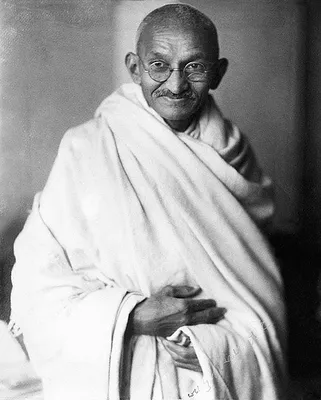
Mohandas Karamchand Gandhi
Mohandas Karamchand Gandhi was an Indian lawyer and leader of the independence movement, known for his philosophy of nonviolent resistance.
Mohandas Karamchand Gandhi, later revered as Mahatma, was an Indian lawyer and anti-colonial leader who spearheaded India's independence from British rule through nonviolent civil disobedience. Born in Gujarat, he studied law in London and later lived in South Africa for 21 years, where he first developed his methods of protest. Upon returning to India in 1915, he organized peasants and laborers, advocating for self-rule, poverty alleviation, and social reforms. His leadership of the Indian National Congress involved nationwide campaigns, including the Dandi Salt March and the call for British withdrawal.
Gandhi adopted a simple lifestyle, symbolized by the hand-spun dhoti, and used fasting as a tool for introspection and political action. His vision of a pluralistic India faced challenges with the demand for a separate Muslim homeland, leading to the partition of British India. Despite his efforts to quell religious violence post-partition through fasts, he was assassinated in 1948 by a Hindu nationalist. Gandhi remains a globally influential figure, celebrated for his philosophy of nonviolence and considered the 'Father of the Nation' in India.
Early Life and Philosophical Influences
Born in 1869 in Porbandar, Gujarat, Mohandas Karamchand Gandhi came from a Hindu family with a background in public service. His father, Karamchand, served as a chief minister in local princely states. Gandhi's childhood was shaped by Hindu epics that instilled values of truth and love, profoundly influencing his later philosophy. His mother, Putlibai, was a deeply religious woman whose daily prayers and vows, including fasting, left a lasting impression on him. Gandhi's early education included arithmetic, history, and languages, though he was a shy student. At age 13, he entered an arranged marriage, an experience he later reflected upon with regret regarding his youthful passions.
Legal Training and Early Activism
Gandhi pursued legal studies in London, arriving in 1888. Before his departure, he made vows to his mother to abstain from meat, alcohol, and women, a commitment he maintained during his time abroad. His early years in South Africa, beginning in 1893, were pivotal. While representing an Indian merchant, he encountered racial discrimination, which spurred him to develop and employ nonviolent resistance as a tool for civil rights advocacy over the next 21 years. This period saw him raise a family and lay the groundwork for his future leadership in India's independence movement.
Leadership in India's Independence Movement
Returning to India in 1915, Gandhi quickly became a central figure in the struggle for independence. He organized peasants, farmers, and laborers against discriminatory practices and oppressive taxes. Assuming leadership of the Indian National Congress in 1921, he campaigned for social and economic justice, including poverty reduction, women's rights, religious harmony, and the eradication of untouchability, all under the banner of achieving 'swaraj' or self-rule. He adopted the simple dhoti as a symbol of solidarity with the rural poor and utilized fasting for both personal reflection and political protest.
Challenging Colonial Rule and Partition
Gandhi's leadership was marked by significant acts of civil disobedience, such as the 1930 Dandi Salt March, a 400 km protest against the British salt tax, and the 1942 'Quit India' movement. He endured multiple imprisonments for his activism. In his later years, his ideal of a unified, religiously pluralistic India was threatened by Muslim nationalism, leading to the partition of British India into India and Pakistan in 1947. Gandhi actively worked to mitigate the widespread religious violence that followed, undertaking fasts to promote peace, even as he abstained from the official independence celebrations.
Assassination and Legacy
Gandhi's unwavering commitment to defending the rights of Indian Muslims, even after the partition, led to resentment among some Hindu nationalists. On January 30, 1948, he was assassinated by Nathuram Godse, a militant Hindu nationalist, while attending an interfaith prayer meeting in Delhi. Gandhi is widely remembered as the 'Father of the Nation' in India and is honored globally through the International Day of Nonviolence on his birthday, October 2nd. His philosophy of nonviolent resistance continues to inspire movements for civil rights and freedom worldwide.
Key Ideas
- Nonviolent resistance (Satyagraha)
- Civil disobedience
- Self-rule (Swaraj)
- Religious pluralism
- Simple living and self-sufficiency
Books by Mohandas Karamchand Gandhi
2 free public domain books · Read online or download