Amrita
 80
80

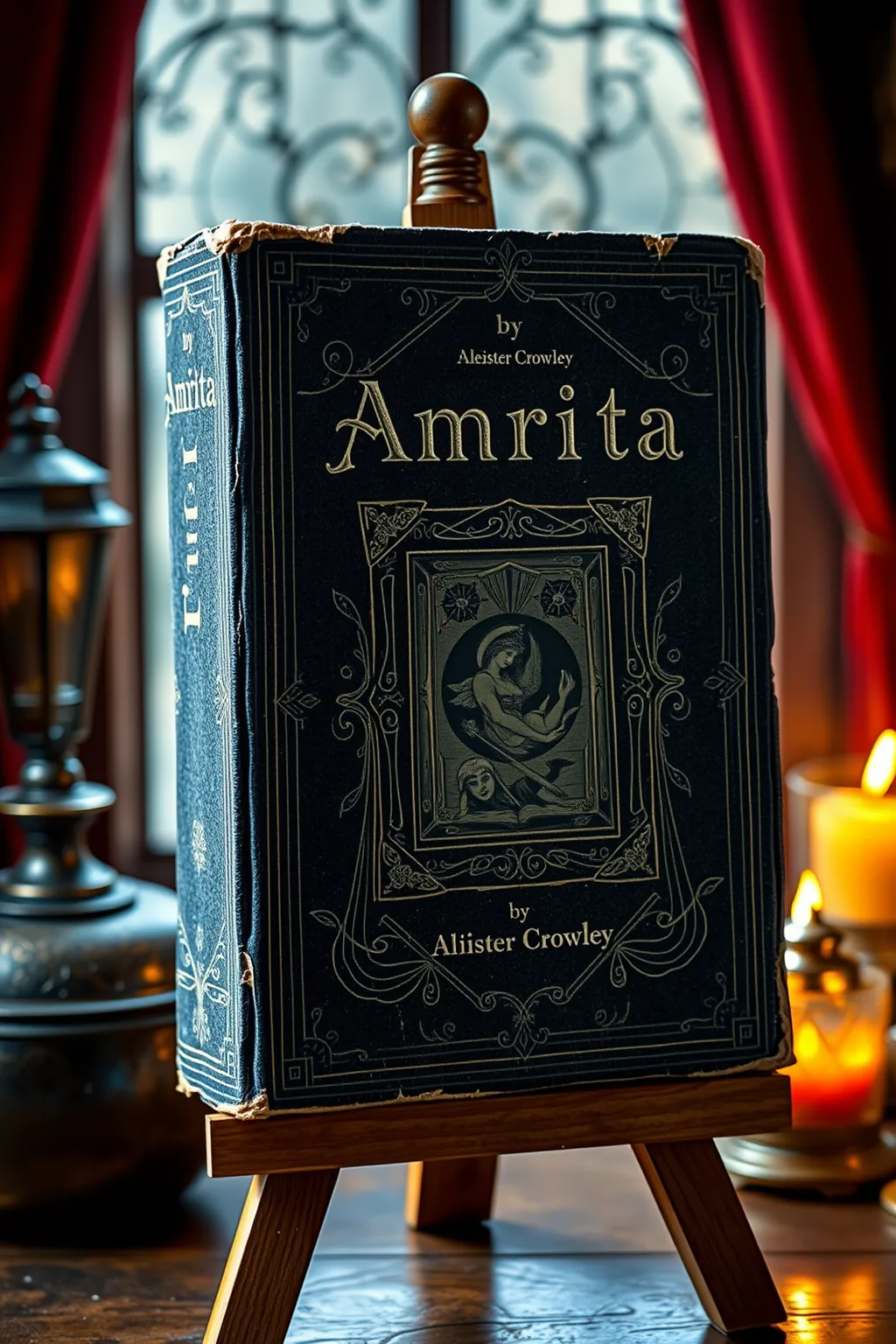
Amrita
Crowley’s *Amrita*, arriving in print decades after its conceptualization, presents a formidable intellectual gauntlet. It eschews accessibility for a direct confrontation with the reader’s preconceptions about magic and consciousness. The text is dense, demanding a reader not afraid of wrestling with complex symbolic language and abstract philosophical propositions. Its strength lies in its unvarnished presentation of Crowley’s thought, particularly concerning the arduous path toward self-realization, epitomized in his discussions of achieving states of gnosis. A notable limitation, however, is the sheer difficulty of extracting practical application without extensive prior knowledge of his larger magical system, thelema. A passage discussing the "union of opposites" requires significant exegesis to grasp its full weight within his cosmology. Ultimately, *Amrita* serves as a potent, albeit austere, testament to Crowley’s idiosyncratic vision of spiritual liberation.
📝 Description
80
Aleister Crowley's Amrita, first published in 1990, collects his writings on consciousness and the occult.
Amrita is not a linear narrative but a compilation of Aleister Crowley's writings that requires careful study. Its dense, symbolic language invites deep contemplation on the nature of reality and the self. The work presents aspects of Crowley's philosophical system, which synthesizes various esoteric traditions into a unique framework. It serves as a guide to the more abstract elements of his teachings, moving beyond introductory subjects.
This volume is best suited for individuals already familiar with Crowley's work and Western esotericism. A basic understanding of occult philosophy, Qabalah, and ceremonial magic is beneficial. Amrita poses complex questions about existence and perception, rather than offering simple answers. Those interested in the development of occult thought in the early 20th century and Crowley's specific contributions will find it a valuable resource.
First published in 1990, Amrita's content originates from Aleister Crowley's active period in the early 20th century. This time saw a synthesis of Eastern philosophies with Western magical systems, an area Crowley significantly impacted. His approach often differed from the more mainstream Theosophical movement, though he was a contemporary of figures like W.B. Yeats. Crowley's engagement with these traditions shaped a distinct branch of occult thought.
💡 Why Read This Book?
• Gain insight into Aleister Crowley’s concept of the 'True Will', understanding its place within his broader magical philosophy as presented in the text, offering a distinct perspective on personal destiny. • Explore the intricate symbolic language used to describe altered states of consciousness, providing a unique lens through which to examine perception beyond the mundane, as detailed in sections concerning yogic traditions. • Understand the specific esoteric context of the early 20th century, situating Crowley's unique synthesis of Eastern and Western occultism against contemporary intellectual currents and movements, as reflected in the book's publication history.
⭐ Reader Reviews
Honest opinions from readers who have explored this book.
❓ Frequently Asked Questions
What is the primary focus of Aleister Crowley's 'Amrita'?
Amrita focuses on exploring consciousness, the nature of reality, and the path to spiritual realization through Crowley's unique esoteric philosophy, drawing heavily on symbolic language and concepts from various traditions.
When was 'Amrita' first published, and what does this imply?
First published in 1990, its later publication suggests it represents ideas developed during Crowley's active period but perhaps not fully disseminated or organized for public consumption until much later, reflecting its complex intellectual origins.
Is 'Amrita' suitable for beginners in occult studies?
No, Amrita is generally considered advanced material. It requires a solid foundation in esoteric concepts and Crowley's own system to fully appreciate its challenging philosophical and symbolic content.
What esoteric traditions influenced the concepts in 'Amrita'?
The work draws upon Western Hermeticism, Qabalah, and significantly, Eastern traditions such as Yoga and Tantra, integrating them into Crowley's distinctive magical framework.
What is the 'True Will' as discussed in 'Amrita'?
The 'True Will' is a central concept in Crowley's philosophy, representing an individual's unique divine purpose or destiny, which the book suggests can be discovered through rigorous self-inquiry and magical practice.
How does 'Amrita' differ from other works by Aleister Crowley?
Amrita often presents more abstract and philosophical explorations of consciousness and existence, demanding deeper theoretical engagement than some of his more practical magical texts, though it remains deeply rooted in his overall system.
🔮 Key Themes & Symbolism
The Nature of True Will
Amrita posits that each individual possesses a unique, divinely ordained purpose known as the 'True Will.' Discovering and enacting this Will is presented not as a mere aspiration but as the fundamental path to spiritual liberation and authentic existence. The text explores the challenges and methods involved in discerning this inner imperative from societal conditioning and egoic desires, emphasizing rigorous self-examination and dedicated practice. It suggests that alignment with one's True Will is the ultimate act of rebellion against limitations and the key to unlocking one's highest potential.
States of Consciousness Beyond the Mundane
A significant portion of Amrita is dedicated to the exploration of altered states of consciousness, drawing parallels with yogic and Tantric practices. The work describes techniques and philosophical underpinnings for transcending ordinary waking perception to access deeper levels of awareness. It presents these states not as mere psychological phenomena but as gateways to understanding the fundamental nature of reality and the divine. The symbolic language employed attempts to articulate experiences that defy conventional description, guiding the reader toward a perception of unity and interconnectedness.
Symbolism of the Divine Feminine
Amrita engages with the concept of the divine feminine, often represented by archetypal figures and symbols within esoteric traditions. This feminine principle is explored not just as a generative force but as integral to the cosmic balance and the process of spiritual realization. The text examines how understanding and integrating this aspect of divinity, often suppressed in patriarchal frameworks, is crucial for achieving wholeness and gnosis. It highlights its role in dissolution, transformation, and the ultimate union of opposites that characterizes Crowley's vision of the Great Work.
The Great Work and Gnosis
The ultimate aim discussed within Amrita is the 'Great Work,' a term synonymous with spiritual attainment and the realization of one's divine nature. The book suggests that achieving gnosis—direct, experiential knowledge of the divine—is intrinsically linked to the successful execution of this Work. It outlines a path characterized by intense discipline, intellectual rigor, and profound self-awareness. The text implies that this process involves a radical transformation of the self, leading to a state of being where the individual is fully aligned with the cosmos and their own essential truth.
💬 Memorable Quotes
Direct passages from the work, attributed to the author.
“The finding of the True Will is the whole duty of man.”
— This statement expresses a core tenet of Crowley's philosophy, positing that an individual's unique, divinely appointed purpose is not merely an option but the fundamental obligation for a meaningful existence and spiritual progress.
“Union of opposites is the key to transcendence.”
— This aphorism points to the alchemical and mystical concept of reconciling dualities (e.g., spirit/matter, male/female) as the necessary mechanism for moving beyond limited, conventional perception into higher states of being.
“Consciousness can be expanded beyond its perceived limits.”
— This idea suggests that the boundaries of human awareness are not fixed and that through specific practices, one can achieve states of expanded perception, accessing deeper truths about reality and the self.
“The path demands absolute surrender of the ego.”
— This highlights the rigorous nature of spiritual discipline within Crowley's system, emphasizing that the dissolution of the false self or ego is a prerequisite for the realization of one's true, divine nature.
“Symbolism is the language of the divine.”
— This interpretation suggests that the universe communicates profound truths through symbolic representations, and that understanding these symbols is crucial for deciphering the deeper meanings of existence and spiritual principles.
🌙 Esoteric Significance
Tradition
Amrita is deeply embedded within the Western Esoteric Tradition, particularly the Hermetic and Gnostic lineages, as interpreted and synthesized by Aleister Crowley. It represents a significant articulation of his personal magical system, Thelema, which sought to integrate Eastern philosophies like Yoga and Tantra with Western ceremonial magic. It departs from earlier occult frameworks by emphasizing individual sovereignty and the direct experience of the divine, positing the 'True Will' as the central guiding principle.
Symbolism
Key symbols in Amrita include the concept of 'Nuit,' representing infinite space and potential, and 'Hadit,' the point-center of consciousness. The interplay between these two, often depicted as the divine feminine and masculine principles, signifies the fundamental creative tension in the universe. Another recurring motif is the 'Amrita' itself, a Sanskrit term for nectar or immortality, symbolizing the attainment of spiritual liberation and divine consciousness, often achieved through transformative practices.
Modern Relevance
Contemporary practitioners of Thelema and related magical systems continue to engage with Amrita as a foundational text for understanding Crowley's philosophy. Its exploration of consciousness, will, and the integration of diverse spiritual traditions appeals to modern New Age thought and various forms of contemporary spirituality. Thinkers and practitioners focused on non-dual philosophies and the psychology of spiritual development often find Amrita's challenging perspectives relevant to their work.
👥 Who Should Read This Book
• Students of Aleister Crowley and Thelema seeking to deepen their understanding of his core philosophical concepts, particularly concerning consciousness and spiritual attainment. • Advanced practitioners of Western Esotericism interested in the historical synthesis of Eastern and Western mystical thought as articulated by a seminal, albeit controversial, figure. • Scholars of comparative religion and philosophy of religion examining the development of occult thought in the early 20th century and its unique contributions to spiritual inquiry.
📜 Historical Context
Aleister Crowley's *Amrita* emerges from the fertile, often contentious, range of early 20th-century Western esotericism. This period witnessed a significant cross-pollination of ideas between Eastern mystical traditions and Western occultism, a phenomenon Crowley actively participated in and shaped. He was a contemporary of figures like Annie Besant and Helena Blavatsky, though his radical interpretations and practices often set him apart from the more mainstream Theosophical Society. While the book itself was first published in 1990, its intellectual roots lie in his prolific writing and magical experiments from the 1910s and 1920s. During this era, Crowley developed his system of Thelema, heavily influenced by his reception of the Book of the Law in 1904. His work was often met with controversy, sometimes bordering on outright condemnation, by both religious authorities and a more conservative occult establishment, marking him as a uniquely provocative figure.
📔 Journal Prompts
The concept of the 'True Will' as the ultimate life purpose.
The symbolic representation of Nuit and Hadit in cosmic creation.
The methods for achieving expanded states of consciousness.
The role of the divine feminine in spiritual realization.
The personal significance of the pursuit of 'Amrita' or immortality.
🗂️ Glossary
Amrita
A Sanskrit term meaning 'immortality' or 'nectar,' often associated with divine elixirs that grant eternal life or spiritual enlightenment in Hindu and Buddhist traditions. In Crowley's context, it represents the ultimate spiritual attainment.
True Will
A central concept in Aleister Crowley's philosophy of Thelema, referring to an individual's unique, divinely appointed purpose or destiny, distinct from societal expectations or egoic desires.
Nuit
In Thelema, Nuit is the primary goddess, representing infinite space, the totality of all possibilities, and the divine feminine principle. She is often depicted as a star-strewn woman arching over the world.
Hadit
The complement to Nuit in Thelema, Hadit represents the infinitely small point-center of consciousness, the individual spark of divinity within each being, and the active, masculine principle.
Gnosis
A Greek term meaning 'knowledge,' particularly intuitive or experiential knowledge of divine or spiritual truths. In esoteric contexts, it refers to a direct, unmediated apprehension of ultimate reality.
The Great Work
The ultimate aim of spiritual practice in many esoteric traditions, including Thelema. It refers to the process of spiritual transformation, self-realization, and the attainment of union with the divine.
Yoga
A broad term for practices originating in ancient India aimed at achieving physical, mental, and spiritual well-being, often leading to liberation or enlightenment. Crowley incorporated elements of yogic philosophy into his magical system.
🔮 Readers Also Liked
Browse all →







More by Aleister Crowley
All books →

More Free Occult Philosophy Books
View all →