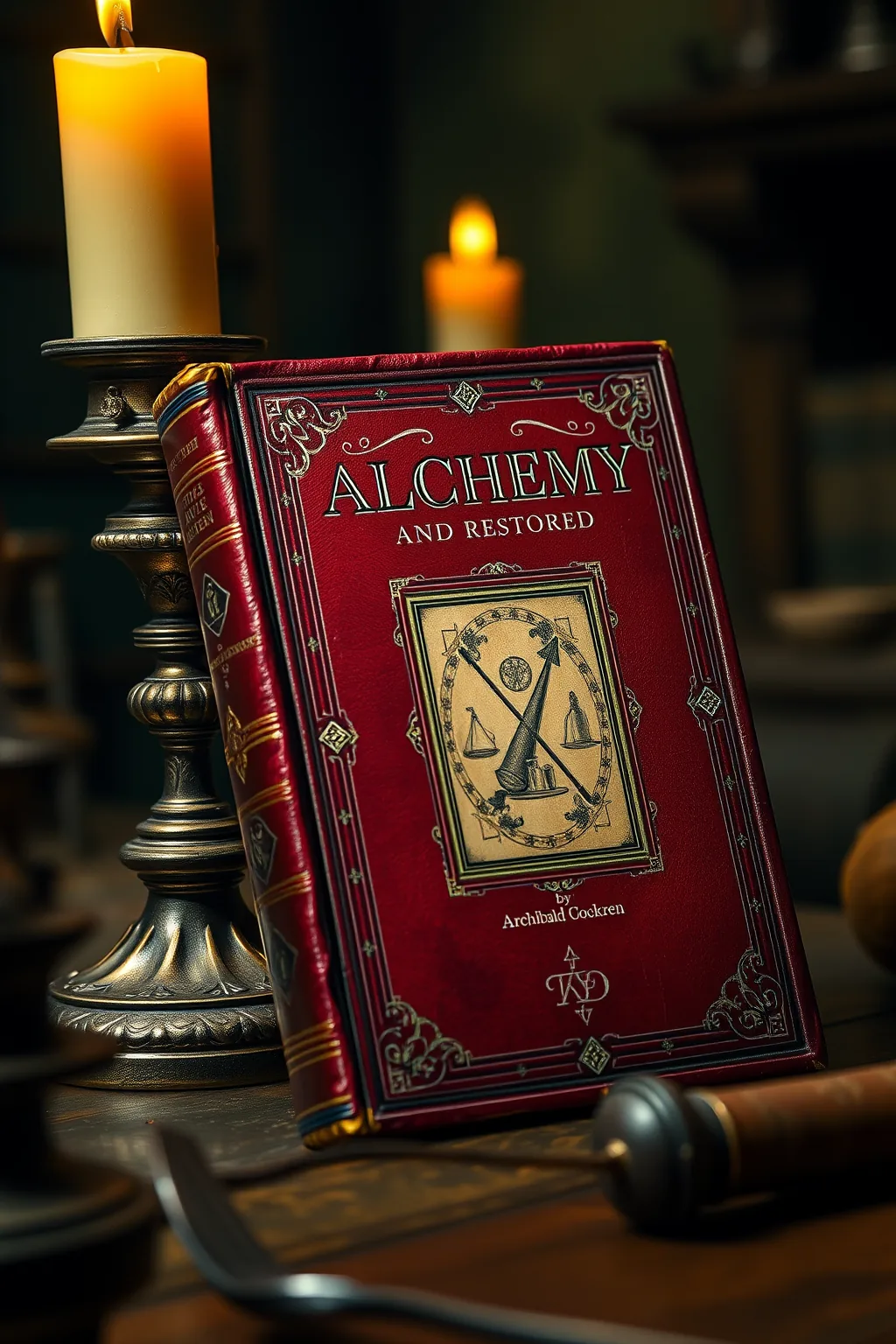
Alchemy Rediscovered and Restored
 77
77

Alchemy Rediscovered and Restored
Cockren's Alchemy Rediscovered and Restored offers a compelling argument for viewing alchemy as a system of spiritual development rather than mere proto-chemistry. The author’s strength lies in his meticulous deconstruction of alchemical operations, presenting them as allegorical steps towards inner transformation. A notable passage details the symbolic significance of the 'Great Work' as a process of purifying the 'inner metals' of the soul. However, the text can sometimes become dense, requiring considerable prior knowledge of esoteric terminology, which may present a barrier for newcomers. The work's reliance on specific interpretations of alchemical texts, while insightful, might not satisfy those seeking a broader comparative overview. Ultimately, it serves as a valuable, albeit challenging, resource for dedicated practitioners and scholars of Hermetic arts.
📝 Description
77
Archibald Cockren's 1926 "Alchemy Rediscovered and Restored" argues for alchemy's spiritual significance.
This book examines alchemical principles, moving past common misunderstandings to present alchemy as a spiritual and philosophical discipline. Cockren dissects alchemical processes not as literal chemistry, but as symbolic paths for inner purification and spiritual growth. He argues that alchemy is a key element in Western esoteric traditions, separate from but connected to Hermeticism and early chemical science.
The text is for serious students of the occult and Western esotericism who have some familiarity with alchemy and Hermetic philosophy. It aims to provide a more rigorous, text-based understanding. Readers interested in the historical development of alchemical ideas, the tradition's symbolic language, and its potential for personal transformation will find ample material. The book is suited for those who appreciate scholarly approaches to mystical subjects.
Cockren's work appeared during a modern revival of interest in alchemy, a practice with roots in Hellenistic Egypt and medieval/Renaissance Europe. While figures like Nicolas Flamel and Paracelsus are known, the practice often faced persecution and misunderstanding. Cockren sought to 'restore' alchemy, countering its obscuring by charlatans and the rise of empirical chemistry, which shifted focus to laboratory experimentation in the 17th and 18th centuries.
Alchemy Rediscovered and Restored situates itself within the lineage of Western esotericism, a broad category encompassing diverse mystical and philosophical traditions. Alchemy, with its roots in ancient Egypt and its development through medieval and Renaissance Europe, is presented as a significant, often misunderstood, spiritual and philosophical discipline. Cockren's work distinguishes this esoteric interpretation from both literal chemical pursuits and common misconceptions, emphasizing its role as a pathway for inner purification and spiritual attainment. It relates alchemy to Hermeticism, another key esoteric current, suggesting a shared philosophical ground while asserting alchemy's unique contribution to Western mystical thought.
💡 Why Read This Book?
• Gain a deeper understanding of the alchemical concept of 'Solve et Coagula' as a practical method for psychological integration, a process detailed extensively within the book's exploration of alchemical operations. • Learn to interpret the symbolism of the Philosopher's Stone beyond its literal meaning, recognizing it as an allegory for spiritual perfection, as elucidated through Cockren's specific textual analyses. • Appreciate the historical context of alchemy as a spiritual discipline, distinct from early chemical experimentation, a distinction Cockren carefully reconstructs by referencing alchemical texts from periods predating figures like Robert Boyle.
⭐ Reader Reviews
Honest opinions from readers who have explored this book.
❓ Frequently Asked Questions
What is the primary goal of alchemy according to Alchemy Rediscovered and Restored?
The book posits that the primary goal of alchemy, as presented, is spiritual transformation and the attainment of inner perfection, rather than the literal transmutation of base metals into gold.
Does this book explain practical laboratory alchemy?
While it discusses alchemical processes, Alchemy Rediscovered and Restored focuses on their symbolic and spiritual interpretations, rather than providing practical, step-by-step laboratory instructions for chemical procedures.
Who was Archibald Cockren and when was this work first published?
Archibald Cockren was an author focused on esoteric subjects. Alchemy Rediscovered and Restored was first published in 2016, bringing his research to a contemporary audience.
What is the 'prima materia' in the context of this book?
The 'prima materia' is presented as the fundamental, unformed substance or potentiality from which all alchemical work begins, often interpreted as the raw, unrefined state of the individual seeking transformation.
How does this book relate to Hermeticism?
The book situates alchemy within the broader Hermetic tradition, exploring shared principles of correspondence and spiritual evolution, treating alchemy as a distinct but related esoteric path.
Is Alchemy Rediscovered and Restored suitable for complete beginners to alchemy?
While it aims to clarify alchemical concepts, the book assumes some familiarity with esoteric philosophy and symbolism, making it more suitable for those who have already encountered introductory material.
🔮 Key Themes & Symbolism
The Great Work as Inner Transformation
The book meticulously details the stages of the 'Great Work' not as a physical process of creating gold, but as an allegorical journey of the alchemist's soul. It examines concepts like the Nigredo (blackening), Albedo (whitening), Citrinitas (yellowing), and Rubedo (reddening) as symbolic phases of purification, dissolution, and reintegration of the individual's spiritual essence. This internal focus distinguishes it from purely chemical interpretations, aligning it with Gnostic and Hermetic traditions of spiritual perfection.
Symbolism of Alchemical Instruments
Alchemy Rediscovered and Restored examines the rich symbolic language of alchemical apparatus. The athanor (furnace), alembic (distillation apparatus), and retort are presented as more than mere tools; they represent the internal psychic and spiritual 'vessels' and 'fires' required for transformation. The book explores how these instruments metaphorically facilitate the separation (solve) and recombination (coagula) of inner elements, leading to the creation of the Philosopher's Stone within.
Prima Materia and Potentiality
A central theme is the exploration of the prima materia, or first matter. Cockren interprets this not as a specific physical substance but as the unmanifest potentiality inherent in all things, and crucially, within the alchemist themselves. It represents the chaotic, undifferentiated state from which spiritual order and perfection can be forged through the application of alchemical principles. This concept aligns with Neoplatonic ideas of emanation and the inherent divinity within the human soul.
Alchemy and Western Esotericism
The work firmly places alchemy within the broader lineage of Western esotericism, drawing connections to Hermeticism, Kabbalah, and even Gnosticism. It argues that alchemy served as a practical, often coded, method for achieving spiritual gnosis and reunion with the divine, running parallel to more theoretical or mystical paths. The book examines how alchemical symbolism provided a universal language for expressing these profound spiritual truths across different eras and traditions.
💬 Memorable Quotes
Direct passages from the work, attributed to the author.
“The alembic is the crucible of the spirit, where separation leads to refinement.”
— This interpretation emphasizes the symbolic role of alchemical equipment. The alembic, used for distillation, is recast as a metaphor for the alchemist's inner process of discerning and purifying spiritual qualities.
“The Philosopher's Stone is the perfected self, realized through the arduous Work.”
— This concept defines the ultimate goal of alchemy not as a tangible substance, but as the alchemist's achieved state of spiritual wholeness and integration, the culmination of the entire transformative process.
💡 Key Ideas
Editorial paraphrase of the work's core concepts — not direct quotes.
The true alchemist seeks not to transmute base metals, but the base elements of his own soul.
This paraphrased concept highlights the book's core argument: that alchemy's purpose is primarily spiritual and psychological, focusing on the internal purification and perfection of the practitioner.
Nigredo is not merely decay, but the necessary dissolution before rebirth.
This quote (or closely paraphrased concept) focuses on the initial, often challenging, stage of the Great Work. It reframes the 'blackening' not as an end, but as a vital precursor to spiritual renewal and transformation.
Understanding the symbols unlocks the hidden science of the soul.
This paraphrased idea underscores the book's approach to alchemy as a symbolic language. It suggests that decoding alchemical imagery is key to grasping its profound teachings on human consciousness and spiritual development.
🌙 Esoteric Significance
Tradition
This work is firmly rooted in the Western Hermetic tradition, viewing alchemy as a practical, initiatory path toward spiritual realization. It aligns with the Hermetic principle of 'As Above, So Below,' interpreting alchemical processes as microcosmic reflections of cosmic laws and divine operations. Cockren's approach emphasizes alchemy as a form of 'spiritual chemistry' or 'theurgy,' a method for transforming the soul and achieving gnosis, thereby departing from purely materialistic or speculative interpretations.
Symbolism
Key symbols explored include the Ouroboros, representing cyclical completion and the unity of opposites, and the Caduceus, signifying balance, healing, and the union of spiritual energies. The text also examines the symbolic meaning of the seven classical planets and their associated metals (e.g., gold with the Sun, silver with the Moon), illustrating the alchemical understanding of planetary influences on both the material and spiritual realms.
Modern Relevance
Alchemy Rediscovered and Restored speaks to contemporary practitioners of Western esotericism, including Hermeticists, Rosicrucians, and those engaged in ceremonial magic. Its detailed exploration of symbolic processes appeals to modern psychological approaches to spiritual development, such as Jungian alchemy. Thinkers and groups focused on restoring the 'soul' to modern life and seeking integrated spiritual practices find value in Cockren's restoration of alchemy's philosophical depth.
👥 Who Should Read This Book
• Students of Hermeticism and esoteric philosophy seeking to understand alchemy's role as a practical path to spiritual perfection. • Researchers interested in the historical development of occult sciences and the symbolic language of pre-modern spiritual traditions. • Individuals on a personal path of inner transformation looking for allegorical frameworks to understand psychological and spiritual purification processes.
📜 Historical Context
Archibald Cockren's Alchemy Rediscovered and Restored emerges in a contemporary milieu fascinated by Western esotericism, a field that experienced significant revivals in the late 19th and 20th centuries, notably influenced by figures like Helena Blavatsky and the Theosophical Society. Cockren's work attempts to reclaim alchemy from purely historical or pseudoscientific interpretations, positioning it as a vital spiritual discipline akin to Hermeticism. This effort stands against the backdrop of centuries where alchemy was often misunderstood, conflated with early chemistry by figures like Robert Boyle in the 17th century, or dismissed entirely. While alchemy faced periods of suspicion and persecution, its symbolic language persisted, influencing later occult traditions. Cockren's book contributes to a modern scholarly and practical engagement with alchemy, seeking to restore its philosophical integrity against the enduring skepticism and the dominance of materialist science.
📔 Journal Prompts
The concept of the prima materia as unmanifest potential within your own being.
Reflecting on the symbolic meaning of the 'solve et coagula' process in your life.
Interpreting the stages of the Great Work (Nigredo, Albedo, etc.) as personal growth phases.
The role of alchemical symbols (like the Ouroboros) in representing cyclical change.
Considering the alchemist's 'inner furnace' and its metaphorical significance for spiritual work.
🗂️ Glossary
Prima Materia
The fundamental, undifferentiated substance or potential from which all alchemical work begins; often interpreted as the raw, unrefined state of the alchemist's being.
Solve et Coagula
Latin for 'dissolve and coagulate'; a core alchemical principle representing the process of breaking down (separation) and then reforming (recombination) matter or consciousness.
Great Work (Main work)
The entire alchemical process aimed at achieving spiritual perfection, often symbolized by the creation of the Philosopher's Stone.
Philosopher's Stone
The legendary substance that could transmute base metals into gold; in esoteric interpretation, it symbolizes the perfected spiritual state of the alchemist.
Nigredo
The first stage of the Great Work, characterized by blackness, decay, and dissolution; symbolically represents the breakdown of the old self and the confrontation with the shadow.
Albedo
The second stage, 'whitening,' following the Nigredo; symbolizes purification, illumination, and the emergence of a refined spiritual essence.
Athanor
A specialized alchemical furnace designed to maintain a consistent, low heat, symbolizing the steady, controlled application of spiritual or psychic energy.
🔮 Readers Also Liked
Browse all →







More by Archibald Cockren
All books →


More Free Alchemy & Hermeticism Books
View all →