Alberuni's India
 82
82

Alberuni's India
The 1887-8 translation of Alberuni's India offers a window into a remarkable 11th-century ethnographic project. Its strength lies in the detailed annotations, which contextualize Al-Biruni’s observations for a Western audience unfamiliar with the intricacies of Indian religious and philosophical systems. However, the sheer density of information, particularly in its discussions of Hindu philosophy and cosmology, can be overwhelming for the uninitiated reader, demanding considerable concentration. A particularly striking section details Al-Biruni's comparative analysis of Islamic and Hindu scientific principles, highlighting both shared knowledge and distinct approaches to understanding the cosmos. This work is indispensable for serious historical inquiry into pre-Islamic India.
📝 Description
82
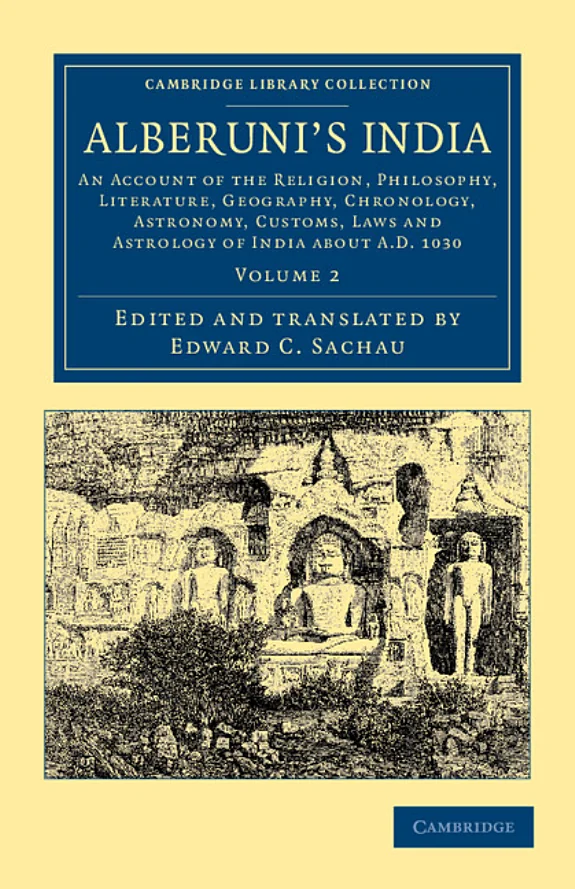
Al-Biruni's India, first translated into English in 1887-8, details 11th-century Indian society.
Muhammad Biruni's annotated English translation of Abu Rayhan al-Biruni's 11th-century account of the Indian subcontinent offers a detailed look at its society, religion, science, and culture. Al-Biruni, a scholar from Khwarazm, wrote his major work on India around 1030 CE after traveling with Ghaznavid armies. His observations provide a contrast to the religiously focused writings of his time, presenting a more detached, though still culturally informed, perspective.
This text meticulously covers Hindu cosmology, philosophical systems such as Vedanta and Samkhya, and astronomical methods. It also addresses the caste system, Indian literature, daily customs, and geography. The work gives readers an outsider's view of the civilization during a period of significant philosophical development and a complex political climate.
While Al-Biruni's work is primarily historical and ethnographic, its detailed examination of Hindu philosophical schools like Vedanta and Samkhya, alongside cosmology and astronomical practices, touches upon elements often considered within esoteric traditions. His objective approach to documenting these beliefs and practices, even those outside his own cultural framework, offers a valuable historical record for understanding the intellectual currents that informed both mainstream and less public spiritual disciplines of the era. The book therefore serves as a critical external reference for the study of Indian religious and philosophical thought.
💡 Why Read This Book?
• Gain an unparalleled 11th-century perspective on Indian religion, philosophy, and society, as documented by Abu Rayhan al-Biruni, offering insights unavailable in contemporary Indian chronicles. • Understand the intellectual climate of the early medieval period through Al-Biruni's comparative approach to science and culture, particularly his engagement with Indian astronomical practices. • Explore the detailed descriptions of Hindu cosmology and philosophical schools like Samkhya, providing a foundational text for comparative religious studies.
⭐ Reader Reviews
Honest opinions from readers who have explored this book.
❓ Frequently Asked Questions
Who was Abu Rayhan al-Biruni and when did he write about India?
Abu Rayhan al-Biruni was a Khwarazmian scholar and polymath who lived from 973 to 1048 CE. He wrote his comprehensive work on India, Kitab fi Tahqiq ma li'l-Hind, in the early 11th century, around 1030 CE.
What is the primary focus of Alberuni's India?
The book focuses on providing a detailed account of Indian religion, philosophy, science, geography, customs, and social structure as observed by Al-Biruni during his time in the subcontinent.
What makes the 1887-8 translation significant?
The 1887-8 edition, translated by Edward C. Sachau, is significant for its extensive annotations and its role in introducing Al-Biruni's work to Western scholarship, providing crucial context for its complex subject matter.
Does Alberuni's India discuss Hindu cosmology?
Yes, Alberuni's India extensively discusses Hindu cosmology, including concepts of creation, the structure of the universe, and the cyclical nature of time, often comparing them with Islamic perspectives.
What historical period does Alberuni's India cover?
Alberuni's India primarily covers the early medieval period of Indian history, specifically the 11th century CE, during which he conducted his observations and research.
Is this book a primary source for ancient Indian history?
While Al-Biruni's work is a primary source from an external observer in the 11th century, it is often studied alongside indigenous Indian texts to provide a more complete historical picture.
🔮 Key Themes & Symbolism
Comparative Cosmology
Alberuni meticulously compares Hindu cosmological models with those of Islam and other traditions he encountered. He details concepts of cyclical time, the nature of the divine, and the structure of the universe as understood by Indian scholars. This comparative analysis highlights the universality of human attempts to grapple with existence while underscoring the distinct philosophical frameworks developed across cultures. His work serves as an early example of cross-cultural intellectual dialogue on fundamental existential questions.
Indian Philosophy Systems
The text provides an extensive overview of major Indian philosophical schools, particularly Vedanta and Samkhya. Alberuni examines their core tenets, epistemology, and metaphysics, aiming for an accurate representation despite potential cultural misunderstandings. For esoteric readers, this offers direct insight into the foundational thought systems that underpin many later mystical and yogic traditions, revealing the intellectual scaffolding of spiritual practices.
Social and Caste Structures
Alberuni’s observations on the Indian caste system offer a crucial external perspective on a complex social hierarchy. He describes the divisions, their perceived origins, and their societal functions, providing valuable data for understanding the socio-religious fabric of 11th-century India. This section is vital for scholars of social history and comparative sociology, as well as for understanding the historical context from which various spiritual disciplines emerged.
Science and Astronomy
A significant portion of Alberuni's work is dedicated to Indian achievements in mathematics, astronomy, and medicine. He discusses concepts like the zodiac, planetary movements, and calendrical systems, often comparing Indian astronomical calculations with those of the Hellenistic and Islamic worlds. This focus reveals the interconnectedness of scientific knowledge across civilizations and the sophisticated understanding of the cosmos prevalent in ancient India.
💬 Memorable Quotes
Direct passages from the work, attributed to the author.
“On the caste system, Alberuni noted its rigid structure and divine attribution.”
— This highlights Al-Biruni's analytical approach, observing the societal stratification and its religious justification, which was a defining feature of Indian society.
“Alberuni described Hindu beliefs about the transmigration of souls and karma.”
— This demonstrates his engagement with core Indian metaphysical doctrines, showing an interest in the cyclical nature of existence and spiritual progression as understood in India.
“The work explored Indian scientific knowledge, particularly in astronomy and mathematics.”
— This points to Al-Biruni's recognition of India's intellectual contributions, suggesting a shared pursuit of understanding the natural world across different cultures.
“He compared Hindu philosophical concepts with those of other religious traditions.”
— This illustrates Al-Biruni's scholarly method of cross-cultural comparison, seeking commonalities and differences in the ways humans conceptualize reality and divinity.
“Alberuni detailed Hindu festivals and their astronomical alignments.”
— This showcases his attention to the practical application of cosmological knowledge in daily life and religious observance, linking celestial events to earthly celebrations.
🌙 Esoteric Significance
Tradition
While Al-Biruni himself was a scholar within the Islamic intellectual tradition, his work on India serves as a crucial bridge to Indic esoteric thought. It engages with philosophies that heavily influenced later esoteric movements globally, such as Vedanta and Samkhya, which form the bedrock of many yogic and meditative practices. His meticulous, almost anthropological, approach to describing these systems can be seen as a precursor to modern comparative mysticism, offering a scholarly yet profound entry point into the cosmology and metaphysics that underpin Eastern spiritual paths.
Symbolism
Al-Biruni's text frequently touches upon the symbolism inherent in Hindu cosmology and ritual. For instance, his discussion of the concept of 'maya' (illusion) offers insight into the Indic understanding of phenomenal reality as a veil obscuring deeper truths, a concept echoed in various mystical traditions. Similarly, his examination of the cyclical nature of time (yugas) and the divine avatars provides symbolic frameworks for understanding cosmic cycles and divine intervention, resonating with Gnostic and Hermetic ideas of cosmic unfolding and divine emanations.
Modern Relevance
Contemporary practitioners of yoga, Vedanta, and various forms of mindfulness meditation often engage with Al-Biruni's work as a foundational historical document. Scholars researching the history of religions, comparative philosophy, and the transmission of knowledge between East and West frequently cite his observations. Thinkers interested in the historical development of consciousness studies and cross-cultural psychology find his detailed accounts of Indian mental disciplines and philosophical inquiries particularly valuable for understanding the diverse ways humanity has sought ultimate knowledge.
👥 Who Should Read This Book
• Scholars of South Asian history and religious studies seeking primary external accounts of 11th-century Indian life and thought. • Students of comparative philosophy and mysticism interested in the historical documentation of Indic philosophical systems like Vedanta and Samkhya. • Researchers of cultural exchange between the Islamic and Indian worlds who wish to understand intellectual dialogues of the medieval period.
📜 Historical Context
Abu Rayhan al-Biruni composed his monumental work on India around 1030 CE. This was a period when the Islamic world was experiencing a golden age of scholarship, fostering intellectual exchange across vast regions. Al-Biruni, a polymath from Khwarazm (modern Uzbekistan), traveled with the Ghaznavid forces into the Indian subcontinent. His work, Kitab fi Tahqiq ma li'l-Hind, emerged during a time of significant philosophical and religious development in India, following the Gupta period and amidst the early medieval transformations. While figures like Avicenna were synthesizing Greek philosophy with Islamic theology in Persia, Al-Biruni focused on empirical observation and detailed ethnography of a distinct civilization. His approach was remarkably objective for its era, aiming to present Indian beliefs and practices accurately to an Arabic-speaking audience, though it was not without its own cultural lens. The translated work gained prominence in the West through scholars like Edward C. Sachau, who published the annotated English version in 1887-8, making Al-Biruni's meticulous research accessible to a new generation of historians and anthropologists.
📔 Journal Prompts
Al-Biruni's comparative approach to cosmology: how does it frame your understanding of universal truths?
The concept of 'maya' as described by Al-Biruni: reflect on its presence in your perception of reality.
Analyze Al-Biruni's description of the Samkhya philosophy; what core principles emerge?
Consider Al-Biruni's observations on Indian astronomical practices and their relation to societal rituals.
Reflect on the external perspective Al-Biruni offers regarding the caste system and its divine attribution.
🗂️ Glossary
Samkhya
An ancient Indian school of philosophy that posits a dualistic reality consisting of Purusha (consciousness) and Prakriti (matter), forming the basis for much of Indian metaphysics and spiritual thought.
Vedanta
A major school of Hindu philosophy that emphasizes the Upanishads, focusing on the nature of Brahman (ultimate reality) and its relationship to Atman (the self).
Cosmology
The study of the origin, evolution, and eventual fate of the universe, encompassing scientific, philosophical, and religious perspectives on the structure and order of existence.
Transmigration of Souls
The belief that after death, the soul or consciousness is reborn into a new body, a concept central to many Indian religious and philosophical systems, often linked with karma.
Maya
A Sanskrit term in Indic philosophies referring to illusion, magic, or the power that conceals the true nature of reality, often seen as a veil that obscures the divine.
Yugas
In Hindu cosmology, these are the epochs or ages that constitute a cycle of time, each characterized by a decline in dharma (righteousness) and moral order.
Ghaznavids
A Turkic dynasty of mamluk origin that ruled over a vast area of Persia, Transoxiana, and northern India from the 10th to the 12th centuries, under whom Al-Biruni traveled.
This book appears in 1 collection
🔮 Readers Also Liked
Browse all →









From the “Astrology” Collection
View all →







More Free Astrology & Cosmology Books
View all →