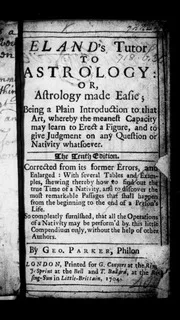
Eland's tutor to astrology: or, astrology made easie; being a plain introduction to that art, ... The tenth edition. Corrected from its former errors, and enlarged: ... By Geo. Parker, ... 1704
 80
80

Eland's tutor to astrology: or, astrology made easie; being a plain introduction to that art, ... The tenth edition. Corrected from its former errors, and enlarged: ... By Geo. Parker, ... 1704


Celeste Moreau (Divination & Symbolism Reviewer) — William Eland's 'Tutor to Astrology,' as presented in this refined 1704 edition by George Parker, stands as a cornerstone for neophytes and seasoned practitioners alike. Parker's diligent corrections and amplifications breathe new life into Eland's clear exposition, making the complex art of astrology remarkably digestible. The work masterfully demystifies planetary energies and house significations, revealing the profound symbolic language of the cosmos. It excels in bridging the gap between theoretical knowledge and practical application, offering a balanced perspective on astrological influence. This edition is an indispensable resource for anyone seeking to understand the celestial influences that shape our existence, providing both foundational wisdom and esoteric depth.
📝 Description
80
Published in 1704, George Parker corrected and enlarged William Eland's 'Tutor to Astrology'.
William Eland's 'Tutor to Astrology' was intended as a straightforward introduction to astrological practice. This tenth edition, revised and augmented by George Parker in 1704, aimed to clarify the subject for those new to it. The text covers core astrological concepts, explaining how to interpret planetary positions, zodiacal signs, and houses.
Parker's revisions sought to correct errors found in earlier printings and add material to make the system more understandable. The book presents astrology as a structured art, where celestial arrangements hold meaning for human affairs. It teaches readers how to approach the study of the heavens and its supposed influence on earthly life. The goal was to demystify astrological principles, making them accessible to a wider audience interested in celestial interpretation.
This work fits within the broader tradition of Western esoteric astrology, which flourished in Europe from the late medieval period through the early modern era. Such texts aimed to provide systematic instruction in astrological methods, often bridging the gap between learned astrological texts and popular interest. They were part of a larger intellectual current that saw correspondences between the celestial and terrestrial realms, influencing fields from medicine to philosophy. Eland's 'Tutor,' as revised by Parker, represents an effort to codify and disseminate these astrological understandings.
💡 Why Read This Book?
Unlock the ancient wisdom of the stars and understand your cosmic blueprint. 'Eland's Tutor to Astrology' offers a clear, foundational path into celestial interpretation, making a complex art accessible. Ideal for seekers of hidden knowledge, aspiring astrologers, and scholars interested in the historical evolution of divination and philosophy.
⭐ Reader Reviews
Honest opinions from readers who have explored this book.
❓ Frequently Asked Questions
What is the primary purpose of this book?
The primary purpose is to serve as a plain and easy introduction to the art of astrology, making its principles understandable for beginners while offering corrected and expanded knowledge for those familiar with the subject.
Who is the author of this specific edition?
The tenth edition was corrected and enlarged by George Parker, building upon the original work by William Eland.
What historical period does this book represent?
Published in 1704, this book represents the early 18th-century approach to astrological study, reflecting the prevailing intellectual and esoteric currents of the time.
Is this book suitable for complete beginners?
Yes, the title explicitly states it's a 'plain introduction' and 'astrology made easie,' suggesting it is designed for those with no prior knowledge of the art.
What makes this the 'tenth edition' significant?
Being the tenth edition indicates its enduring popularity and influence over time. The corrections and enlargements by George Parker suggest an effort to improve and update the original text for its audience.
🔮 Key Themes & Symbolism
The Celestial Mirror
This work posits the cosmos as a vast, intricate mirror reflecting the divine order and human destiny. It explores how celestial bodies – planets, stars, and their luminous pathways through the zodiacal signs and houses – act as symbolic signifiers, not deterministic forces, but potent influences that shape character, potential, and the ebb and flow of life's currents. The book invites readers to gaze into this celestial mirror, not to passively observe, but to actively interpret the divine language inscribed in the heavens, fostering a deeper understanding of self and the universe.
Esoteric Harmony and Correspondence
Fundamentally, Eland's tutor studies the principle of 'as above, so below.' It elucidates the profound interconnectedness between the macrocosm (the universe) and the microcosm (humanity and the earthly realm). The book reveals how astrological configurations are not arbitrary but represent a universal language of correspondence, where each planetary archetype and zodiacal energy speaks to specific psychological traits, earthly events, and spiritual potentials. Understanding these correspondences allows for a more harmonious engagement with life's cycles and challenges.
The Art of Divination and Self-Knowledge
Beyond mere prediction, this astrological treatise is presented as a profound tool for self-discovery and spiritual growth. By learning to read the stars, the practitioner gains insight into their inherent strengths, weaknesses, and life path. The book frames astrology as a sacred art, a divinatory practice that, when approached with humility and wisdom, can illuminate the soul's journey, foster self-awareness, and guide individuals toward a more conscious and fulfilling existence. It emphasizes the pursuit of wisdom through celestial observation.
💬 Memorable Quotes
Direct passages from the work, attributed to the author.
“Wisdom is the true light by which we must steer.”
— This highlights the importance of interpretive skill and discernment in understanding astrological data, emphasizing that knowledge and insight are paramount.
“The Heavens themselves have a Language.”
— This phrase conveys the core belief that the celestial bodies communicate meaningful information about the universe and our place within it.
“To know the Causes is to rule the Effects.”
— This speaks to the power of understanding astrological principles, implying that by comprehending the underlying celestial causes, one can better navigate and influence earthly outcomes.
“The Art of Astrology is the Art of Observation.”
— This underscores the empirical and observational basis of astrology, emphasizing that diligent study of celestial movements is key to mastering the art.
💡 Key Ideas
Editorial paraphrase of the work's core concepts — not direct quotes.
The Stars do not command, but incline.
This quote expresses the nuanced view of astrological influence, suggesting that celestial bodies exert a persuasive rather than an absolute power over human affairs.
🌙 Esoteric Significance
Tradition
This work is firmly rooted in the Western Hermetic tradition, which views astrology as a sacred science and a key component of understanding the interconnectedness of the cosmos. It aligns with the Neoplatonic emphasis on divine order and celestial influence as pathways to spiritual knowledge. The book offers a glimpse into the practical application of Hermetic principles for divination and self-understanding, reflecting a time when the separation between science, magic, and religion was far less distinct than today.
Symbolism
The book's symbolism revolves around archetypal planetary energies, zodiacal signs representing fundamental human experiences, and houses signifying specific life domains. Planets are seen as divine messengers or forces, each with a unique character (e.g., Mars for action, Venus for love). Zodiac signs are symbolic gateways (e.g., Aries for beginnings, Pisces for dissolution). Houses represent the stages and arenas of life's journey. The interplay of these symbols forms a complex, divinely orchestrated language for interpreting the human condition.
Modern Relevance
In contemporary times, 'Eland's Tutor to Astrology' offers a valuable historical perspective on the evolution of Western astrological thought. It provides a foundation for understanding the core principles that continue to inform modern practice, even as methodologies have advanced. For esoteric seekers, it represents a direct link to historical divination techniques and a reminder of astrology's philosophical depth beyond mere predictive applications, encouraging a more holistic and symbolic approach to self-awareness.
👥 Who Should Read This Book
Aspiring astrologers will find a clear, foundational text that explains core concepts. Seekers of esoteric knowledge will discover a historical perspective on divination and its philosophical underpinnings. Scholars of intellectual history can explore the role of astrology in the early 18th century. Practitioners looking to deepen their understanding of traditional astrological principles will benefit from the corrected and expanded insights offered in this edition.
📜 Historical Context
Published in 1704, 'Eland's Tutor to Astrology' emerges from a period where astrology was still widely considered a legitimate intellectual pursuit, often intertwined with natural philosophy, medicine, and theology. The early 18th century was a time of transition, with the burgeoning Enlightenment questioning traditional authorities, yet the esoteric arts retained a significant following. This edition, corrected and enlarged by George Parker, reflects a desire to present astrological knowledge in a clear, systematic manner, likely catering to a growing interest among a broader educated populace. It stands as a evidence of the enduring fascination with the celestial realm and its perceived influence on human affairs, bridging the gap between ancient wisdom and the evolving scientific field of its era.
📔 Journal Prompts
Reflect on a planetary influence in your birth chart and how it manifests in your daily life.
Consider the symbolism of your Sun sign; how does it represent your core identity and life's purpose?
How can understanding astrological correspondences help you navigate a current challenge?
What does the phrase 'The Stars do not command, but incline' mean to you in practice?
Explore the concept of 'as above, so below' in relation to your personal experiences or observations of nature.
🗂️ Glossary
Horary Astrology
A branch of astrology concerned with answering specific questions by casting a chart for the exact moment the question is understood by the astrologer.
Zodiac
An ancient astronomical term referring to a band of the celestial sphere, containing the paths of the Sun, Moon, and planets, divided into twelve equal sections called signs.
Houses
In astrology, the twelve divisions of the celestial sphere, each representing a different area of human experience and life, determined by the time and place of birth.
Planetary Aspects
The angular relationships between planets in an astrological chart, which are believed to indicate the nature of their interaction and influence.
Ascendant (Asc.)
The zodiacal sign and degree that is rising on the eastern horizon at the moment of birth; it represents the outward personality and how one appears to others.
This book appears in 1 collection
🔮 Readers Also Liked
Browse all →









From the “Astrology” Collection
View all →








More Free Astrology & Cosmology Books
View all →