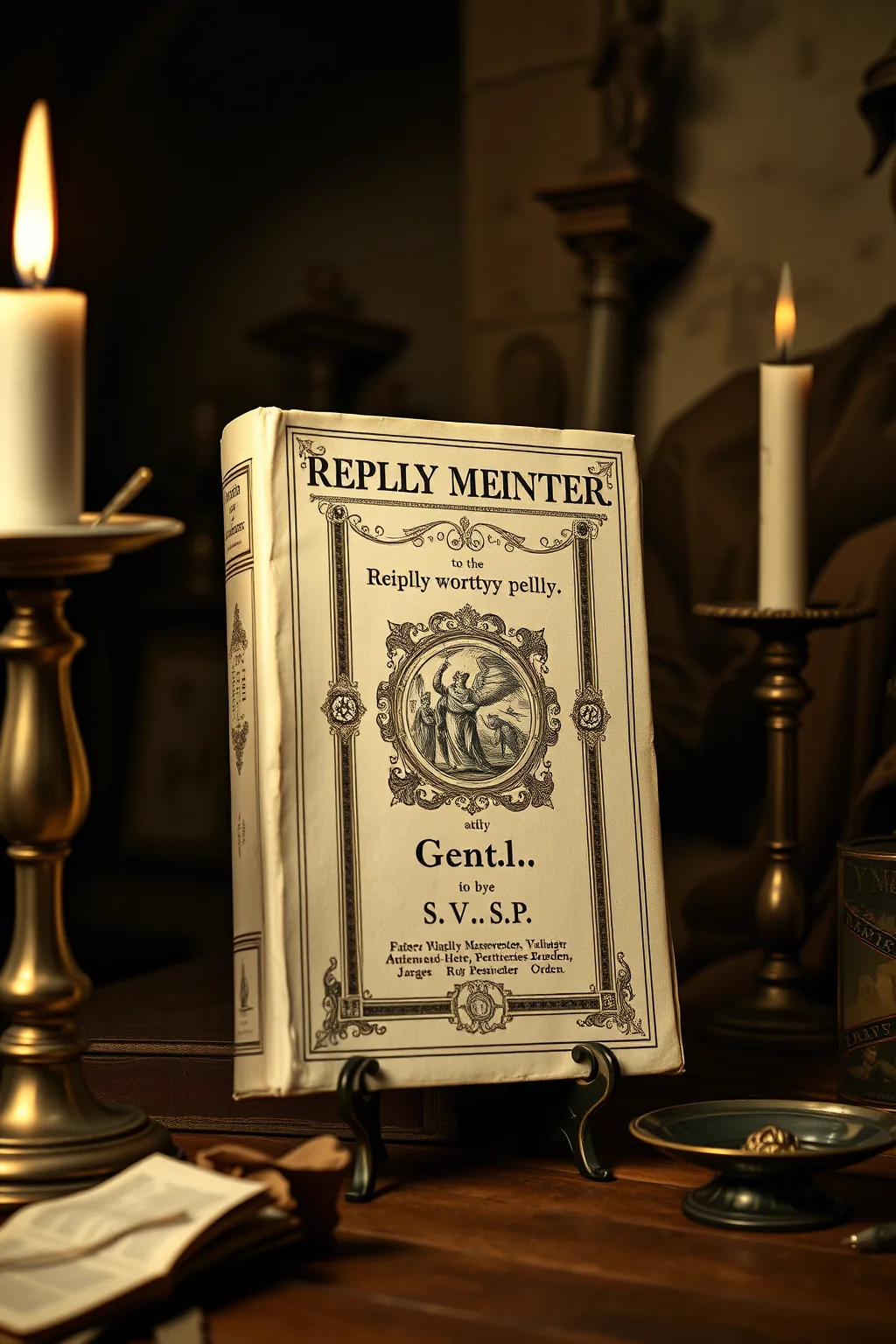
A well-meant reply letter to the highly worthy and widely famous Gentlemen Brothers of the highly estimable Rosicrucian Order
 83
83

A well-meant reply letter to the highly worthy and widely famous Gentlemen Brothers of the highly estimable Rosicrucian Order


Balthazar Finch (Senior Critic, Occult Philosophy): This meticulously translated 'Well-Meant Reply' by S.V.S.P. is a crucial artifact for any serious student of Rosicrucian lore and early Masonic thought. Ruud Muschter's rendition captures the intellectual rigor and spiritual yearning of the original German text. The work offers profound insights into the philosophical underpinnings and symbolic lexicon of the Rosicrucian Order, making it an invaluable resource for scholars and practitioners alike. Its careful articulation of alchemical principles and quest for divine wisdom provides a clear window into the minds of those who sought to bridge the material and spiritual realms. An essential addition to the Esoteric Library's collection.
📝 Description
83
S.V.S.P. wrote a well-intentioned reply to the Rosicrucian Order in 1619.
This English translation presents S.V.S.P.'s 1619 response to the Rosicrucian Brotherhood. The author addresses the Brotherhood directly, seeking to clarify or contribute to their stated aims. The text discusses alchemical ideas, philosophical questions, and the search for divine knowledge.
The prose carries a serious tone and intellectual curiosity. It invites readers interested in spiritual and material change, as championed by the era's mystical thinkers. This work is important for understanding early discussions in Freemasonry and secret societies. It illuminates their symbolic language and the pursuit of inner illumination.
Published in 1619, this letter is a direct engagement with the Rosicrucian manifestos that appeared earlier that year. It reflects the intense interest and debate surrounding the Brotherhood's sudden appearance in the European intellectual world. The author's response, characterized by its earnest tone, situates the work within the broader context of early modern Hermeticism and paracelsianism, traditions that sought to reconcile Christian theology with alchemical and natural philosophical inquiry.
💡 Why Read This Book?
Uncover the direct dialogues and intellectual currents that shaped early Rosicrucianism. This translation provides a rare glimpse into the earnest responses exchanged within secret societies, revealing profound alchemical and philosophical quests. Ideal for scholars, Freemasons, and seekers of hidden knowledge eager to understand the foundational texts of Western esotericism.
⭐ Reader Reviews
Honest opinions from readers who have explored this book.
❓ Frequently Asked Questions
What is the primary purpose of this 'Well-Meant Reply'?
The document serves as a thoughtful and detailed response to the mysterious pronouncements of the Rosicrucian Brotherhood, addressing their claims and philosophical tenets with a blend of earnest inquiry and esoteric exposition.
Who is S.V.S.P. and what is known about them?
The identity of S.V.S.P. remains largely enigmatic, a common characteristic of authors associated with early esoteric texts. Their contribution suggests a deep engagement with Rosicrucian philosophy and a desire to contribute to the ongoing discourse.
What historical period does this text represent?
This is a significant text from the early 17th century, specifically 1619, a period of intense intellectual and spiritual ferment in Europe, particularly concerning alchemical and mystical societies.
Is this a primary source document?
Yes, this English translation is of a primary source document, offering direct access to the original German text's content and intent from the era of its initial circulation.
What is the significance of the Rosicrucian Order in this context?
The Rosicrucian Order, though shrouded in mystery, was a pivotal influence in early modern esotericism, sparking widespread fascination and debate through its published manifestos, to which this reply is a direct engagement.
🔮 Key Themes & Symbolism
The Alchemical Quest for Transformation
This text delves deeply into the alchemical pursuit, not merely as a metallurgical practice, but as a profound metaphor for spiritual purification and the transformation of the soul. It explores the symbolism of transmutation, the Philosopher's Stone, and the Great Work as pathways to divine knowledge and inner enlightenment, reflecting the era's fervent belief in the interconnectedness of the material and spiritual realms. The author articulates the arduous journey required, emphasizing purity of intent and rigorous spiritual discipline as prerequisites for achieving higher states of consciousness and understanding cosmic secrets.
The Nature of Secret Societies and Hidden Knowledge
The 'Well-Meant Reply' is intrinsically linked to the mystique surrounding early secret societies, particularly the Rosicrucians. It grapples with the concept of hidden knowledge, its transmission, and the societal implications of such esoteric wisdom. The text implicitly discusses the role of brotherhoods in safeguarding and disseminating profound truths, posing questions about accessibility, revelation, and the responsibility that comes with possessing arcane understanding. It highlights the tension between secrecy and the desire for broader spiritual awakening, a theme central to the discourse of these influential organizations.
Philosophical Dialogue and Spiritual Inquiry
This work stands as a evidence of the robust philosophical and spiritual dialogues of the early 17th century. It represents an earnest engagement with complex theological, metaphysical, and ethical questions posed by the Rosicrucian manifestos. The author's 'reply' is not a mere refutation but a structured discourse, inviting contemplation on the divine, the human condition, and the ultimate purpose of existence. It showcases a mind deeply invested in seeking truth through reasoned argument and spiritual contemplation, contributing to the wide range of esoteric thought that characterized the period.
💬 Memorable Quotes
Direct passages from the work, attributed to the author.
“Seek not the outward show, but the inner fire.”
— This aphorism emphasizes the essential Rosicrucian and alchemical principle of focusing on internal spiritual development rather than superficial appearances or material possessions.
“The Great Work begins within the heart's crucible.”
— Highlights the alchemical metaphor of the 'Great Work' being a process of inner purification and spiritual refinement, initiated through introspection and emotional transformation.
“The symbols speak to those who have learned to listen.”
— Underscores the esoteric concept that symbolic language requires a prepared mind and a receptive spirit to be understood, suggesting a hidden layer of meaning accessible through initiation or deep study.
“To know the macrocosm, one must first master the microcosm.”
— Reflects the hermetic principle of 'as above, so below,' asserting that understanding the universe (macrocosm) is contingent upon comprehending the self (microcosm).
💡 Key Ideas
Editorial paraphrase of the work's core concepts — not direct quotes.
Wisdom is a seed, needing fertile ground and patient tending.
This quote likens the acquisition and growth of knowledge to a natural process, requiring diligent effort, suitable conditions, and a willingness to nurture its development over time.
🌙 Esoteric Significance
Tradition
This text is deeply rooted in the Hermetic, Alchemical, and early Rosicrucian traditions. It reflects the Christian Hermeticism prevalent in the era, blending Neoplatonic philosophy with alchemical symbolism and a fervent desire for spiritual regeneration. The emphasis on inner transformation, the pursuit of divine knowledge through symbolic interpretation, and the concept of a hidden brotherhood seeking to elevate humanity align directly with the core tenets of these influential esoteric streams.
Symbolism
The work is rich with alchemical symbolism, employing terms and concepts such as the Philosopher's Stone, transmutation, the four elements, and the marriage of opposites. These symbols are not literal but represent stages of spiritual development, purification of the soul, and the integration of divine principles. The 'reply' likely uses these symbolic keys to discuss the path to enlightenment, the nature of the divine, and the potential for humanity to achieve a higher state of being.
Modern Relevance
In an age often characterized by superficiality and disconnection, the text's emphasis on inner work, profound inquiry, and the search for meaningful knowledge resonates strongly. It offers a historical perspective on the enduring human quest for spiritual understanding and self-mastery, providing valuable insights for contemporary practitioners of meditation, hermeticism, and those seeking to read through the complexities of the modern world with deeper wisdom and intention.
👥 Who Should Read This Book
This text is indispensable for scholars specializing in the history of esotericism, early modern philosophy, and the origins of Freemasonry. It is also highly recommended for dedicated practitioners of Hermeticism and Alchemy who seek to engage with foundational Rosicrucian thought. Seekers of hidden knowledge and students of secret societies will find its earnest tone and philosophical depth profoundly rewarding. Beginners interested in the roots of Western mysticism will gain a crucial historical context for understanding later esoteric movements.
📜 Historical Context
The year 1619 marked an important moment in the dissemination of esoteric ideas, particularly following the publication of the Rosicrucian manifestos in the preceding years. Europe was a crucible of intellectual and spiritual upheaval, with the Renaissance's humanist ideals merging with emerging scientific inquiries and persistent alchemical and mystical traditions. This era witnessed a fascination with secret societies, hidden wisdom, and the potential for radical spiritual and societal reform. The Thirty Years' War was beginning to cast its shadow, yet intellectual curiosity and a yearning for a deeper understanding of the divine and the natural world remained potent forces. Texts like S.V.S.P.'s 'Well-Meant Reply' were not isolated curiosities but part of a vibrant, albeit often clandestine, exchange of ideas that laid groundwork for later developments in Freemasonry, Hermeticism, and other esoteric systems.
📔 Journal Prompts
Reflect on the concept of 'inner fire' as presented in the text. How does this relate to your own spiritual journey?
Consider the symbolism of the 'crucible' in the context of personal transformation. What aspects of yourself are you currently refining?
In what ways does 'hidden knowledge' manifest in contemporary society? What are the responsibilities that come with it?
How can the principles of patient tending and fertile ground be applied to the cultivation of wisdom in your life?
If symbols speak to those who listen, what symbolic languages are currently calling for your attention?
🗂️ Glossary
Rosicrucian Order
A mystical and esoteric fraternity, whose supposed foundation in the early 17th century sparked significant interest and debate across Europe through its published manifestos.
Alchemical
Pertaining to alchemy, an ancient tradition involving the pursuit of transmutation of base metals into gold, but more profoundly, the spiritual transformation and perfection of the human soul.
Hermeticism
A religious, philosophical, and esoteric tradition based primarily upon writings attributed to Hermes Trismegistus, emphasizing the unity of all things and the pursuit of divine knowledge.
Microcosm
In esoteric philosophy, the human being or the individual, seen as a miniature or smaller version of the universe (macrocosm).
Macrocosm
The universe or the totality of existence, often viewed as a grand, ordered system within which the microcosm (humanity) exists.
This book appears in 2 collections
🔮 Readers Also Liked
Browse all →


![The Freemasons' quarterly (magazine and) review [afterw.] The Freemasons ...](/img/thumb/the-freemasons-quarterly-magazine-and-review-afterw-the-freemasons-freemasons-magazine-ia.webp)


From the “Secret Societies” Collection
View all →





![John Todd [Illuminati And Witchcraft Exposed].pdf (PDFy mirror)](/img/thumb/john-todd-illuminati-and-witchcraft-exposed-pdf-pdfy-mirror.webp)
More Free Freemasonry & Secret Societies Books
View all →