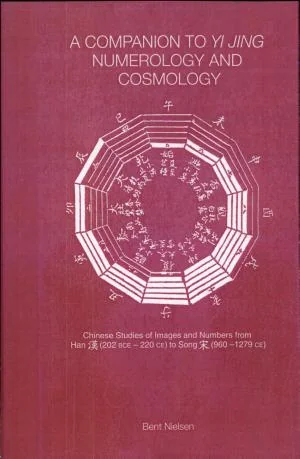
A Companion to Yi Jing Numerology and Cosmology
 72
72

A Companion to Yi Jing Numerology and Cosmology
Bent Nielsen’s *A Companion to Yi Jing Numerology and Cosmology* offers a scholarly antidote to the more ephemeral writings on the I Ching. Its strength lies in its encyclopedic structure and its dual-language presentation, a significant undertaking that provides researchers direct access to primary terminology. The alphabetical arrangement by pinyin, while logical for reference, can feel somewhat disjoined for narrative reading, a minor inconvenience for its intended purpose. The section detailing the various calendrical systems and their relation to the hexagrams is particularly well-executed, illustrating Nielsen’s command of complex cosmological concepts. However, the book occasionally leans towards exhaustive listing rather than insightful synthesis, which might leave readers seeking deeper interpretive frameworks wanting. Nevertheless, for its sheer utility as a reference, it is an indispensable resource for serious I Ching scholars.
📝 Description
72
Bent Nielsen's 2003 companion provides a systematic Chinese-English encyclopedia of Yi Jing numerology and cosmology.
This reference work organizes information on the Yi Jing alphabetically by pinyin, including original Chinese characters for accuracy. It contains essential indexes for both characters and English terms, making it a thorough scholarly resource. Nielsen's companion was first published in 2003, a time of growing academic and popular interest in East Asian traditions. It aimed to fill a gap for a structured, bilingual reference that could clarify the numerological and cosmological frameworks often implied in Yi Jing scholarship. The book focuses on a systematic, encyclopedic presentation of foundational elements, rather than interpretive or philosophical analyses.
The companion details the connections between Yi Jing hexagrams, trigrams, and Chinese cosmological numbering systems. It covers the associations between trigrams like Qian and Kun, their corresponding numbers, colors, directions, and elements. The text also explains the calendrical cycles and philosophical concepts, such as Yin and Yang and the Five Phases, that shape the Yi Jing's structure and interpretation. This systematic approach aids readers in understanding the underlying numerical and cosmological logic of the classic text.
Bent Nielsen's work situates itself within the scholarly study of the I Ching, a foundational text in Chinese philosophy and divination. It addresses the complex numerological and cosmological systems that have developed around the I Ching over centuries. Rather than focusing on divination practices or philosophical exegesis alone, the book systematically unpacks the numerical and symbolic correspondences integral to understanding the text's structure. This approach supports readers who wish to grasp the mathematical and cosmological underpinnings that inform the I Ching's interpretation across various Chinese traditions.
💡 Why Read This Book?
• Gain a systematic understanding of the numerical correspondences and cosmological frameworks underpinning the I Ching, learning how concepts like Yin and Yang are integrated with specific hexagrams. • Access precise definitions and transliterations for key Chinese terms related to I Ching divination, facilitated by the book's bilingual Chinese-English encyclopedia format. • Explore the intricate relationships between the eight trigrams (Ba Gua) and their associated numerological, elemental, and directional symbolism as detailed in Nielsen's structured analysis.
⭐ Reader Reviews
Honest opinions from readers who have explored this book.
❓ Frequently Asked Questions
What is the primary organizational principle of A Companion to Yi Jing Numerology and Cosmology?
The book is organized as a Chinese-English encyclopedia, arranged alphabetically according to the pinyin romanization of terms, with original Chinese characters provided for each entry.
Who is the author, Bent Nielsen, and what is his background relevant to this work?
Bent Nielsen is an author specializing in Chinese philosophy and the I Ching. His work reflects a deep engagement with the textual and cosmological traditions of China, aiming for scholarly precision.
Does the book explain the divination process itself, or focus on underlying structures?
The book primarily focuses on the numerological and cosmological structures that form the foundation of the I Ching, rather than providing a step-by-step guide to the divination process.
What kind of information can be found for terms within the encyclopedia?
Entries typically include the term in pinyin and Chinese characters, followed by a detailed explanation of its meaning within the context of I Ching numerology and cosmology.
What are the included indexes in the book?
The companion features both a character index and an English index, designed to aid users in locating specific terms and concepts quickly and efficiently.
When was A Companion to Yi Jing Numerology and Cosmology first published?
The book was first published in 2003, addressing a need for structured reference material on I Ching cosmology at the turn of the millennium.
🔮 Key Themes & Symbolism
Trigram Symbolism and Correspondences
The work systematically details the symbolic meanings and numerical correspondences associated with the eight trigrams (Ba Gua) of the I Ching. Each trigram, such as Qian (Heaven) and Kun (Earth), is linked to specific elements, directions, colors, and abstract qualities within Chinese cosmology. Understanding these links is crucial for interpreting the layered meanings within hexagrams and their application in divination and philosophical thought.
Numerological Frameworks
Central to the companion is the exploration of the numerical systems that interpenetrate the I Ching. This includes the Lo Shu square and the He Tu diagrams, which provide foundational numerological blueprints. The book elucidates how these numbers relate to the lines of the hexagrams, the counting methods used in divination, and the cyclical patterns of the cosmos, offering a rigorous look at the mathematical underpinnings.
Cosmological Integration
Nielsen's work situates the I Ching within the broader context of traditional Chinese cosmology. It explains how concepts such as Yin and Yang, the Five Phases (Wu Xing), and the celestial spheres are integrated into the structure and interpretation of the I Ching. This provides readers with a framework for understanding the I Ching not merely as a text, but as a microcosm reflecting universal cosmic principles.
Bilingual Reference Structure
The encyclopedic, bilingual Chinese-English format is a defining feature, designed for scholarly precision. By organizing entries alphabetically via pinyin and including original Chinese characters, the companion facilitates direct engagement with the source terminology. This structure minimizes interpretive drift and supports comparative studies of I Ching scholarship across different languages and traditions.
💬 Memorable Quotes
Direct passages from the work, attributed to the author.
“The arrangement of the sixty-four hexagrams is not arbitrary but reflects a deep cosmological order.”
— This statement highlights the book's core premise: that the I Ching's structure is intrinsically linked to ancient Chinese cosmological beliefs, suggesting a divinely or naturally ordered universe mirrored in the text.
“Each trigram is a fundamental building block, possessing distinct numerological and symbolic values.”
— This emphasizes the foundational role of the eight trigrams (Ba Gua) as irreducible units within the I Ching system, each carrying specific numerical weight and symbolic meaning crucial for deeper comprehension.
“Understanding the Five Phases (Wu Xing) is essential for grasping the cyclical interactions depicted in the I Ching.”
— This points to the interconnectedness of I Ching symbolism with other major Chinese philosophical concepts, particularly the dynamic cycle of Wood, Fire, Earth, Metal, and Water.
“The pinyin romanization facilitates access, while the inclusion of Chinese characters ensures scholarly accuracy.”
— This reflects the book's dual objective: to make the complex subject matter accessible to a wider audience through English transliteration while maintaining the fidelity and precision required by academic study.
“Calendrical systems provide a temporal dimension to the spatial and symbolic arrangements of the hexagrams.”
— This interpretation suggests that the book explores how the I Ching's structure is not static but relates to the flow of time, cycles, and celestial movements as understood through traditional Chinese astronomy and calendrics.
🌙 Esoteric Significance
Tradition
This work firmly sits within the scholarly tradition of Chinese metaphysics and cosmology, specifically as it relates to the I Ching. While not strictly aligned with Western esoteric lineages like Hermeticism or Kabbalah, it provides foundational knowledge essential for understanding Eastern systems that have influenced global esoteric thought. It offers a rigorous, text-based exploration of concepts that resonate with universal principles of order, transformation, and divination found across various esoteric traditions.
Symbolism
Key symbols explored include the Ba Gua (Eight Trigrams) and their associated elements (Wood, Fire, Earth, Metal, Water) and Yin/Yang polarities. The companion details how these trigrams combine to form the 64 hexagrams, each imbued with numerological significance derived from ancient Chinese cosmology. The cyclical nature of the Five Phases (Wu Xing) is also central, illustrating dynamic processes of generation and overcoming that are mirrored in the hexagrams' interpretations.
Modern Relevance
Contemporary practitioners of Taoist internal arts, I Ching divination, and comparative cosmology draw upon Nielsen's meticulous cataloging. Thinkers exploring archetypal patterns in global mythologies and divination systems find value in its structured presentation of Chinese cosmological models. The book serves as a crucial resource for those seeking to integrate Eastern philosophical frameworks into modern psychological or spiritual practices, providing a precise lexicon for complex ideas.
👥 Who Should Read This Book
• Students of Chinese philosophy and cosmology: Those seeking a systematic, bilingual reference to understand the numerical and elemental frameworks integral to classical Chinese thought. • Serious I Ching practitioners: Individuals who have moved beyond introductory divination and wish to explore the deeper mathematical and cosmological structures that inform the hexagrams. • Comparative religion and symbolism scholars: Researchers interested in the unique symbolic language and numerological systems of East Asian traditions and their place within global esoteric thought.
📜 Historical Context
Bent Nielsen's *A Companion to Yi Jing Numerology and Cosmology*, published in 2003, arrived at a time when Western engagement with the I Ching was diversifying. Academic Sinology continued its rigorous textual and philosophical analyses, while New Age interpretations offered more accessible, often less structured, approaches. Nielsen's work carved a niche by providing a systematic, encyclopedic reference, grounded in the numerical and cosmological traditions that underpin the classic text. It addressed a gap left by more philosophically focused works, such as those by Richard Wilhelm, and contrasted with the popular, often simplified, divination manuals. The early 2000s saw continued scholarly interest in Taoism and Chinese metaphysics, making a comprehensive bilingual reference like Nielsen's a valuable tool for researchers and serious practitioners alike, offering a structured counterpoint to the more fluid interpretations prevalent in popular culture.
📔 Journal Prompts
The correspondence between the eight trigrams and their elemental associations.
How the numerological values assigned to lines and hexagrams might influence interpretation.
The integration of Yin and Yang principles within specific hexagram structures.
Reflecting on the cyclical interactions of the Five Phases (Wu Xing) as presented.
The significance of calendrical systems in the ordering of the I Ching's cosmological framework.
🗂️ Glossary
Yi Jing
The classic Chinese text, also known as the Book of Changes, central to Chinese philosophy, divination, and cosmology. It comprises 64 hexagrams derived from combinations of eight trigrams.
Hexagram
A figure composed of six stacked horizontal lines, each line being either Yang (solid) or Yin (broken). There are 64 hexagrams in the Yi Jing, representing a wide array of situations and transformations.
Trigram (Ba Gua)
A symbol consisting of three stacked lines, representing fundamental forces and concepts in Chinese cosmology. The eight trigrams (Qian, Kun, Zhen, Xun, Kan, Li, Gen, Dui) are the building blocks of the hexagrams.
Pinyin
The official system for romanizing Chinese characters into the Latin alphabet, used for pronunciation and alphabetical ordering in this companion.
Wu Xing
The Five Phases or Five Elements (Wood, Fire, Earth, Metal, Water) in Chinese philosophy, representing a dynamic system of correspondences and cycles that are integral to understanding Chinese cosmology.
Yang
In Chinese philosophy, one of the two fundamental, complementary principles (alongside Yin). Yang typically represents the active, masculine, bright, and heavenward aspects.
Yin
The complementary principle to Yang, representing the passive, feminine, dark, and earthbound aspects. Together, Yin and Yang describe the dynamic interplay of forces in the universe.
This book appears in 1 collection
🔮 Readers Also Liked
Browse all →









From the “Numerology” Collection
View all →









More Free Occult Philosophy Books
View all →