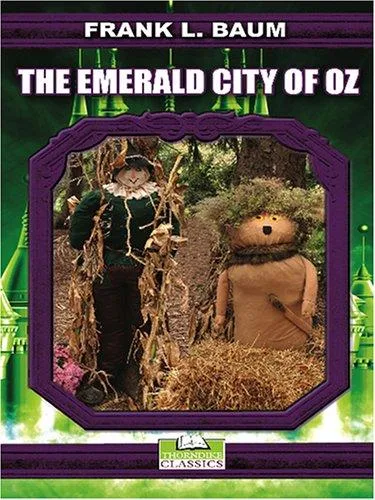
The Emerald City of Oz
 82
82

The Emerald City of Oz
Baum's venture into the political machinations of Oz in 'The Emerald City of Oz' presents a more complex, and at times unsettling, vision than earlier installments. The introduction of the Nome King and his subterranean empire, alongside the internal strife threatening Ozma's rule, adds a layer of genuine peril. One notable strength is the detailed depiction of the Emerald City's infrastructure and the societal anxieties it harbors. However, the narrative occasionally falters in its pacing, particularly during lengthy explanations of the Nome King's motivations. The scene where Dorothy and her companions must navigate the perilous journey to the Nome King's domain, facing magical obstacles and illusions, remains a high point of imaginative dread. While not as whimsical as 'The Wizard of Oz,' this installment offers a compelling examination of power and consequence within the magical realm.
📝 Description
82
The Emerald City of Oz, published in 1910, sees Dorothy return to a land facing internal strife.
L. Frank Baum's sixth Oz book, published in 1910, brings Dorothy Gale back to the Land of Oz, only to find the Emerald City under threat. The narrative details the return of the Wizard, who attempts to seize power by deceiving the citizens and inciting rebellion against the young ruler, Ozma. Dorothy and her friends must rally to protect the city and restore order.
This installment delves into themes of political maneuvering and the nature of authority within a seemingly idyllic society. Baum uses the fantastical setting to examine how illusion and manipulation can challenge established governance. The story questions the stability of the ruling structure when faced with external threats and internal dissent, offering a complex look at leadership and citizenship through a fairy tale lens.
While published before the widespread influence of Theosophy, Baum's Oz series, including The Emerald City of Oz, aligns with a late Victorian and Edwardian fascination with the occult and spiritualism. The series' engagement with magic, fantastical beings, and the manipulation of perception through illusion connects with a broader cultural interest in hidden knowledge and alternative realities prevalent during the period. Interpretations of the Oz books as allegories, such as Henry M. Littlefield's analysis linking them to the Populist movement, also reflect a tendency to seek deeper, symbolic meanings within popular narratives, a common practice in esoteric traditions.
💡 Why Read This Book?
• Gain insight into political allegories within children's literature by analyzing how Baum uses the Nome King's invasion and the Emerald City's internal struggles to comment on societal unrest, a theme present from the book's 1910 publication. • Understand the evolving nature of Ozma's rule and the challenges of maintaining order, as depicted in the narrative's focus on the Emerald City's governance and the threat of external forces. • Explore the symbolic significance of magical artifacts and subterranean realms, particularly the Nome King's domain, which represents a contrasting, often darker, form of power and control within the Oz universe.
⭐ Reader Reviews
Honest opinions from readers who have explored this book.
❓ Frequently Asked Questions
When was The Emerald City of Oz first published?
The Emerald City of Oz was first published in 1910, though specific editions, such as the one noted with a 1952 date, exist and may feature different illustrations or introductions.
What is the main conflict in The Emerald City of Oz?
The primary conflict involves an invasion of Oz by the Nome King, who seeks to conquer the Emerald City, and the internal disruption caused by a group of disgruntled Oz citizens who wish to depose Princess Ozma.
Who are the main characters in The Emerald City of Oz?
Key characters include Dorothy Gale, Princess Ozma, the Wizard of Oz, the Nome King, and his reluctant companion, Billina the hen, who plays a crucial role in the narrative.
What makes The Emerald City of Oz different from other Oz books?
This book is noted for its more serious tone, darker themes of rebellion and invasion, and a significant focus on the political and structural aspects of the Emerald City, moving beyond simple adventure.
Are there any allegorical interpretations of The Emerald City of Oz?
Yes, scholars have interpreted the book as an allegory for the Populist movement, with the Nome King representing industrial interests and the Emerald City symbolizing agrarian America facing economic hardship.
What is the significance of the Nome King in the story?
The Nome King represents an antagonistic, subterranean force seeking to usurp control and exploit Oz's resources. His character embodies a different kind of power, rooted in earth and industry, contrasting with Ozma's benevolent rule.
🔮 Key Themes & Symbolism
Political Discontent and Rebellion
The narrative explores the fragility of governance, even in a seemingly idyllic land like Oz. A faction within the Emerald City, dissatisfied with Princess Ozma's rule, conspires with the Nome King to overthrow her. This theme reflects anxieties about social order and the potential for internal dissent, mirroring real-world political tensions of the early 20th century. The book examines how discontent can fester and lead to drastic actions, exploring the motivations behind rebellion and the consequences for a society built on magic and harmony.
The Nature of Power and Authority
Baum scrutinizes the exercise of power through contrasting figures like Princess Ozma and the Nome King. Ozma represents benevolent, if sometimes naive, authority, while the Nome King embodies a more tyrannical and exploitative form of control, rooted in his subterranean empire. The story questions what constitutes legitimate rule, the responsibilities of leaders, and the dangers of unchecked ambition. It explores how power can be both a tool for good and a corrupting force, especially when wielded by those with less noble intentions.
Illusion vs. Reality in Governance
The Emerald City itself, with its shimmering green facades, represents a form of constructed reality or illusion that masks underlying societal issues. The Wizard of Oz, who previously used illusions to maintain his status, reappears and contributes to the confusion. The story contrasts the outward appearance of prosperity with the internal anxieties and plots brewing beneath the surface. This theme prompts reflection on how appearances can deceive and how true stability requires addressing genuine problems rather than merely presenting a facade.
The Subterranean and the Surface World
A significant element is the juxtaposition of the Emerald City's surface world with the underground kingdom of the Nomes. This duality symbolizes different societal structures, values, and forms of power. The Nomes, with their connection to earth and mining, represent a more grounded, perhaps industrial, force, whereas Oz represents a more ethereal, magical realm. The conflict between these two worlds highlights cultural clashes and the challenges of integrating disparate societies and their respective forms of influence.
💬 Memorable Quotes
Direct passages from the work, attributed to the author.
“The Nome King's desire to conquer Oz.”
— This represents a core conflict, symbolizing external forces or subterranean powers seeking to dominate the established, magical area of Oz. It highlights themes of invasion and the clash of different civilizations or forms of governance.
“Princess Ozma's concern for her people's safety.”
— This emphasizes Ozma's responsible leadership and her deep connection to her subjects. It underscores the value placed on the well-being of citizens within Oz's political framework.
“Dorothy's loyalty to Oz and her friends.”
— Dorothy's unwavering commitment to Oz and its inhabitants showcases the theme of friendship and solidarity. Her willingness to face danger for her friends is a recurring motif throughout the series.
“The Emerald City's shimmering facade.”
— This symbolizes the potentially superficial nature of prosperity or utopia. It suggests that outward appearances can hide underlying problems or vulnerabilities within a society.
“Billina the hen's unexpected bravery.”
— This highlights that courage and importance can come from unexpected sources. Billina's role demonstrates that even the smallest or seemingly least significant characters can play a key part in critical events.
🌙 Esoteric Significance
Tradition
While not strictly aligned with a single esoteric tradition, Baum's Oz series, including 'The Emerald City of Oz,' draws on a broad Western esoteric current interested in magical realms, symbolic governance, and the power of the imagination. It shares thematic resonance with Gnostic ideas of a flawed material world and the potential for spiritual liberation, as well as with Theosophical concepts of hidden worlds and elemental beings (like the Nomes). The series contributes to a late Victorian/Edwardian fascination with alternative realities and the hidden potential within the mundane.
Symbolism
The Emerald City itself functions as a potent symbol of perceived utopia, whose green luminescence can represent both prosperity and illusion, a constructed reality that may mask underlying societal tensions. The Nome King and his subterranean domain symbolize primal, earth-bound forces and a more materialistic, perhaps exploitative, form of power that contrasts with the magical, surface-level governance of Oz. Billina the hen, an unlikely hero, symbolizes the potential for the seemingly insignificant to play a central role in overcoming great challenges, echoing alchemical ideas of transformation and the hidden value in base elements.
Modern Relevance
Contemporary thinkers exploring the intersection of literature and psychology, particularly Jungian archetypes, find relevance in Oz's characters and their symbolic journeys. Educators and cultural critics continue to analyze Baum's work for its layered social commentary, relevant to discussions on populism, governance, and economic inequality. Furthermore, the enduring appeal of Oz inspires modern fantasy authors and world-builders who look to Baum's intricate creation for lessons in crafting immersive magical landscapes and exploring complex societal dynamics through accessible narratives.
👥 Who Should Read This Book
• Students of American children's literature seeking to understand early 20th-century allegorical narratives and their socio-political underpinnings. • Readers interested in comparative mythology and folklore who wish to explore recurring themes of invasion, subterranean realms, and benevolent versus tyrannical rulers. • Enthusiasts of L. Frank Baum's Oz series who are looking for a deeper dive into the more complex political and existential challenges faced by the characters and the Emerald City.
📜 Historical Context
Published in 1910, 'The Emerald City of Oz' appeared during the Progressive Era in America, a period marked by significant social reform movements and a growing critique of industrial capitalism. L. Frank Baum's Oz series, and this installment in particular, has been subject to allegorical readings, most notably by Henry M. Littlefield, who interpreted it as a commentary on the Populist movement of the 1890s, with the Nome King representing exploitative financiers and Oz symbolizing agrarian America. While Baum himself did not explicitly confirm these interpretations, the timing of the book's release and its themes of political unrest, economic anxiety, and the struggle for control align with the era's prevailing concerns. This work engaged with a broader cultural fascination with fantasy and the supernatural, a trend evident in the rise of Theosophy and spiritualism, though Baum's approach remained distinctly his own, focusing on American settings and democratic ideals rather than strictly adhering to established occult doctrines.
📔 Journal Prompts
The Nome King's subterranean kingdom and its contrast with the Emerald City.
Princess Ozma's challenges in maintaining order amidst internal dissent.
Billina the hen's unexpected role in the Nomes' defeat.
The symbolic meaning of the Emerald City's green hue.
Dorothy's perception of Oz upon her return and the city's evolving state.
🗂️ Glossary
Nome King
The ruler of the Nomes, a race of earth-dwelling beings. He is a primary antagonist who seeks to conquer Oz and exploit its magical resources, representing a subterranean, often greedy, power.
Nomes
A race of subterranean creatures, often depicted as miners and craftsmen. They possess a connection to the earth and its treasures, and their society operates under the rule of the Nome King.
Billina
A hen who accompanies Dorothy and her friends on their journey to the Nome King's domain. Despite her humble nature, she plays a critical role in thwarting the Nomes' plans through her unique abilities and bravery.
Ozma's Royal Army
The defensive force of the Emerald City, tasked with protecting the kingdom. In this book, their effectiveness is tested by the internal conspiracy and the external threat posed by the Nome King.
The Wizard of Oz
Once the ruler of the Emerald City, he reappears in this installment, now a commoner but still possessing his inventive skills. He aids Dorothy and her companions, though his past reliance on illusion creates complications.
The Conspiracy
A plot hatched by disgruntled Oz citizens who wish to depose Princess Ozma and seize control of the Emerald City, aligning themselves with the Nome King.
The Magic Belt
An artifact used by the Nome King, capable of transporting individuals and objects. Its possession and use are central to the Nomes' strategy and the characters' efforts to overcome them.
🔮 Readers Also Liked
Browse all →









More by L. Frank Baum
All books →





More Free Occult Philosophy Books
View all →