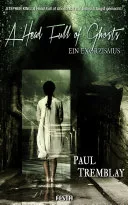
A Head Full of Ghosts - Ein Exorzismus
 79
79

A Head Full of Ghosts - Ein Exorzismus
Paul Tremblay’s A Head Full of Ghosts is a masterful exercise in misdirection, initially presenting itself as a straightforward account of demonic possession, only to unravel into a far more unsettling exploration of family trauma and media manipulation. The novel’s strength lies in its dual-narrative structure, interspersing Merry’s adult reflections with the frenzied blog posts of a superfan, creating a disorienting yet compelling effect. The passage detailing the televised exorcism, framed through the eyes of a child and a feverish online commentator, is particularly chilling, highlighting how spectacle can both obscure and amplify genuine suffering. If there’s a limitation, it’s that the ambiguity, while central to the book's power, might leave some readers yearning for a more definitive resolution. Yet, this very open-endedness forces a confrontation with the subjective nature of truth. It’s a disquieting, intelligent novel that lingers long after the final page.
📝 Description
79
Paul Tremblay's 2018 novel fractured perceptions of possession through fragmented recall.
Marjorie, a young girl, apparently becomes possessed, drawing her family into a media spectacle surrounding an exorcism. The narrative, primarily told by Marjorie's younger sister, Merry, years later, mixes her memories with fan blog posts about the events. This structure forces readers to question what is real, how memory warps, and how media can twist tragedy into entertainment.
The book appeals to those who enjoy psychological horror that doesn't clearly separate mental illness from the paranormal. It's for readers who like unreliable narrators and stories that show how media coverage affects personal disasters. Those who appreciate literary fiction that includes uncanny elements and explores public anxieties about faith, family, and madness will find ample material for thought.
Published in 2018, the novel arrived amid a renewed interest in horror narratives that refuse easy answers and critique reality television. It taps into a cultural moment where documented supernatural claims, magnified by the internet and reality TV, became a significant public topic. The book's portrayal of faith healing and exorcism as potential spectacles echoes ongoing discussions about controversial figures in religious media.
💡 Why Read This Book?
• Gain insight into the psychological underpinnings of horror through the lens of Merry’s fractured memories, understanding how trauma can warp perception. • Examine the societal fascination with the occult and extreme religious experiences as depicted through the lens of the 2015 blog posts, revealing contemporary anxieties. • Appreciate the narrative craft that deliberately blurs lines between mental illness, genuine possession, and media fabrication, challenging conventional horror tropes.
⭐ Reader Reviews
Honest opinions from readers who have explored this book.
❓ Frequently Asked Questions
Is 'A Head Full of Ghosts' based on a true story?
While the novel draws inspiration from real-world phenomena like alleged demonic possessions and televised exorcisms, it is a work of fiction. Paul Tremblay uses these elements to explore psychological horror and media critique, not to recount a specific event.
What is the significance of the blog posts in the book?
The blog posts, written by a character named 'Terror Twin,' serve to offer a feverish, fan-obsessed perspective on the events surrounding Marjorie. They represent a cultural consumption of tragedy and amplify the sensationalism inherent in the story.
Does the book offer a clear explanation for Marjorie's condition?
No, the book deliberately maintains ambiguity. It presents possibilities ranging from mental illness and family dysfunction to genuine demonic possession, leaving the reader to question the ultimate cause.
What is the 'Four Horsemen' concept in the book?
The 'Four Horsemen' is a fictional horror film series within the novel, created by Marjorie's father. It reflects his background in filmmaking and becomes a recurring motif, potentially influencing how events are perceived or staged.
When was 'A Head Full of Ghosts' originally published?
'A Head Full of Ghosts' was first published in 2018, quickly establishing itself as a significant contemporary horror novel.
What does the title 'A Head Full of Ghosts' refer to?
The title suggests a mind haunted by intrusive thoughts, traumatic memories, or perhaps literal supernatural entities. It encapsulates the psychological and potentially supernatural disturbances experienced by the characters.
🔮 Key Themes & Symbolism
The Unreliable Narrator
The novel masterfully employs multiple unreliable narrators, primarily Merry and the pseudonymous blogger 'Terror Twin.' Merry's adult recollections are filtered through years of trauma and repressed memory, while 'Terror Twin's' fanatical blog posts are fueled by obsessive speculation and a desire to sensationalize. This duality forces readers to constantly question what is real, mirroring how media narratives can distort personal tragedies and create distorted public perceptions of events like Marjorie's alleged possession.
Possession as Metaphor
The concept of possession in 'A Head Full of Ghosts' transcends simple demonic infestation. It functions as a potent metaphor for various afflictions: mental illness, the overwhelming influence of media, family dysfunction, and the consuming nature of obsessive fandom. The ambiguity surrounding Marjorie's state allows the narrative to explore how societal interpretations, religious beliefs, and psychological frameworks can all 'possess' an individual or a situation, shaping reality.
Media and Spectacle
The televised exorcism of Marjorie becomes a central focal point, exposing the book's critique of reality television and media sensationalism. The event is presented not just as a spiritual crisis but as a performance, exploited for ratings and public fascination. This theme looks at how genuine suffering can be commodified and distorted when subjected to the demands of entertainment, a concept particularly relevant in the age of viral content and social media.
Faith and Doubt in Modernity
The novel navigates the complex relationship between faith, doubt, and the supernatural in a contemporary context. It questions whether Marjorie's affliction is a genuine manifestation of spiritual warfare, a product of mental health issues, or a carefully constructed narrative. The family's desperate turn to an exorcism, amplified by media, highlights a societal struggle to reconcile traditional beliefs with scientific understanding and media-driven narratives.
💬 Memorable Quotes
Direct passages from the work, attributed to the author.
“We didn’t know what was happening. We just knew something was wrong.”
— This statement expresses the pervasive sense of helplessness and confusion experienced by the family as Marjorie's condition deteriorates. It underscores the thematic exploration of uncertainty and the desperate search for answers in the face of the inexplicable.
“It was all a show. A performance for the cameras.”
— This interpretation reflects the critical stance the novel takes on the televised exorcism. It suggests that the events were manufactured or heavily manipulated for public consumption, questioning the authenticity of the spectacle.
“My sister. My sister is not sick. My sister is possessed.”
— This statement, representing a potential belief held by a character, starkly presents the central conflict between perceiving Marjorie's condition as a medical issue versus a supernatural one, driving the narrative's core tension.
💡 Key Ideas
Editorial paraphrase of the work's core concepts — not direct quotes.
Sometimes I think about it, and sometimes I don’t. It’s like a dream I can’t quite remember.
This paraphrased sentiment captures Merry's fragmented memory of her sister's ordeal. It speaks to the difficulty of processing traumatic childhood events and how they can recede into a subconscious haze, only to resurface with unsettling clarity.
The blog posts are feverish. They’re obsessed. They’re the worst kind of people.
This quote, likely from Merry's perspective, directly addresses the intrusive and sensationalist nature of the online commentary surrounding her family's tragedy, highlighting the exploitative aspect of public interest in private suffering.
🌙 Esoteric Significance
Tradition
While not strictly adhering to a single esoteric tradition, "A Head Full of Ghosts" taps into ancient and persistent themes found across various spiritual and occult practices concerning spiritual affliction and the boundaries of the human psyche. It echoes Gnostic ideas of the material world as a prison and the struggle against malevolent forces, as well as more modern explorations of psychic phenomena and demonic influence prevalent in certain branches of Western Esotericism.
Symbolism
The 'Four Horsemen' film series, created by Marjorie's father, acts as a symbolic motif, representing a descent into chaos and staged horror that mirrors the family's real-life crisis. The motif of mirrors, often used to reflect reality or hidden truths, also plays a role, suggesting a fractured self or distorted perceptions. The figure of the possessed child is a potent symbol across many cultures, representing vulnerability, the corruption of innocence, and the uncanny intrusion of the 'other'.
Modern Relevance
Contemporary thinkers and practitioners in fields ranging from critical theory to parapsychology can draw from this work. It informs discussions on media influence, the sociology of belief, and the psychological dimensions of alleged supernatural experiences. Its deconstruction of the possession narrative remains relevant for those exploring the intersection of mental health discourse, religious interpretation, and the enduring human fascination with the uncanny in an increasingly skeptical, yet paradoxically belief-driven, world.
👥 Who Should Read This Book
• Readers interested in psychological horror and unreliable narration: Those who enjoy narratives that question perception and memory, like the works of Shirley Jackson or Mark Z. Danielewski, will find a compelling exploration of these themes. • Fans of media critique and meta-fiction: Individuals fascinated by how media shapes our understanding of events and enjoy stories that comment on their own construction will appreciate the novel's structure. • Students of contemporary horror: Readers seeking to understand the evolution of horror literature beyond jump scares, focusing on subtle dread and thematic depth, will find this a significant contemporary example.
📜 Historical Context
Published in 2018, Paul Tremblay's "A Head Full of Ghosts" emerged in an era saturated with paranormal reality television and online subcultures dedicated to dissecting alleged supernatural events. The novel directly engages with the cultural landscape shaped by shows like "Ghost Hunters" and the rise of internet forums where such phenomena are debated and sensationalized. It arrived as a sophisticated critique of how these media forms can blur the lines between genuine belief, psychological distress, and manufactured entertainment. While not directly comparable to the literary output of contemporaries like Grady Hendrix, who also explored horror tropes with a meta-commentary, Tremblay’s work offered a more introspective and structurally complex examination of possession narratives. The book’s reception highlighted a public appetite for horror that questions the nature of reality itself, echoing a broader trend in speculative fiction that probes societal anxieties about truth and perception in the digital age. Its nuanced approach distinguished it from more straightforward supernatural tales.
📔 Journal Prompts
Marjorie's perceived possession as a lens for examining societal anxieties.
The reliability of Merry's memories versus the 'Terror Twin' blog entries.
The performance of exorcism and its implications for faith.
The 'Four Horsemen' motif and its connection to psychological breakdown.
The boundary between mental illness and supernatural phenomena in the narrative.
🗂️ Glossary
Exorcism
A ritual performed to expel demons or evil spirits from a person or place. In the novel, it becomes a public spectacle, raising questions about authenticity and exploitation.
Possession
The state of being controlled by a supernatural entity or a dominant influence. The book explores this concept ambiguously, linking it to mental illness, media manipulation, and potential genuine spiritual affliction.
Unreliable Narrator
A character whose credibility is compromised. The novel uses Merry and the blogger 'Terror Twin' to create narrative ambiguity and challenge the reader's perception of truth.
Four Horsemen
A fictional horror film series within the novel created by Marjorie's father, serving as a recurring motif that reflects the narrative's themes of horror, family dysfunction, and staged events.
Terror Twin
The pseudonym of a character who writes obsessive blog posts about Marjorie's case, representing fan culture and the sensationalist consumption of tragedy.
Psychological Horror
A subgenre of horror fiction that relies on mental and emotional states to create fear, dread, and unease, often blurring the lines between reality and delusion.
Meta-fiction
Fiction that self-consciously draws attention to its status as a work of art, often by discussing its own construction. The novel's structure and commentary on media employ meta-fictional elements.