Raja
Raja, meaning "king" or "ruler," denotes a sovereign prince in ancient India. In spiritual contexts, it refers to the highest state of consciousness or the supreme ruler within oneself, as in Raja Yoga, the "royal path" to spiritual mastery.
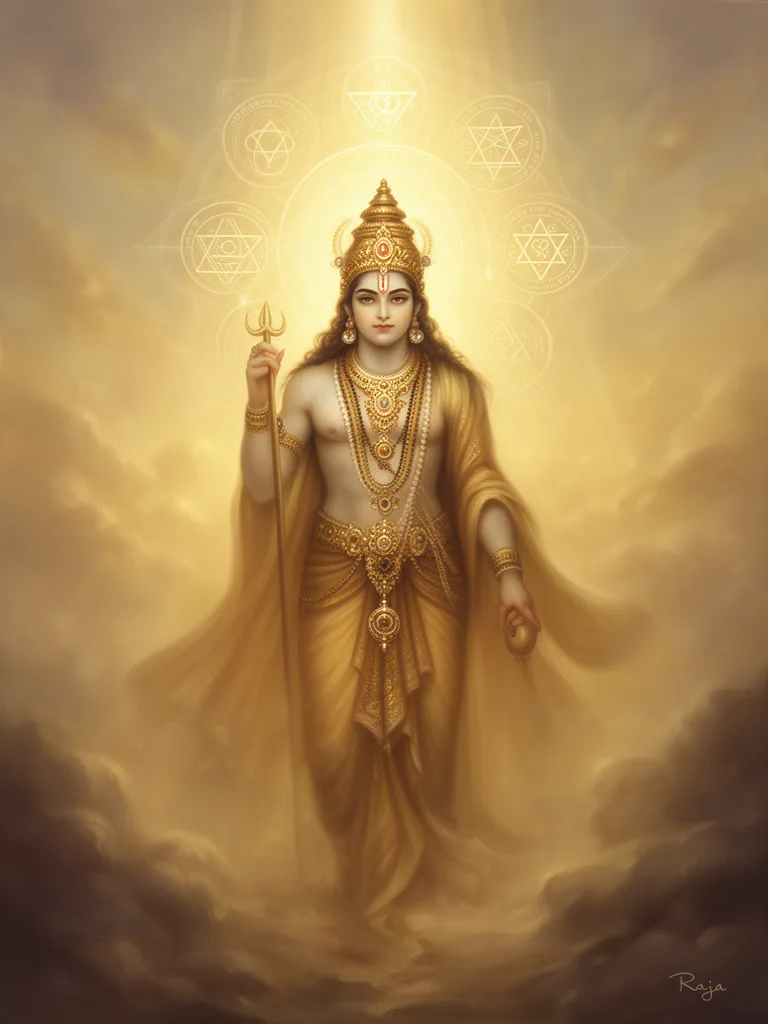
Where the word comes from
The term "Raja" derives from the Sanskrit root rā́j, meaning "to rule" or "to be king." It is cognate with the Old Persian rāja and Proto-Indo-European h₃rḗǵs, also meaning "king." The concept appears in Vedic literature and gained prominence with the rise of Indian monarchies.
In depth
The latter thougrh professedly a Northern Buddhist, is simply a worshipper of the old demon-jrods of the aborig;ines, the nature-sprites or elementals. worshipped in the land befon.' the introduction of Bud dhism. All stranjjers are prevented from penetratinj? into p]astern or Great Tibet, and the few scholars who venture on their travels into those forbidden rejrions, are ])ermitted to penetrate no further than the border-lands of the land of Bod. They journey about Bhutan. Sikkhim. and elsewhere on the frontiers of the country, but can learn or know nothinjr of true Tibet; hence, nothing of the true Northern Buddhism or Lamaism of Tsonfr-klia-pa. And yet, while describing: no more than the rites and beliefs of the Bhons and the travclliiifr Shamans, they assure the world they are {jivinpr it the pure Xortlici-n Buddhism, and comment on its preat fall from its pristint' purity' Tat (E(j.). An E<ryj)tian s_\inbol : an upriglit round standard tapering toward the summit, with four cross-pieces placed on the top. It was used as an amidet. The top part is a regular equilateral cross. This, on its phallic basis, represented the two principles of creation, the male and the female, and related to nature and cosmos; but when the tnt stood by itself, crowned with the atf (or atcf), the triple crown of Horus — two feathers with tlie uraeus in front — it represented the septntary man; the cross, or the two cross-pieces, standing for the lower (|uaternary, and the atf for the higher triad. As Dr. Birch well remarks: "The four horizontal bars . . . represent the four founda tions of all things, the tat ))eing an emblem of stability "". Tathagata (Sk.). "Oi.r who is like the coming"; he who is. like his predecessors (the Buddhas) and successors, the commpr future Buddha or World-Saviour. One of the titles of Gautama Buddluu and the highest epitliet, since the first and the la.'it Buddhas were the direct inriiiediatf avatars of the One Deity.
How different paths see it
What it means today
The word "Raja" whispers of ancient Indian courts, of maharajas adorned with jewels, their power extending over vast territories. Yet, its deeper resonance, particularly when encountered in the context of Raja Yoga, shifts this dominion inward. It is not about the scepter, but the self-mastered spirit. As Mircea Eliade observed in his studies of yoga, the aim is not to conquer the external world, but to achieve a profound inner victory, a stillness that is more potent than any outward display of authority. This "royal path" is less about commanding armies and more about commanding the unruly currents of thought and desire.
The yogic tradition posits that the true sovereign is the one who has attained a state of samadhi, a profound meditative absorption where the mind, like a perfectly still lake, reflects the unblemished truth of existence. This is a sovereignty not of ego, but of awareness. The practitioner becomes the king of their own inner kingdom, the undisputed ruler of their perceptions, emotions, and impulses. It is a difficult ascent, as any true ruler knows, requiring unwavering discipline and a profound understanding of one's own territory. The goal is not to escape the world, but to inhabit it with the serene detachment and clear-sighted authority of a true monarch, a Raja of the self.
The spiritual Raja, therefore, is not a distant potentate but an accessible ideal, a testament to the power of inner cultivation. It is the quiet dignity of a mind that has learned to govern itself, finding its true throne not on a golden seat, but within the boundless expanse of consciousness.
Related esoteric terms
Books on this concept








No reflections yet. Be the first.
Share your interpretation, experience, or question.
