Loki
Loki is a complex figure in Norse mythology, often depicted as a trickster and shape-shifter. Esoterically, he represents an "opposing power" that arises from differentiation within primordial harmony, symbolizing the passions born from intense vital forces.
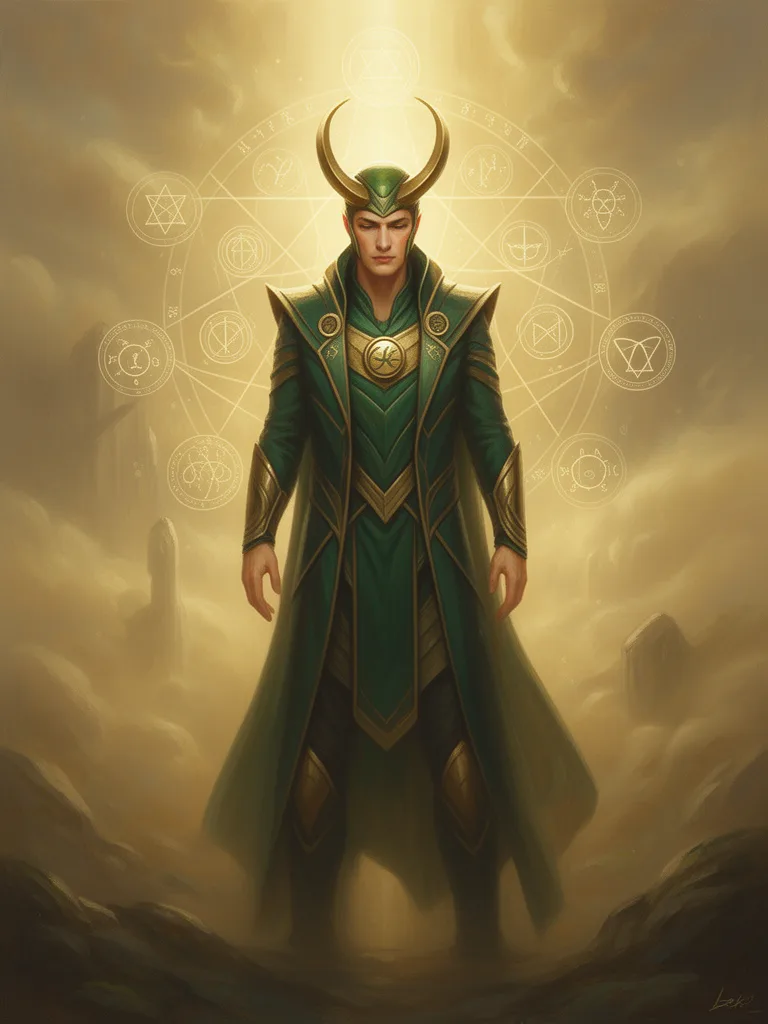
Where the word comes from
The precise etymology of "Loki" is debated, with theories suggesting connections to Proto-Germanic roots related to "lock" or "closing," implying a sense of obstruction or entanglement. Its first clear appearance is within Old Norse literature, particularly the Poetic Edda and Prose Edda, dating from the 12th and 13th centuries CE.
In depth
The Scandinavian Evil Spirits exoterically. In esoteric philosophy "an opposing power" only because differentiating from primordial harmony. In tlie Edda, he is the father of the terrible Fenris Wolf, and of the Midgard Snake. By blood he is the brother of Odin, the good and valiant god ; but in nature he is his opposite. LokiOdin is simply two in one. As Odin is, in one sense, vital heat, so is Loki the symbol of the passions produced by the intensity of the former. Loreley. The German copy of the Scandinavian "Lake Maiden". Undine is one of the names given to these maidens, who are known in exoteric ]\Iagic and Occultism as the Water-Elementals.
How different paths see it
What it means today
Blavatsky’s rendering of Loki as an "opposing power" arising from "primordial harmony" is a profound reinterpretation of a figure often relegated to the pantheon of simple villains. She invites us to see not an external evil, but an internal dynamic. In the grand cosmic dance, the very act of creation, the differentiation of the One into the Many, necessitates the emergence of its counterpoint. This is not a moral judgment but a recognition of polarity, a concept deeply explored by Carl Jung in his understanding of the shadow self. The trickster, in his disruptive and often destructive play, forces a reckoning. He is the catalyst for change, the agent that breaks down ossified structures, compelling a re-evaluation of what is considered stable or "good."
Consider the alchemical process, where the prima materia must be subjected to fire and dissolution before it can be reformed into something more refined. Loki, in this light, is the fire, the solvent, the force that breaks the initial unity, not to destroy it, but to prepare it for a higher synthesis. His paternity of the Fenris Wolf and the Midgard Serpent, monstrous entities that ultimately bring about Ragnarok, the twilight of the gods, can be read as the inevitable consequence of an imbalanced or unacknowledged shadow. Yet, even Ragnarok, in Norse cosmology, is not an end but a precursor to a renewed world. This mirrors the insights of Mircea Eliade regarding the cyclical nature of time and the sacred, where destruction is often a prelude to rebirth.
Blavatsky’s comparison to the Lorelei and Undine, elemental spirits of water, further emphasizes Loki’s connection to primal, untamed forces. These are not the ordered elements of the physical world, but the fluid, often seductive, and dangerous currents of emotion and passion. Odin, representing vital heat and divine will, produces these passions through their very intensity. Loki embodies their potential for chaos, their capacity to lead one astray from the path of divine order. The crucial insight is that these forces are not inherently evil, but rather are inherent aspects of existence, requiring conscious integration rather than simple suppression. The challenge for the modern seeker is to recognize these "opposing powers" within themselves, not as enemies to be vanquished, but as energies to be understood and transmuted, lest they, like the monstrous offspring of Loki, overwhelm the ordered cosmos of the self.
RELATED_TERMS: Trickster, Shadow, Duality, Chaos, Primordial, Polarity, Transformation, Ragnarok
Related esoteric terms
Books on this concept







No reflections yet. Be the first.
Share your interpretation, experience, or question.
