Ases
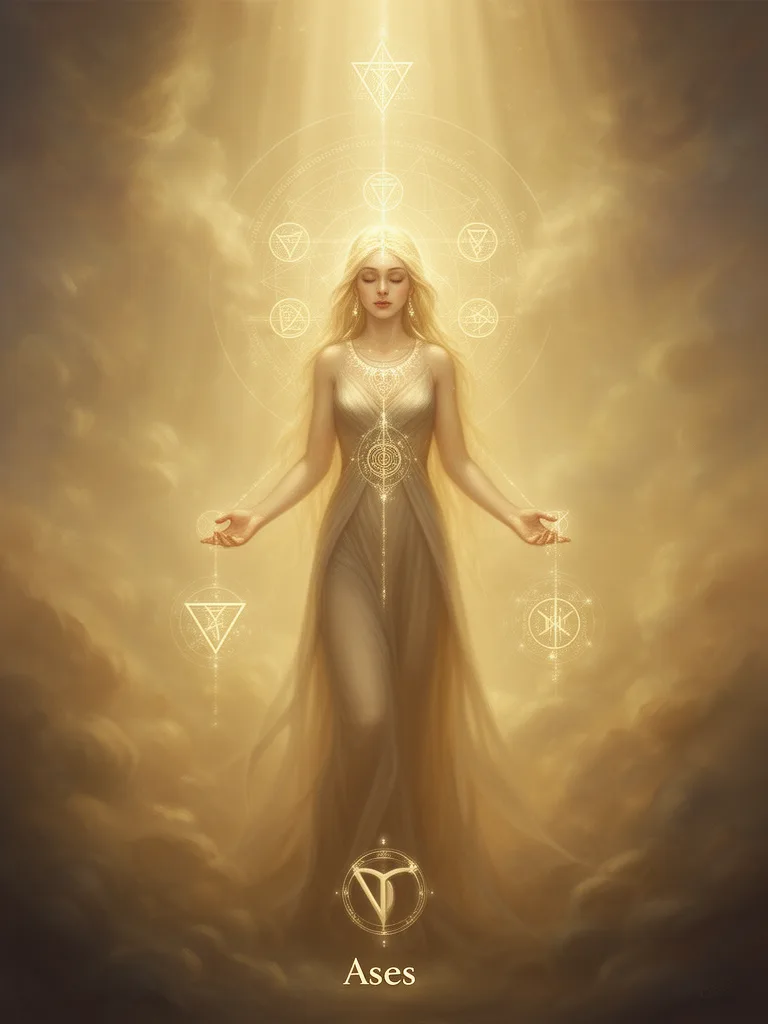
The Ases are divine beings in Norse mythology, often translated as "gods" or "Aesir." They are the principal deities of the Æsir pantheon, dwelling in Asgard and governing aspects of the cosmos, human destiny, and warfare. They represent a foundational element of the ancient Germanic religious worldview.
Where the word comes from
The term "Ases" derives from Old Norse "áss," plural "æsir." Its etymology is debated, with proposed links to Proto-Germanic *ansuz, meaning "god" or "spirit." Some scholars suggest a connection to Proto-Indo-European roots related to "being" or "power." The term first appears in early Norse sagas and Eddic poetry.
In depth
Tin* creators of the Dwarfs and Elves, the Elenieiitals below men. in the Xorse lays. They arc the prop-ny of Odin ; the same as the ^Ksir.
How different paths see it
What it means today
Blavatsky's definition, though brief and rooted in a specific, albeit esoteric, interpretation of Norse lore, points to a fundamental archetype of divine creators or principal deities. The Ases, in the context of Norse mythology, are not merely celestial figures but active participants in the unfolding drama of existence, sharing in both triumph and tragedy. Mircea Eliade, in his extensive work on comparative religion, often highlighted the importance of these primal divine figures as embodiments of cosmic order and the forces that shape human experience. They are the architects of reality, but also bound by its inherent laws, including the eventual Ragnarök, the twilight of the gods.
Their association with creation, as suggested by Blavatsky's "creators," aligns with the broader Indo-European mythic structure where a divine assembly is responsible for shaping the world. The Ases, led by Odin, represent a complex pantheon, embodying wisdom, power, war, and even the darker aspects of existence. Their stories are not simply tales of omnipotent beings, but narratives of struggle, alliance, and the constant negotiation with chaos. For the modern seeker, the Ases offer a potent symbol of the immanent divine, a force that is both awe-inspiring and intimately connected to the trials and tribulations of life, reminding us that even the gods face their own impermanence. Their mythos invites contemplation on the nature of power, destiny, and the cyclical nature of creation and destruction.
RELATED_TERMS: Gods, Devas, Æsir, Vanir, Asgard, Odin, Ragnarök, Archetypes
Related esoteric terms
Books on this concept






No reflections yet. Be the first.
Share your interpretation, experience, or question.
