Corpus Hermeticum
A collection of ancient Greek philosophical and religious treatises attributed to Hermes Trismegistus. These texts, written between the 1st and 3rd centuries CE, explore themes of cosmology, divinity, alchemy, astrology, and the human soul's ascent. They form the foundational literature of Hermeticism.
Where the word comes from
The name "Corpus Hermeticum" translates from Latin as "Body of Hermes." It refers to a compilation of writings attributed to the mythical figure Hermes Trismegistus, a syncretic deity merging the Greek Hermes with the Egyptian Thoth. The term itself gained currency with the rediscovery and translation of these texts in the Renaissance.
In depth
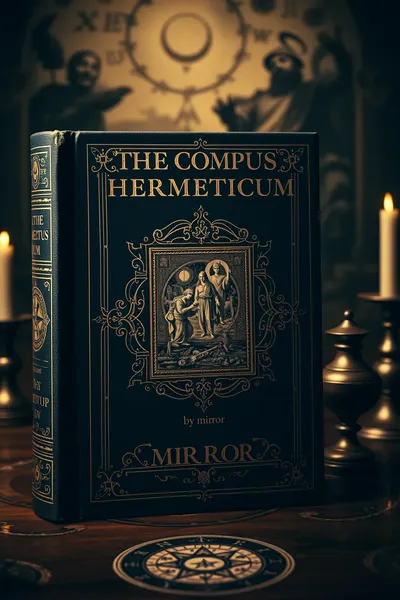
The Corpus Hermeticum is a collection of 17 Greek writings whose authorship is traditionally attributed to the legendary Hellenistic figure Hermes Trismegistus, a syncretic combination of the Greek god Hermes and the Egyptian god Thoth. The treatises were originally written c. 100 – c. 300 CE, but the collection as known today was first compiled by medieval Byzantine editors. It was translated into Latin in the 15th century by the Italian humanist scholars Marsilio Ficino (1433–1499) and Lodovico...
How different paths see it
What it means today
The Corpus Hermeticum, a collection of dialogues and discourses attributed to the legendary Hermes Trismegistus, stands as a cornerstone of Western esoteric thought. These ancient Greek texts, penned between the first and third centuries CE, offer a vibrant tapestry of ideas that captivated Renaissance thinkers and continue to resonate with seekers today. Mircea Eliade, in his seminal works on shamanism and the history of religions, recognized the Hermetic tradition as a significant current in the perennial philosophy, bridging Hellenistic philosophy with earlier Egyptian wisdom.
The treatises within the Corpus explore the nature of God, the creation of the universe, the role of the human soul, and the path to spiritual illumination. They speak of a primordial Mind, a divine intellect from which all things flow, and a universe imbued with divine presence. This concept of a unified, immanent divinity, accessible through direct experience and intellectual ascent, offers a compelling alternative to purely materialistic or dogmatic worldviews. Carl Jung, in his exploration of alchemy and the collective unconscious, saw Hermeticism as a vital expression of the human psyche's striving for wholeness, a symbolic language for psychological transformation.
The practice implied within the Corpus is one of gnosis, a direct, intuitive knowledge of the divine. It is not merely intellectual assent but a transformative apprehension of reality. The texts encourage contemplation, introspection, and a careful observation of the natural world as reflections of divine order. The alchemical imagery, often present, serves as a metaphor for the purification and elevation of the soul. For the modern reader, the Corpus Hermeticum provides a rich source of contemplation on the relationship between the microcosm (human) and the macrocosm (universe), suggesting that within us lies the potential to comprehend and align with the grand cosmic design. It is a call to recognize the divine spark within and to awaken to our inherent connection to the source of all being. The pursuit of wisdom, as outlined in these ancient dialogues, is not an escape from the world, but a deeper engagement with its sacred essence.
RELATED_TERMS: Gnosis, Theurgy, Alchemy, Neoplatonism, Anthropos, Nous, Sophia, Logos
Related esoteric terms
Books on this concept







No reflections yet. Be the first.
Share your interpretation, experience, or question.
