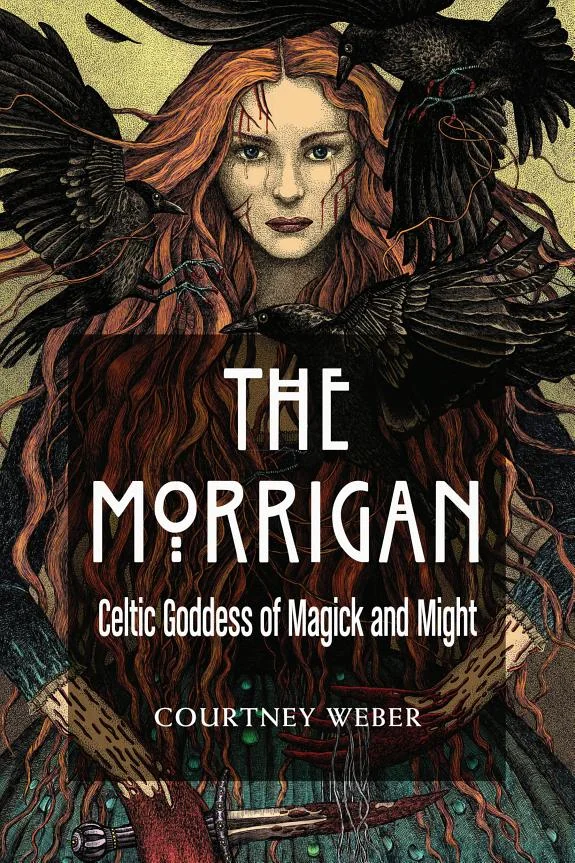
The Morrigan
 82
82

The Morrigan
Courtney Weber's "The Morrigan" grapples with a complex and often misunderstood Celtic deity, moving beyond simplistic "goddess of war" archetypes. Weber meticulously traces the deity's lineage through ancient Irish texts, highlighting her multifaceted nature as a figure of sovereignty, sexuality, and fate. The book offers a robust exploration of the Morrigan's connections to the Sidhe and her fluid, sometimes unsettling, manifestations. While the text is commendably thorough in its academic approach, at times it can feel dense for those less familiar with Old Irish mythology or scholarly discourse. The chapter detailing the Battle of Moytura, for instance, is a deep dive into the narrative's spiritual and political implications. Weber successfully situates the Morrigan not just as an ancient figure but as a relevant, potent force for modern practitioners. It is a vital resource for serious students of Celtic paganism.
📝 Description
82
### What It Is ### Who It's For ### Historical Context ### Key Concepts
💡 Why Read This Book?
• Understand the Morrigan's multifaceted roles beyond war and death, exploring her connections to sovereignty and sexuality as detailed in the analysis of the Táin Bó Cúailnge. • Gain insight into the deity's historical evolution, tracing her presence from Iron Age Ireland to contemporary Neo-Pagan practices. • Learn about the Morrigan's classification among the Sidhe, and the implications of her potential mermaid or phantom queen incarnations.
⭐ Reader Reviews
Honest opinions from readers who have explored this book.
❓ Frequently Asked Questions
What is the origin of the name 'The Morrigan'?
The name 'The Morrigan' is typically translated from Old Irish as 'phantom queen' or 'great queen,' reflecting her powerful and often spectral nature within Celtic mythology.
What historical period does the book cover regarding The Morrigan?
The book traces The Morrigan's presence from at least Ireland's Iron Age, referencing ancient myths and sagas, through to her modern interpretations in contemporary paganism.
Is The Morrigan solely a goddess of war?
No, Courtney Weber's work emphasizes that while associated with war, The Morrigan is also a goddess of sexuality, witchcraft, death, protection, and retribution, embodying a complex spectrum of divine power.
What are the Sidhe?
The Sidhe are a supernatural race in Irish mythology, often described as fairies or spirits of the land. The Morrigan is classified among them, suggesting her connection to these ancient, otherworldly beings.
Does the book discuss modern practices related to The Morrigan?
Yes, the work explores how this ancient goddess remains relevant and is actively invoked by modern practitioners of paganism and witchcraft, bridging ancient lore with contemporary spiritual needs.
What does 'phantom queen' signify about The Morrigan?
The translation 'phantom queen' points to The Morrigan's association with the spectral realm, spirits, and perhaps even the liminal spaces between life and death, emphasizing her mysterious and otherworldly presence.
🔮 Key Themes & Symbolism
Sovereignty and Justice
This theme examines The Morrigan not merely as a war deity but as a potent symbol of national sovereignty and divine justice within the Irish pantheon. Weber explores how her presence often presages or influences the fate of kings and kingdoms, linking her to the land itself. Her role in retribution, ensuring balance or consequence, is central, often depicted through acts of prophecy or direct intervention in battles. This aspect positions her as a guardian of rightful rule and a force against injustice, a concept deeply embedded in ancient Celtic societal structures.
The Fluidity of Form
Weber investigates The Morrigan's protean nature, her ability to shift forms and associations. This includes her classification among the Sidhe (fairies) and potential incarnations as a mermaid or other liminal beings. The crow, a common animal form, is a powerful symbol of her connection to battlefields and death, but also to prophecy and wisdom. This fluidity challenges static interpretations, suggesting a deity deeply connected to the ever-changing cycles of life, death, and transformation, embodying the wild, untamed aspects of the natural world.
Ancient Roots, Modern Practice
A significant focus is placed on tracing The Morrigan's historical trajectory from her earliest mentions in Iron Age Ireland through medieval texts like the Ulster Cycle, to her resurgence in contemporary Neo-Paganism and witchcraft. The work illuminates how modern practitioners engage with her energies, adapting ancient lore to current spiritual needs. This theme highlights the enduring power and adaptability of this goddess, demonstrating her relevance across millennia and her capacity to inspire contemporary spiritual seekers.
War, Death, and Sexuality
This theme addresses the triad of domains often attributed to The Morrigan. Weber unpacks how her association with war extends beyond mere bloodshed to encompass the strategic, the fated, and the spiritual dimensions of conflict. Her connection to death is explored not just as an end, but as a transition and a source of power. Intriguingly, her role in sexuality is presented as a vital, life-affirming force, often intertwined with sovereignty and fertility, revealing a complex interplay of destructive and creative energies.
💬 Memorable Quotes
Direct passages from the work, attributed to the author.
“Her name is translated as 'phantom queen' or 'great queen.'”
— This etymological insight immediately establishes The Morrigan's dual nature: her connection to the spectral, otherworldly realm and her position of supreme authority and power.
“The Morrigan is a goddess of war and sexuality, witchcraft and death, protection and retribution.”
— This captures the polyvocal nature of The Morrigan, highlighting her dominion over seemingly contradictory forces, suggesting a deity who embodies the full spectrum of existence and cosmic balance.
“This goddess of justice is classified among the Sidhe—Ireland's fairies—but she may have a mermaid incarnation, as well.”
— This points to The Morrigan's liminality and adaptability, situating her within the magical Otherworld of the Sidhe while also acknowledging her potential manifestations in other mythological forms, like sea spirits.
“The Morrigan dates back at least to Ireland's Iron Age, but she is as modern as she is ancient.”
— This highlights the enduring relevance and timeless quality of The Morrigan, emphasizing that her influence and presence span vast historical epochs and continue to resonate in the present day.
“With the possible exception of the witch goddess Hekate, the Morrigan is currently the most widely recognized and worked with goddess in the Neo-Pagan world.”
— This statement underscores The Morrigan's significant standing and popularity within contemporary esoteric and pagan communities, positioning her as a central figure for modern spiritual practice.
🌙 Esoteric Significance
Tradition
This work primarily engages with the Celtic Reconstructionist Paganism and broader Neo-Pagan traditions, though its roots are deeply embedded in historical and mythological scholarship concerning ancient Ireland. It departs from purely academic approaches by centering the lived experience and devotional practices of modern pagans, seeking to bridge the gap between historical evidence and contemporary spiritual application. It aligns with traditions that emphasize direct experience with deities and the natural world, drawing from a lineage that values ancestral wisdom.
Symbolism
Key symbols include the crow, representing prophecy, death, and the Morrigan's connection to battlefields; the phantom or spectral aspect, signifying her liminality and connection to the Otherworld and the veil between life and death; and the concept of sovereignty, symbolizing her role as a divine embodiment of rightful rule and the land's authority. These symbols collectively portray a deity deeply intertwined with fate, transformation, and the potent energies of existence.
Modern Relevance
Contemporary practitioners of witchcraft, Celtic Reconstructionist Paganism, and Heathenry draw heavily on Weber's work. Thinkers and practitioners focused on reclaiming 'dark goddess' archetypes find resonance with The Morrigan's complex nature. Her representation as a goddess of justice and sovereignty also appeals to those interested in political and social activism within spiritual contexts, linking ancient power to modern struggles for balance and right.
👥 Who Should Read This Book
• Students of Celtic mythology and history seeking a comprehensive overview of The Morrigan's historical and mythological context, moving beyond simplified portrayals. • Modern Pagan and witchcraft practitioners interested in deepening their understanding and devotional practice related to The Morrigan, with insights grounded in both lore and contemporary application. • Comparative religion scholars examining the evolution of goddess figures and their role in both ancient societies and modern spiritual movements, particularly within the context of European pagan traditions.
📜 Historical Context
Published in 2019, Courtney Weber's "The Morrigan" arrived during a period of significant resurgence in interest surrounding Celtic mythology and Neo-Paganism. The work emerged in dialogue with earlier academic and popular explorations of Irish deities, such as those by scholars like Dáithí Ó hÓgáin, who extensively documented Irish folklore. Weber's approach distinguishes itself by its direct engagement with modern practitioners and its integration of contemporary esoteric perspectives alongside rigorous textual analysis. While the 20th century saw foundational works on Celtic paganism, Weber's book reflects a 21st-century synthesis, addressing a community actively seeking to understand and embody these ancient traditions. The book implicitly engages with the ongoing academic debate regarding the historical accuracy and reconstruction of pre-Christian Irish religion, a field influenced by figures like R.A. Macalister's earlier archaeological interpretations.
📔 Journal Prompts
The Morrigan's association with the Sidhe and potential mermaid incarnations.
Reflections on the concept of sovereignty as embodied by The Morrigan.
Exploring the duality of The Morrigan as a goddess of both death and sexuality.
Personal connection to The Morrigan's role as a figure of retribution.
The significance of the crow symbol in relation to The Morrigan's domains.
🗂️ Glossary
Sidhe
A supernatural race in Irish mythology, often translated as 'fairies' or 'people of the mounds.' They are considered inhabitants of the Otherworld and are sometimes associated with ancient burial mounds and enchanted landscapes.
Phantom Queen
A common translation of 'Morrigan,' suggesting her connection to spirits, the spectral realm, and possibly the liminal space between life and death, emphasizing her mysterious and otherworldly nature.
Sovereignty
In the context of Irish mythology, sovereignty refers to the divine right to rule, often personified by a goddess who embodies the land and its legitimate authority. The Morrigan is strongly linked to this concept.
Ulster Cycle
A major body of medieval Irish heroic tales concerning the legendary heroes of the northern region of Ulster, including figures like Cú Chulainn. The Morrigan features prominently in many of these sagas.
Iron Age Ireland
The historical period in Ireland characterized by the use of iron tools and weapons, generally considered to span from roughly 500 BCE to the arrival of Christianity, a period from which early mentions of The Morrigan likely originate.
Retribution
The act of delivering punishment or vengeance for wrongdoing. The Morrigan's association with retribution highlights her role in enforcing cosmic justice or balancing scales.
Protector
One who defends or guards against harm or danger. The Morrigan's protective aspect often relates to defending the land, lineage, or those who uphold rightful order.
This book appears in 1 collection
🔮 Readers Also Liked
Browse all →





From the “Paganism” Collection
View all →






More Free Witchcraft & Paganism Books
View all →